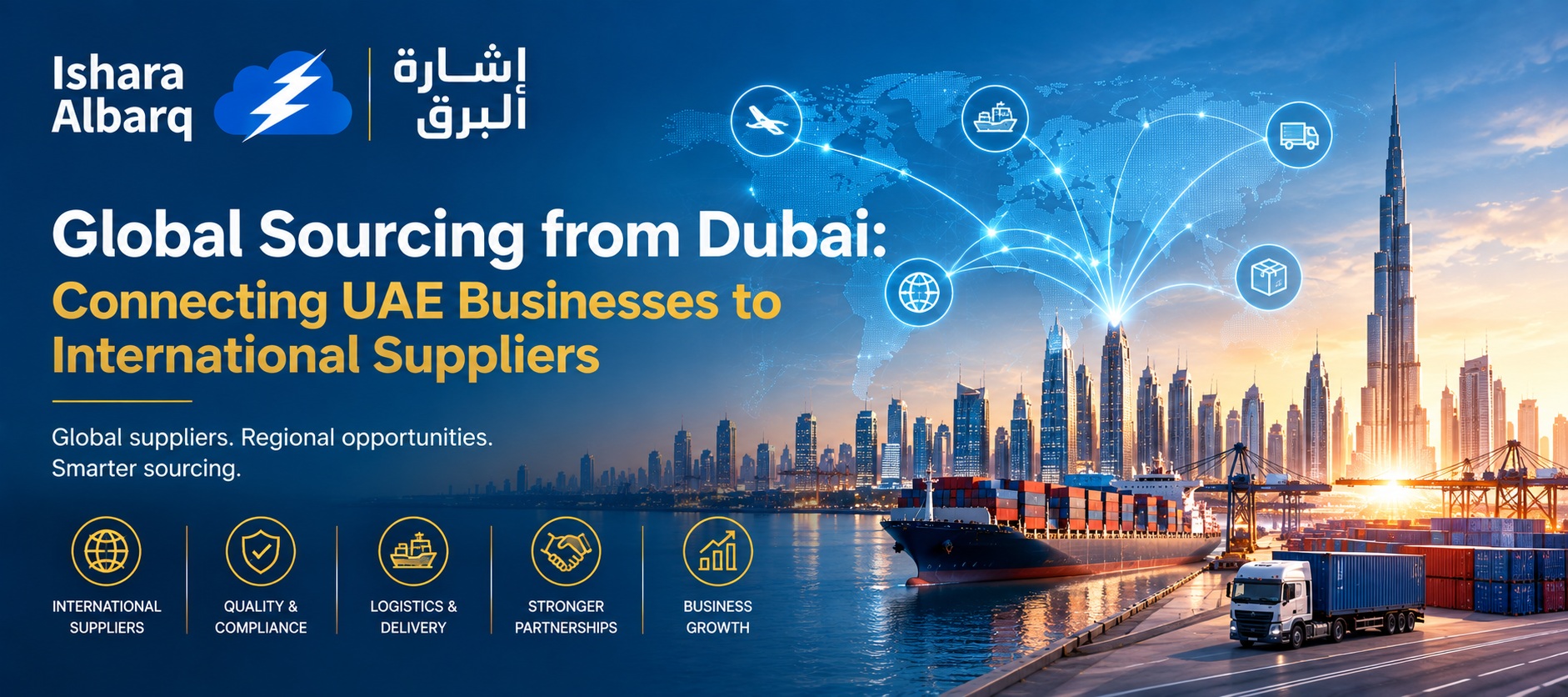
In today’s interconnected economy, businesses are no longer limited to suppliers within their own country.
A company in the UAE can source telecommunications equipment from Asia, industrial components from Europe, technology products from North America, raw materials from Africa, and specialized products from manufacturers across the world.
At the center of this international activity is Dubai.
With its strategic location, international business environment, logistics capabilities, and access to global markets, Dubai has developed into an important hub for businesses looking to connect with international suppliers and customers.
But successful global sourcing involves much more than finding a supplier and placing an order.
It requires supplier evaluation, product knowledge, commercial negotiation, logistics planning, quality control, compliance, documentation, and risk management.
For UAE businesses, developing a structured sourcing strategy can create opportunities to access better products, competitive pricing, specialized expertise, and new international markets.
What Is Global Sourcing?
Global sourcing is the process of identifying, evaluating, purchasing from, and managing suppliers located in different countries.
Businesses may source internationally for several reasons:
-
Access to specialized products
-
Competitive pricing
-
Greater supplier availability
-
Advanced manufacturing capabilities
-
Access to new technologies
-
Improved product variety
-
Alternative supply sources
-
Capacity that may not be available locally
Global sourcing can apply to almost every industry.
It is particularly relevant to sectors such as:
-
Telecommunications
-
Information technology
-
Electronics
-
Industrial equipment
-
Construction
-
Energy
-
Manufacturing
-
Automotive
-
Healthcare
-
Logistics
-
Consumer products
The objective should not simply be to find the lowest price.
The objective is to find the right supplier and the right commercial arrangement for the business.
Why Dubai Is an Important Sourcing Hub
Dubai's geographic position places it between major markets across Asia, Europe, Africa, and the Middle East.
This position can provide businesses with access to international suppliers and regional markets through established trade and logistics networks.
For companies operating in or around the UAE, Dubai can function as more than a commercial destination.
It can serve as a connection point between suppliers, distributors, manufacturers, logistics providers, and customers.
This creates an ecosystem in which businesses can coordinate international procurement while maintaining a regional base.
From Supplier Discovery to Delivery
A successful global sourcing process involves multiple stages.
A typical sourcing cycle can look like:
Requirement → Supplier Search → Supplier Evaluation → Quotation → Negotiation → Order → Quality Control → Shipping → Customs → Delivery → After-Sales Support
Every stage can affect the final cost, timeline, and quality of the product.
For example, a supplier offering the lowest unit price may not provide the lowest overall cost once shipping, insurance, customs-related costs, inspection, payment terms, and potential delays are considered.
This is why businesses should evaluate the complete sourcing process, rather than focusing on one number.
1. Start With a Clear Product Requirement
One of the most important steps in global sourcing happens before contacting suppliers.
Businesses should clearly define what they need.
A sourcing specification may include:
-
Product description
-
Technical specifications
-
Required standards
-
Quantity
-
Packaging requirements
-
Delivery location
-
Required delivery timeline
-
Quality requirements
-
Certifications
-
Warranty expectations
-
After-sales requirements
For technical products, specifications need to be particularly precise.
For example, a telecommunications equipment requirement may need to identify interfaces, capacity, compatibility, environmental conditions, power requirements, standards, and network application.
The clearer the requirement, the easier it becomes to compare suppliers objectively.
2. Finding the Right International Suppliers
Supplier discovery is one of the most visible parts of global sourcing, but it should not be treated as simply collecting supplier names.
Businesses should investigate whether potential suppliers have:
-
Relevant manufacturing experience
-
Appropriate product capabilities
-
Export experience
-
Quality-management processes
-
Sufficient production capacity
-
Technical expertise
-
Reliable delivery performance
-
Appropriate certifications
-
References or established customers
A supplier that produces a product successfully for one market may not necessarily meet the technical, regulatory, or commercial requirements of another.
Supplier suitability must be evaluated against the specific business requirement.
3. Supplier Verification Matters
International procurement introduces additional risks because buyers may be dealing with companies located thousands of kilometers away.
Before entering a significant commercial relationship, businesses should conduct appropriate due diligence.
Depending on the size and nature of the transaction, this may include reviewing:
-
Company registration information
-
Manufacturing capabilities
-
Product certifications
-
Quality-management systems
-
Export history
-
Financial and commercial information
-
References
-
Factory or facility information
-
Contract terms
-
Warranty policies
For high-value or technically complex purchases, independent inspections or audits may also be appropriate.
The goal is simple:
Know who you are buying from before committing significant resources.
4. Price Is Only One Part of the Equation
Price is obviously important in global sourcing.
But comparing suppliers purely on unit price can lead to poor commercial decisions.
Businesses should consider the Total Landed Cost.
This may include:
Product Cost + Packaging + Inspection + Freight + Insurance + Duties/Taxes + Customs Costs + Local Delivery + Financing + Other Associated Costs
A supplier with a slightly higher product price may ultimately be more competitive if it offers:
-
Better quality
-
Lower defect rates
-
More favorable payment terms
-
Faster delivery
-
Better packaging
-
Lower logistics costs
-
Stronger warranty support
The right question is therefore not:
“Who has the lowest price?”
It is:
“Who provides the best overall value for the required specification?”
5. Quality Control Across Borders
Quality management becomes especially important when products are sourced internationally.
A defect discovered after goods arrive in the UAE can be significantly more expensive to resolve than a problem identified before shipment.
Depending on the product and risk level, businesses can consider quality controls such as:
-
Supplier quality assessments
-
Product samples
-
Pre-production approval
-
Factory inspections
-
Pre-shipment inspections
-
Documentation checks
-
Testing against agreed specifications
For technical equipment, quality control may also involve verifying performance against specified standards and requirements.
A structured quality process can help reduce costly surprises after delivery.
6. Logistics Is Part of the Sourcing Strategy
Finding the right supplier is only half the job.
The goods still need to reach the customer.
International sourcing therefore requires careful consideration of logistics.
Factors can include:
-
Shipping method
-
Transit time
-
Freight cost
-
Packaging
-
Insurance
-
Documentation
-
Customs procedures
-
Warehousing
-
Local transportation
-
Delivery scheduling
Businesses should also understand the agreed Incoterms® and clearly establish which party is responsible for costs, risks, transport, insurance, and other obligations at each stage.
Good logistics planning can make the difference between a sourcing strategy that works efficiently and one that creates unnecessary delays and costs.
7. Managing Currency and Payment Risks
International transactions can involve different currencies and payment arrangements.
Currency fluctuations can affect the final cost of imported goods.
Payment structures can also influence risk for both buyers and suppliers.
Depending on the transaction, businesses may consider arrangements involving:
-
Advance payments
-
Milestone payments
-
Letters of credit
-
Documentary collections
-
Open-account terms
-
Other agreed payment mechanisms
The appropriate structure depends on the supplier relationship, transaction value, risk profile, and contractual arrangement.
Commercial terms should be reviewed carefully before the order is placed.
8. Compliance and Documentation
International trade involves documentation and regulatory considerations.
Depending on the product, origin, destination, and transaction structure, businesses may need to manage documentation related to:
-
Commercial invoices
-
Packing lists
-
Certificates of origin
-
Shipping documents
-
Product certifications
-
Customs requirements
-
Import requirements
-
Regulatory approvals
Technical products can have additional requirements depending on their intended use and applicable regulations.
This is why businesses should establish compliance requirements before purchasing, rather than discovering them when the shipment is already in transit.
9. Building Supplier Relationships
Global sourcing should not always be viewed as a series of individual transactions.
Long-term supplier relationships can create significant value.
A strong relationship can help businesses achieve:
-
Better communication
-
More predictable supply
-
Improved product development
-
Faster issue resolution
-
Better understanding of production capacity
-
Potentially more favorable commercial arrangements
-
Greater visibility into future availability
However, supplier relationships should still be supported by clear contracts, specifications, quality requirements, delivery expectations, and commercial terms.
Trust is valuable, but good processes protect both parties.
10. Supply Chain Resilience
Global sourcing can provide access to more suppliers, but it can also introduce new risks.
Potential disruptions can include:
-
Shipping delays
-
Geopolitical events
-
Port congestion
-
Natural disasters
-
Regulatory changes
-
Supplier capacity constraints
-
Currency fluctuations
-
Changes in trade policies
This makes supplier diversification an important consideration for many businesses.
Depending on the product, organizations may benefit from having alternative suppliers, multiple sourcing regions, safety stock, or backup logistics arrangements.
The objective is not to eliminate every risk.
It is to avoid unnecessary dependence on a single point of failure.
Dubai as a Bridge Between Suppliers and Regional Markets
One of the opportunities associated with sourcing from Dubai is its role as a regional commercial and logistics center.
A business can potentially use Dubai as a base for coordinating international procurement while serving customers across the UAE and wider regional markets.
This can create a broader commercial model:
International Supplier → Dubai → Regional Distribution → Customers
For companies involved in technology, telecommunications, industrial products, and other specialized sectors, such a structure can provide flexibility in managing international supply and regional demand.
Global Sourcing in Telecommunications
Global sourcing is particularly important in telecommunications because networks depend on a wide range of specialized equipment and components.
These may include:
-
Fiber-optic products
-
Optical networking equipment
-
Network switches
-
Routers
-
Transmission equipment
-
Cabinets and enclosures
-
Power systems
-
Connectivity components
-
Testing equipment
-
Passive infrastructure products
Technical compatibility is critical in this sector.
A product that looks suitable commercially may not integrate correctly with an existing network.
This makes the combination of technical expertise and commercial sourcing knowledge particularly valuable.
Technology Is Changing Global Sourcing
The sourcing process itself is becoming increasingly digital.
Businesses can use technology to improve:
-
Supplier discovery
-
Product comparison
-
Procurement management
-
Inventory visibility
-
Shipment tracking
-
Supplier communication
-
Documentation
-
Spend analysis
-
Demand forecasting
Data and analytics can also help organizations identify purchasing patterns and make more informed decisions.
Artificial intelligence is likely to further influence procurement by helping businesses analyze large volumes of supplier and market information.
However, technology does not replace human judgment.
Supplier credibility, product suitability, contractual risk, quality, and strategic fit still require careful evaluation.
Global Sourcing Is About More Than Buying
Successful global sourcing connects several disciplines.
Procurement + Technology + Logistics + Quality + Compliance + Finance + Market Knowledge
If one element is overlooked, the overall sourcing strategy can suffer.
A strong sourcing partner should therefore understand not only where a product can be purchased, but also:
-
Why the product is required
-
Which specifications matter
-
How suppliers should be evaluated
-
What commercial terms are appropriate
-
How the product should be transported
-
What risks need to be managed
-
How the product fits into the customer's broader operation
This broader perspective can help businesses move from transactional purchasing to strategic sourcing.
The Future of Global Sourcing From Dubai
Global sourcing will continue to evolve as businesses become more connected and supply chains become increasingly data-driven.
Future sourcing strategies are likely to place greater emphasis on:
-
Supplier transparency
-
Supply chain resilience
-
Digital procurement
-
Sustainability
-
Quality assurance
-
Faster market access
-
Regional distribution
-
Data-driven supplier selection
-
Diversified sourcing
For Dubai and the wider UAE, this creates opportunities to strengthen the connection between international suppliers and regional businesses.
The competitive advantage will increasingly come from knowing not just where to source, but how to source intelligently.
Final Thoughts
Global sourcing can open doors to international products, technologies, manufacturing capabilities, and commercial opportunities.
But successful sourcing requires more than finding a supplier with an attractive price.
It requires a structured approach that considers quality, technical requirements, supplier credibility, logistics, compliance, total landed cost, payment terms, and long-term supply resilience.
Dubai's position as an international business and logistics hub provides a strong environment for businesses looking to connect with suppliers and markets across borders.
For UAE businesses, the opportunity is to use global sourcing not simply as a purchasing function, but as a strategic tool for growth, competitiveness, and access to international capabilities.
At Ishara Al Barq, global sourcing means bringing together international supplier networks, technical understanding, commercial insight, and reliable execution.
Global suppliers. Regional opportunities. Smarter sourcing.
Ishara Al Barq
Connecting UAE businesses to the world.
Key Takeaways
-
Global sourcing enables businesses to access international suppliers, products, technologies, and manufacturing capabilities.
-
Dubai can serve as an important connection point between international suppliers and regional businesses.
-
Successful sourcing starts with clearly defined technical and commercial requirements.
-
Supplier verification and due diligence are essential before major commitments.
-
The lowest unit price does not necessarily represent the lowest total cost.
-
Total landed cost should include logistics, insurance, duties, documentation, and other associated expenses.
-
Quality control should be considered before products are shipped.
-
Compliance and documentation requirements should be identified early.
-
Supplier diversification can strengthen supply chain resilience.
-
Technology and data are making procurement and supplier management more efficient.
-
Technical expertise is particularly important when sourcing specialized telecommunications and technology equipment.