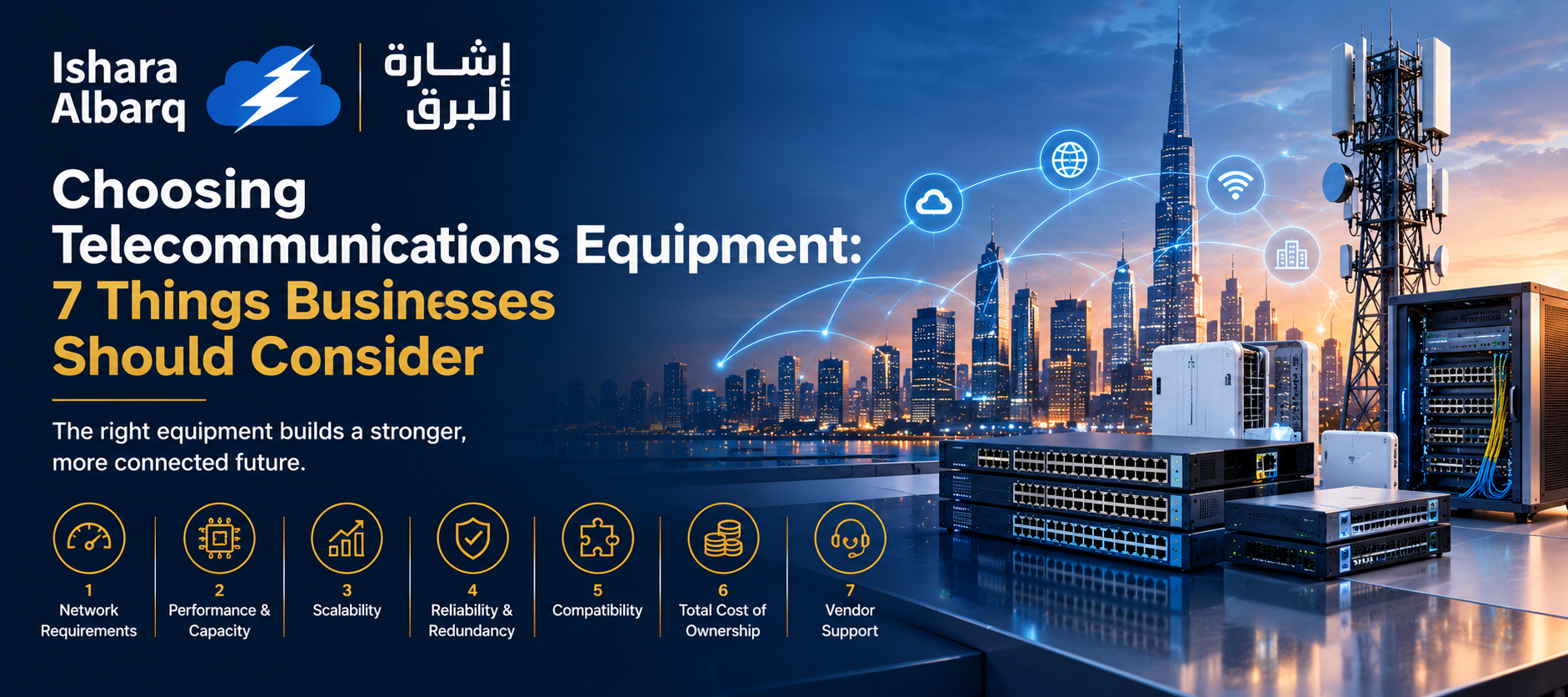
Choosing Telecommunications Equipment: 7 Things Businesses Should Consider
Commercial + Technical Expertise | Industry Education
Choosing telecommunications equipment is not simply a technical purchasing decision.
For businesses, the equipment selected today can influence network performance, reliability, operating costs, scalability, security, and future growth for years to come.
Whether an organization is building a new network, upgrading existing infrastructure, expanding into new locations, or improving connectivity between facilities, the right equipment needs to balance technical requirements with commercial realities.
A product may have impressive specifications, but that does not necessarily mean it is the right solution for a particular business.
The better question is:
Does this equipment meet today's requirements while providing a practical path for tomorrow's needs?
Here are seven important factors businesses should consider before making a telecommunications equipment investment.
1. Understand Your Actual Network Requirements
Before comparing manufacturers or equipment models, businesses should first understand what the network actually needs to accomplish.
Every organization has different requirements.
A small office, data center, telecommunications operator, industrial facility, and multinational enterprise will have very different network demands.
Important considerations include:
-
Number of users and connected devices
-
Current bandwidth requirements
-
Expected traffic growth
-
Number of locations
-
Required network coverage
-
Application requirements
-
Data center connectivity
-
Cloud connectivity
-
Voice and video requirements
-
Geographic expansion plans
For example, equipment designed for a small enterprise network may not be appropriate for a rapidly growing organization with multiple locations and increasing data traffic.
Start with the requirement, not the product.
This approach helps businesses avoid purchasing equipment based purely on specifications or brand familiarity.
2. Consider Performance and Capacity
Network performance is one of the most obvious factors when evaluating telecommunications equipment—but performance should be considered in the context of future demand.
Businesses should evaluate parameters such as:
-
Throughput
-
Port capacity
-
Interface speeds
-
Latency
-
Processing capability
-
Concurrent connections
-
Optical capacity
-
Network utilization
It is also important to distinguish between maximum theoretical performance and expected real-world performance.
Equipment should be evaluated according to the environment in which it will actually operate.
For example, a network device might support a particular throughput under ideal conditions, but actual performance can depend on traffic patterns, configuration, packet sizes, security functions, software features, and network architecture.
A well-planned equipment selection should provide sufficient capacity without unnecessarily paying for capabilities the organization will never use.
3. Think About Scalability
Network traffic rarely remains static.
Businesses grow. Employees are added. New applications are introduced. Cloud adoption increases. More devices become connected. Customers expect faster digital services.
Equipment that meets today's requirements may become a limitation tomorrow if scalability was not considered during procurement.
Businesses should therefore ask:
Can this equipment grow with us?
Look for features such as:
-
Expandable ports
-
Modular architecture
-
Higher-speed interface support
-
Software upgrades
-
Additional capacity options
-
Network virtualization capabilities
-
Compatibility with future technologies
Scalability can reduce the need for frequent equipment replacement and help organizations protect their infrastructure investment.
The objective is not necessarily to purchase the most powerful equipment available.
It is to choose equipment with a realistic and cost-effective growth path.
4. Evaluate Reliability and Redundancy
For many businesses, network connectivity is now essential to daily operations.
A network interruption can affect communication, cloud applications, customer services, transactions, production systems, and remote operations.
This makes equipment reliability an important commercial consideration—not just a technical one.
Businesses should examine:
-
Hardware reliability
-
Mean time between failures
-
Redundant power options
-
Failover capabilities
-
Hot-swappable components
-
Link redundancy
-
High-availability features
-
Manufacturer support
In critical environments, redundancy can be particularly important.
For example, depending on the network architecture, organizations may use redundant power supplies, multiple network links, or paired devices to reduce the impact of individual equipment failures.
The key principle is simple:
Critical services should not depend on a single point of failure.
5. Check Compatibility With Existing Infrastructure
New telecommunications equipment rarely operates in isolation.
It needs to work with existing networks, cables, optical systems, routers, switches, servers, security platforms, management systems, and other infrastructure.
Before purchasing, businesses should verify:
-
Interface compatibility
-
Fiber compatibility
-
Protocol support
-
Network management compatibility
-
Power requirements
-
Software compatibility
-
Existing equipment interoperability
-
Vendor ecosystem requirements
This is particularly important when upgrading an existing network.
An attractive piece of equipment can become an expensive mistake if it requires major infrastructure changes or creates compatibility limitations.
A good procurement process therefore considers the entire network ecosystem, not just the individual device.
6. Look Beyond the Purchase Price
The lowest purchase price does not always mean the lowest overall cost.
Businesses should consider the Total Cost of Ownership (TCO).
TCO can include:
Equipment + Licensing + Installation + Configuration + Maintenance + Power + Training + Support + Upgrades
For example, equipment with a lower initial price could become more expensive over time if it requires costly licenses, frequent maintenance, specialized support, or early replacement.
Commercial evaluation should therefore look at the equipment's expected lifecycle.
Questions worth asking include:
-
What is the expected operational lifespan?
-
Are software licenses required?
-
What does technical support cost?
-
Are spare parts readily available?
-
How difficult is maintenance?
-
What are the power requirements?
-
What upgrade options are available?
This provides a more realistic picture of the investment.
7. Evaluate Vendor Support and Long-Term Availability
Telecommunications infrastructure can remain in service for many years.
That means the company supplying the equipment matters almost as much as the equipment itself.
Businesses should consider the vendor's:
-
Technical expertise
-
Product lifecycle policy
-
Warranty
-
Support availability
-
Spare-parts availability
-
Software update policy
-
Documentation
-
Training resources
-
Regional support capabilities
-
Track record
A strong supplier relationship can become particularly valuable when organizations need troubleshooting, replacement equipment, configuration assistance, or future upgrades.
Businesses should also understand the manufacturer's End-of-Life (EOL) and End-of-Support (EOS) policies.
Buying equipment that is approaching the end of its supported lifecycle can create unnecessary risk.
Commercial and Technical Decisions Should Work Together
One of the biggest mistakes businesses can make is treating technical and commercial evaluation as completely separate processes.
A technically excellent product may not be commercially appropriate.
Likewise, the cheapest option may create technical limitations that become expensive later.
The strongest procurement decisions balance both sides.
Technical questions
-
Does it meet the required performance?
-
Is it compatible with our infrastructure?
-
Can it scale?
-
Is it reliable?
-
Does it support our architecture?
-
Can it integrate with future technologies?
Commercial questions
-
What is the total cost of ownership?
-
What support is included?
-
What is the expected lifecycle?
-
Are spare parts available?
-
What are the licensing costs?
-
Can the supplier support future expansion?
The right equipment sits at the intersection of technical suitability and commercial value.
Don't Choose Equipment Based on Specifications Alone
Technical specifications are important, but numbers do not tell the whole story.
Two products may appear similar on paper while offering very different experiences in areas such as reliability, management, interoperability, support, and lifecycle cost.
Businesses should therefore consider the complete solution.
This includes:
Equipment + Network Design + Installation + Configuration + Monitoring + Maintenance + Support
A well-designed network can often deliver better results than simply purchasing higher-specification equipment without considering the overall architecture.
Security Should Be Part of Equipment Selection
Cybersecurity should also be considered when evaluating modern telecommunications equipment.
Network devices can sit at critical points within an organization's infrastructure, making their security capabilities important.
Depending on the application, businesses may evaluate features such as:
-
Secure management
-
Access controls
-
Authentication
-
Encryption support
-
Logging
-
Firmware security
-
Security updates
-
Network segmentation capabilities
Security should not be treated as something to add after the equipment has been purchased.
It should be considered during the design and procurement stage.
Energy Efficiency and Operational Requirements
As networks become larger, energy consumption can become an important operational consideration.
Businesses should evaluate the equipment's:
-
Power consumption
-
Cooling requirements
-
Physical footprint
-
Environmental operating conditions
-
Energy efficiency
This becomes particularly relevant in data centers, telecom facilities, and large-scale network deployments where thousands of devices may operate continuously.
Equipment that is efficient to operate can contribute to lower long-term operating costs while supporting broader sustainability objectives.
A Practical Equipment Selection Framework
Before making a purchase, organizations can use a simple evaluation process:
Step 1 — Define the requirement
Understand current network needs and expected growth.
Step 2 — Define technical specifications
Identify the required capacity, interfaces, protocols, reliability, and security capabilities.
Step 3 — Evaluate compatibility
Confirm that the equipment integrates with the existing network environment.
Step 4 — Compare total cost
Look beyond the initial purchase price and calculate expected lifecycle costs.
Step 5 — Assess the supplier
Review support, warranty, availability, expertise, and lifecycle policies.
Step 6 — Consider future expansion
Determine whether the solution can scale as business requirements change.
Step 7 — Validate the complete solution
Where appropriate, test equipment through proof-of-concept or controlled deployment before large-scale implementation.
This structured approach can reduce procurement risks and help businesses make more informed infrastructure decisions.
The Future of Telecommunications Equipment
Telecommunications networks are evolving rapidly.
Cloud computing, 5G, artificial intelligence, edge computing, IoT, high-capacity optical networking, and software-defined infrastructure are changing what businesses expect from their networks.
Future equipment will increasingly need to support:
-
Higher bandwidth
-
Greater automation
-
Intelligent monitoring
-
Cloud integration
-
Advanced security
-
Lower latency
-
Energy efficiency
-
Flexible scalability
This means equipment selection will become less about choosing individual devices and more about selecting technology ecosystems that can evolve with the organization.
Final Thoughts
Choosing telecommunications equipment is a decision that extends far beyond comparing technical specifications and prices.
The right solution should support the organization's current operations while creating a foundation for future growth.
Businesses should evaluate performance, scalability, reliability, compatibility, total cost of ownership, security, and supplier support before making an investment.
Most importantly, equipment should be selected as part of a broader network strategy.
At Ishara Al Barq, technical knowledge and commercial understanding go hand in hand. The goal is not simply to identify equipment—it is to understand how technology, infrastructure, and business requirements work together to create dependable connectivity.
The right equipment is not necessarily the most expensive or the most powerful.
It is the equipment that delivers the right performance, value, reliability, and future potential for the business.
Ishara Al Barq
Connecting technology with practical business needs.
7 Key Considerations at a Glance
-
Network Requirements — Understand what the business actually needs.
-
Performance & Capacity — Select equipment capable of handling current and future traffic.
-
Scalability — Ensure the solution can grow with the organization.
-
Reliability & Redundancy — Reduce the impact of equipment and connectivity failures.
-
Compatibility — Make sure new equipment works with existing infrastructure.
-
Total Cost of Ownership — Evaluate the complete lifecycle cost, not just purchase price.
-
Vendor Support — Consider warranty, technical support, availability, and long-term product lifecycle.