Category: Trading & International Business
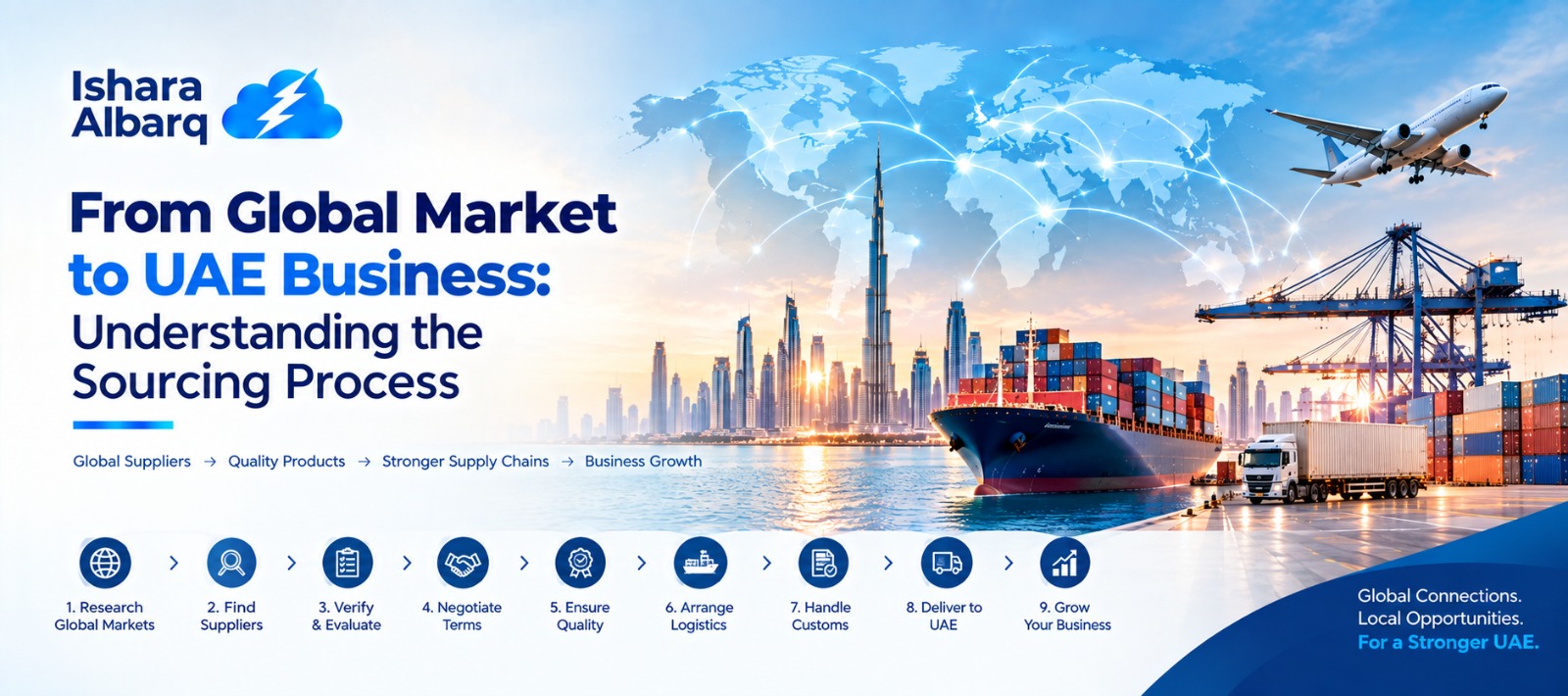
Today, a UAE business can discover a product from an overseas manufacturer, compare suppliers, negotiate commercial terms, arrange quality checks, manage international shipping, and eventually deliver the product to customers in the UAE.
But successful international sourcing is not as simple as finding a supplier and placing an order.
Behind every successful sourcing transaction is a process involving market research, supplier evaluation, product specifications, pricing, quality verification, logistics, documentation, customs, and delivery planning.
For businesses involved in trading, technology, telecommunications, infrastructure, and distribution, understanding this process can help reduce avoidable risks and create a more reliable supply chain.
What Is International Sourcing?
International sourcing is the process of finding and purchasing products, equipment, materials, or services from suppliers located in other countries.
A typical sourcing journey can look like:
Business Requirement → Global Supplier Search → Supplier Evaluation → Quotation → Negotiation → Quality Verification → Order → Shipping → Customs → UAE Delivery
Every stage can influence the final cost, quality, and delivery timeline.
That is why professional sourcing should be approached as a structured business process rather than a simple purchasing activity.
1. Start With a Clear Business Requirement
Before searching for suppliers, a business should understand exactly what it needs.
This can include:
-
Product name
-
Technical specifications
-
Required quantity
-
Quality standards
-
Certifications
-
Packaging requirements
-
Delivery location
-
Required delivery date
-
Target budget
-
Warranty requirements
-
Installation or support requirements
For technical products, specifications are particularly important.
For example, a telecommunications project may require specific equipment compatibility, performance standards, connectivity features, or installation requirements.
If these details are unclear, supplier quotations may not be directly comparable.
2. Research the Global Market
Once the requirement is defined, businesses can explore suitable international sourcing markets.
Depending on the product, potential sourcing locations may include:
-
China
-
Turkey
-
India
-
Europe
-
Southeast Asia
-
North America
-
Other manufacturing markets
Different countries and regions may have different strengths.
One market may offer large-scale manufacturing capacity, while another may specialize in a particular technology, material, or industrial product.
The objective is not simply to find the cheapest market.
It is to identify markets that can provide the right combination of quality, availability, capacity, cost, and delivery.
3. Identify Potential Suppliers
Finding several potential suppliers gives businesses an opportunity to compare options.
Supplier research can consider:
-
Manufacturing capabilities
-
Product range
-
Industry experience
-
Export experience
-
Production capacity
-
Certifications
-
Quality systems
-
Lead times
-
Customer references
-
Communication capabilities
Businesses should avoid making decisions based only on an attractive online profile or low quotation.
Supplier information should be verified before significant commitments are made.
4. Conduct Supplier Due Diligence
Supplier due diligence is an important part of international sourcing.
A supplier may appear suitable during the initial search but may not have the capacity or systems required for a specific project.
Depending on the transaction, businesses can evaluate:
Company Information
Understand who the supplier is and what it actually provides.
Production Capability
Check whether the supplier can handle the required quantity.
Quality Management
Understand how the supplier manages product quality.
Export Experience
Review whether the supplier has experience serving international customers.
Documentation
Check whether the supplier can provide relevant commercial and technical documentation.
Business Communication
Reliable communication is essential when multiple countries and time zones are involved.
The level of due diligence should match the value and risk of the procurement.
5. Request Detailed Quotations
After identifying suitable suppliers, businesses can request formal quotations.
A useful quotation should clearly identify:
-
Product
-
Model or specification
-
Quantity
-
Unit price
-
Total price
-
Minimum order quantity
-
Lead time
-
Packaging
-
Payment terms
-
Warranty
-
Shipping terms
-
Validity period
Clear quotations make supplier comparison easier.
They also reduce the risk of discovering unexpected costs later.
6. Compare Total Cost, Not Just Product Price
One of the most common sourcing mistakes is comparing only the supplier's unit price.
The actual cost of bringing a product into the UAE may include:
Product Cost + Packaging + Inspection + Freight + Insurance + Customs/Duties + Handling + Storage + Other Relevant Costs
This is why a supplier offering the lowest product price may not necessarily provide the lowest overall cost.
Businesses should calculate the total landed cost wherever possible before making a final sourcing decision.
7. Evaluate Product Quality
Price and availability mean little if the product does not meet the required specifications.
Depending on the product, businesses may use:
-
Samples
-
Product testing
-
Factory inspection
-
Pre-shipment inspection
-
Technical documentation
-
Certification checks
-
Quantity verification
-
Packaging inspection
For technology and infrastructure products, businesses should also consider compatibility with existing systems.
Quality requirements should ideally be agreed before production or shipment, rather than after the products arrive.
8. Negotiate With Suppliers
International sourcing often involves negotiation, but negotiation should go beyond price.
Businesses may discuss:
-
Unit pricing
-
Volume discounts
-
Minimum order quantities
-
Payment terms
-
Lead times
-
Warranty
-
Packaging
-
Replacement policies
-
Inspection
-
Technical support
-
Delivery arrangements
A slightly higher product price may sometimes be acceptable if the supplier offers better delivery, quality assurance, warranty, or support.
The objective should be overall commercial value, not simply the lowest quotation.
9. Confirm Product Availability and Lead Time
A supplier may quote an attractive price but require a long production period.
Businesses should confirm:
-
Current stock
-
Production lead time
-
Manufacturing capacity
-
Estimated shipping time
-
Minimum order quantity
-
Expected delivery date
This is particularly important for project-based procurement.
A delayed component can affect installation schedules, contractors, customer handover, and other project activities.
10. Place the Purchase Order Carefully
Once the supplier is selected, the order should clearly document the agreed requirements.
Important details can include:
-
Product specifications
-
Quantity
-
Price
-
Delivery terms
-
Payment terms
-
Quality requirements
-
Packaging
-
Inspection requirements
-
Warranty
-
Documentation
-
Delivery location
A clear purchase order helps both buyer and supplier understand what has been agreed.
11. Monitor Production
For larger or more complex international orders, procurement does not end when the purchase order is issued.
Businesses may need to monitor:
-
Production progress
-
Material availability
-
Quality
-
Packaging
-
Expected completion
-
Documentation
Regular communication can help identify potential delays before they become major problems.
12. Verify Quality Before Shipment
Where appropriate, quality verification can be conducted before the products leave the supplier's location.
This may involve checking:
-
Product specifications
-
Quantity
-
Appearance
-
Functionality
-
Packaging
-
Labelling
-
Documentation
The inspection process should be appropriate to the product and its risk.
For high-value or project-critical equipment, pre-shipment verification can provide additional visibility before the goods enter international transportation.
13. Arrange International Logistics
After production and quality checks, the products need to move from the supplier to the UAE.
The logistics process can involve:
Supplier → Export Handling → International Transportation → UAE Entry → Customs → Warehouse/Delivery
Businesses need to consider:
-
Shipping method
-
Freight cost
-
Transit time
-
Insurance
-
Packaging
-
Cargo handling
-
Customs documentation
-
Final delivery
The most suitable logistics option depends on product type, urgency, shipment size, cost, and destination.
14. Understand Customs and Import Requirements
International sourcing also requires attention to UAE import requirements.
Depending on the product, businesses may need to consider:
-
Customs documentation
-
Product classification
-
Country of origin
-
Applicable duties or taxes
-
Product-specific requirements
-
Certifications
-
Labelling
-
Import permissions where applicable
Requirements can vary according to the product and transaction.
Businesses should verify the applicable requirements before shipment rather than discovering them after the goods arrive.
15. Receive and Inspect the Goods
Once the products arrive in the UAE, the receiving process should not simply be about accepting the shipment.
Businesses can verify:
-
Quantity
-
Product condition
-
Packaging
-
Model numbers
-
Specifications
-
Visible damage
-
Supporting documents
For technical or high-value products, additional testing may be appropriate.
This creates another opportunity to identify discrepancies before products are distributed or installed.
16. Manage Warehousing and Distribution
After customs clearance and receiving inspection, products may need to be stored before reaching the final customer or project site.
Effective inventory management can help businesses track:
-
Stock levels
-
Product locations
-
Batch information
-
Demand
-
Reorder requirements
-
Delivery schedules
For businesses serving multiple customers or regional markets, distribution planning becomes an important part of the sourcing process.
17. Build Long-Term Supplier Relationships
International sourcing should not always be treated as a one-time transaction.
A reliable supplier relationship can improve communication around:
-
Forecasts
-
Pricing
-
Production capacity
-
Product availability
-
Lead times
-
Quality improvements
-
New product developments
Businesses should still monitor supplier performance regularly.
A strong relationship works best when supported by clear specifications, agreements, performance metrics, and quality controls.
The Complete International Sourcing Process
A simplified sourcing workflow can be represented as:
1. Requirement
Understand exactly what the business needs.
↓
2. Market Research
Identify suitable global sourcing markets.
↓
3. Supplier Identification
Find potential suppliers.
↓
4. Due Diligence
Evaluate supplier capability and reliability.
↓
5. Quotation
Request detailed commercial offers.
↓
6. Comparison
Evaluate cost, quality, availability, and delivery.
↓
7. Negotiation
Agree on commercial and technical terms.
↓
8. Order
Issue a clear purchase order.
↓
9. Production
Monitor manufacturing and progress.
↓
10. Quality Verification
Check products before shipment where appropriate.
↓
11. Logistics
Arrange international transportation.
↓
12. Customs
Complete applicable import procedures.
↓
13. UAE Delivery
Receive and inspect the goods.
↓
14. Distribution
Move products to customers or project locations.
Common International Sourcing Mistakes
Choosing a supplier based only on price
A low quotation does not guarantee low total cost.
Not defining specifications
Unclear requirements can lead to unsuitable products.
Skipping supplier verification
Supplier capabilities should be assessed before major commitments.
Ignoring lead times
Production and shipping can take longer than expected.
Not checking availability
A product may be technically suitable but unavailable when needed.
Forgetting logistics costs
Freight, handling, insurance, and other costs can significantly affect the final price.
Conducting quality checks too late
Identifying problems after arrival can make corrections more expensive.
Poor documentation
Missing or incorrect documents can create unnecessary delays.
Depending on one supplier
For critical products, businesses may consider approved alternatives.
How UAE Businesses Can Make Sourcing More Efficient
Businesses can improve their international sourcing process by focusing on several areas.
Standardize Requirements
Use clear product specifications and procurement documentation.
Maintain Approved Supplier Lists
Keep records of suppliers that have already been evaluated.
Compare Total Cost
Look beyond the quoted unit price.
Plan Earlier
Allow sufficient time for production, inspection, shipping, and customs.
Use Quality Controls
Match inspection and testing levels to the product's risk.
Monitor Supplier Performance
Track quality, delivery, communication, and commercial performance.
Develop Alternative Sources
For critical products, consider qualified secondary suppliers.
Why International Sourcing Is More Than Buying Products
International sourcing connects multiple parts of a business ecosystem.
It involves:
Market Research + Supplier Management + Procurement + Quality + Logistics + Customs + Distribution
A business that understands the complete process can make more informed decisions about where to source, whom to work with, how much to order, and how to manage delivery.
For UAE businesses, this can be particularly valuable when serving customers across multiple sectors and regional markets.
Final Thoughts
Moving a product from a global supplier to a UAE business involves far more than placing an international order.
A successful sourcing process starts with a clear requirement and continues through supplier evaluation, quotation, negotiation, quality verification, production monitoring, logistics, customs, receiving, and distribution.
Businesses that manage each stage carefully can improve visibility over cost, quality, availability, and delivery.
For companies involved in trading, technology, telecommunications, infrastructure, procurement, and international business, a structured sourcing process can create a stronger foundation for sustainable growth.
Global sourcing creates access. Smart sourcing creates value.