Category: Procurement & Sourcing
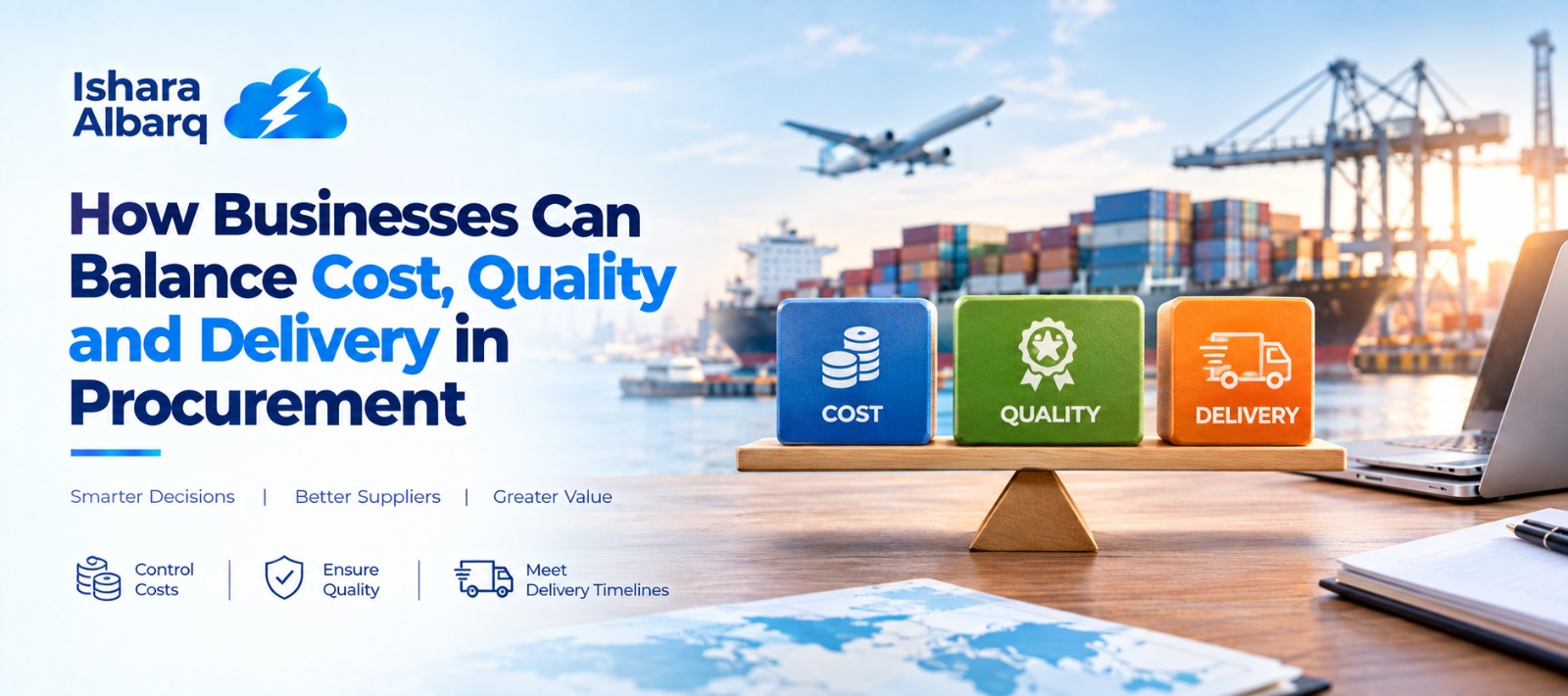
In procurement, businesses are often expected to achieve three things at the same time: competitive cost, consistent quality, and reliable delivery.
The challenge is that these three priorities can sometimes pull in different directions. A supplier may offer a low price but require a longer lead time. Another may provide excellent quality but at a higher cost. A third may deliver quickly but have limited capacity or inconsistent quality.
For businesses involved in technology, telecommunications, infrastructure, international sourcing, and global trade, finding the right balance is essential.
The objective of effective procurement is not simply to find the cheapest supplier. It is to identify the best overall value for the specific business and project requirements.
Understanding the Cost–Quality–Delivery Balance
Cost, quality, and delivery are closely connected.
Cost
This includes more than the supplier's quoted price. Businesses may also need to consider:
-
Shipping
-
Customs duties
-
Insurance
-
Handling
-
Inspection
-
Storage
-
Installation
-
Maintenance
-
Replacement costs
Quality
Quality means that the product or service meets the agreed requirements consistently.
This can involve:
-
Materials
-
Performance
-
Specifications
-
Reliability
-
Certifications
-
Compatibility
-
Workmanship
-
Testing
Delivery
Delivery is not simply about shipping a product.
It includes:
-
Production lead time
-
Supplier capacity
-
Inspection time
-
Shipping
-
Customs clearance
-
Local transportation
-
Delivery to the project site
A procurement decision should consider all three areas rather than evaluating them independently.
Why Choosing the Lowest Price Can Be Risky
Price is an important factor in procurement, but the lowest quotation does not automatically represent the lowest overall cost.
Consider a supplier offering a product at a significantly lower price.
If that supplier also has:
-
Longer lead times
-
Higher defect rates
-
Poor packaging
-
Limited technical support
-
Unreliable delivery
the business may eventually spend more correcting those problems.
Possible additional costs could include:
-
Replacement products
-
Rework
-
Expedited shipping
-
Additional inspection
-
Labour costs
-
Project delays
This is why procurement teams should evaluate total cost and overall value, rather than focusing only on the initial purchase price.
1. Define Business Requirements Before Comparing Suppliers
The first step toward balancing cost, quality, and delivery is understanding exactly what the business needs.
Procurement teams should work with relevant departments to define:
-
Required specifications
-
Quantity
-
Quality standards
-
Delivery date
-
Budget
-
Certifications
-
Warranty
-
Packaging
-
Technical requirements
-
Installation requirements
Without clear requirements, supplier comparisons can become misleading.
For example, one supplier may quote a lower price because its product does not include features or specifications that another supplier has included.
A fair comparison requires businesses to compare equivalent requirements.
2. Use Total Cost of Ownership
Businesses should look beyond the initial purchase price.
Total Cost of Ownership (TCO) can include:
Purchase Price + Logistics + Installation + Maintenance + Support + Replacement + Other Relevant Costs
The exact components depend on the product and project.
For example, a technology product with a slightly higher purchase price may have lower maintenance requirements and a longer useful life.
In another situation, a lower-priced product may be perfectly appropriate if it meets all required specifications and has reliable availability.
The important point is to evaluate the complete financial picture.
3. Establish Minimum Quality Requirements
Businesses should determine which quality characteristics are essential and which are negotiable.
Not every procurement category requires the same quality level.
For critical infrastructure, technical equipment, or safety-related applications, quality requirements may be highly specific.
For other products, businesses may have more flexibility.
A useful approach is to divide requirements into:
Mandatory Requirements
These must be met for the product to be acceptable.
Preferred Requirements
These provide additional value but may not be essential.
Optional Features
These can be considered if they fit within the budget.
This helps procurement teams avoid paying extra for features that are not actually required while protecting critical quality requirements.
4. Evaluate Supplier Reliability
The supplier itself is an important part of the procurement decision.
Businesses can evaluate:
-
Delivery history
-
Production capacity
-
Quality performance
-
Financial stability indicators
-
Certifications
-
Customer references
-
Technical capabilities
-
Communication
-
Export experience
-
After-sales support
A supplier with reliable performance can reduce the operational risks associated with procurement.
However, supplier evaluation should be based on documented requirements and appropriate evidence rather than assumptions.
5. Treat Delivery Time as a Cost Factor
A delayed product can create costs even when the purchase price is attractive.
For project-based businesses, delays can affect:
-
Installation teams
-
Contractors
-
Project milestones
-
Equipment rentals
-
Customer handover
-
Labour planning
For example, if a critical component arrives two weeks late, the business may need to reschedule an installation team or delay another stage of the project.
The supplier's price may remain unchanged, but the overall project cost can increase.
This is why delivery reliability should be considered alongside price.
6. Compare Suppliers Using the Same Criteria
A structured supplier comparison makes procurement decisions more consistent.
Businesses can create a comparison matrix such as:
| Evaluation Area | Supplier A | Supplier B | Supplier C |
|---|---|---|---|
| Product Price | Compare | Compare | Compare |
| Quality Compliance | Verify | Verify | Verify |
| Lead Time | Verify | Verify | Verify |
| Delivery Reliability | Review | Review | Review |
| Certifications | Verify | Verify | Verify |
| Capacity | Review | Review | Review |
| Warranty | Compare | Compare | Compare |
| Logistics Cost | Calculate | Calculate | Calculate |
| Technical Support | Review | Review | Review |
| Total Cost | Calculate | Calculate | Calculate |
The purpose is not to reduce the decision to a single number.
Instead, it provides procurement teams with a clearer view of the differences between suppliers.
7. Negotiate Beyond Price
Procurement negotiations do not have to focus exclusively on reducing the unit price.
Businesses may also negotiate:
-
Payment terms
-
Delivery schedules
-
Minimum order quantities
-
Warranty
-
Packaging
-
Inspection requirements
-
Technical support
-
Replacement procedures
-
Volume-based pricing
-
Long-term supply arrangements
For example, a supplier may not reduce its unit price significantly but may offer improved payment terms or more efficient delivery arrangements.
These factors can also influence the overall value of the procurement agreement.
8. Use Quality Verification Where Appropriate
Quality verification is particularly important when sourcing internationally or purchasing high-value products.
Depending on the product, businesses may consider:
-
Sample approval
-
Production inspection
-
Pre-shipment inspection
-
Product testing
-
Documentation checks
-
Receiving inspection
The appropriate level of inspection depends on the product's value, complexity, risk, and intended use.
The goal is to identify potential quality issues before they create larger costs or project disruptions.
9. Plan Procurement Early
Last-minute procurement makes balancing cost, quality, and delivery more difficult.
When a business needs a product urgently, it may have fewer options and may need to:
-
Accept higher prices
-
Use expedited shipping
-
Select from limited available suppliers
-
Accept alternative products
-
Reduce negotiation time
Early procurement planning provides more flexibility.
Businesses can compare suppliers properly, verify quality, negotiate commercial terms, and select appropriate logistics options.
10. Consider Product Availability
Supplier pricing is only useful if the supplier can actually provide the required quantity within the required timeframe.
Before finalizing a procurement decision, businesses should check:
-
Current availability
-
Production capacity
-
Lead time
-
Minimum order quantity
-
Product lifecycle
-
Supplier inventory
-
Availability of alternatives
For technology products, lifecycle status can be particularly important.
A product that is currently available but approaching end-of-sale may not be the best fit for a long-term project.
11. Avoid Overdependence on a Single Supplier
For critical products, relying entirely on one supplier can create supply risk.
If that supplier experiences a production problem, capacity shortage, or logistics disruption, the buyer may have limited alternatives.
Depending on the category, businesses may consider:
-
Secondary suppliers
-
Approved alternative products
-
Multiple sourcing locations
-
Strategic inventory
-
Long-term supply arrangements
This does not mean every product needs multiple suppliers. The appropriate approach depends on the product's importance, availability, cost, and risk.
12. Build Long-Term Supplier Relationships
Supplier relationships can influence all three procurement priorities.
A supplier that understands a customer's requirements and future demand may be better positioned to support:
-
Consistent quality
-
Capacity planning
-
Delivery scheduling
-
Product development
-
Forecasting
-
Issue resolution
However, long-term relationships should still be supported by clear specifications, contracts, performance measurements, and regular reviews.
A good relationship complements strong procurement processes; it should not replace them.
13. Use Supplier Performance Metrics
Businesses can monitor supplier performance using measurable indicators.
Cost
-
Price changes
-
Total procurement cost
-
Logistics costs
Quality
-
Defect rate
-
Rejection rate
-
Inspection results
-
Corrective-action performance
Delivery
-
On-time delivery
-
Lead-time accuracy
-
Order completeness
Service
-
Response time
-
Issue-resolution time
-
Technical support
Regular measurement can help businesses identify trends and discuss improvement opportunities with suppliers.
14. Use a Risk-Based Approach
Not every purchase needs the same procurement strategy.
A low-value, easily replaceable product may require a relatively simple sourcing process.
A high-value, project-critical technology product may require:
-
Detailed specifications
-
Supplier due diligence
-
Multiple quotations
-
Sample approval
-
Quality verification
-
Delivery planning
-
Alternative sourcing
A risk-based approach allows businesses to invest more procurement effort where the consequences of failure are greater.
A Practical Framework for Balancing Cost, Quality and Delivery
Businesses can use the following process:
Step 1: Define
Clearly establish product, quality, quantity, budget, and delivery requirements.
Step 2: Identify
Find suppliers capable of meeting the technical and commercial requirements.
Step 3: Verify
Check supplier capability, product quality, certifications, availability, and lead times.
Step 4: Compare
Evaluate price, total cost, quality, delivery, capacity, warranty, and service.
Step 5: Negotiate
Discuss commercial terms beyond the initial purchase price.
Step 6: Control
Use appropriate inspection, documentation, and delivery monitoring.
Step 7: Review
Measure supplier performance and improve the sourcing strategy over time.
This creates a procurement process based on value rather than price alone.
Common Procurement Mistakes to Avoid
Focusing only on price
The lowest quotation may not represent the lowest total cost.
Accepting unclear specifications
Ambiguous requirements make supplier comparison difficult and increase the risk of receiving unsuitable products.
Ignoring lead times
A product that arrives late can affect the entire project schedule.
Skipping supplier verification
Supplier capability should be evaluated before significant commitments are made.
Waiting until the last minute
Urgent procurement often reduces negotiating power and available options.
Changing specifications after ordering
Late changes can increase cost, delay production, or create compatibility issues.
Not measuring supplier performance
Without performance data, businesses may continue repeating the same procurement problems.
Cost, Quality and Delivery: Finding the Right Balance
There is no universal formula that gives every business the same balance.
The appropriate decision depends on factors such as:
-
Product importance
-
Project timeline
-
Budget
-
Quality requirements
-
Supply availability
-
Supplier capability
-
Risk tolerance
-
Lifecycle requirements
For one project, delivery speed may be critical.
For another, lifecycle cost may matter more.
For a technical infrastructure project, quality and compatibility may be essential.
The procurement strategy should therefore reflect the actual business requirement, rather than following a one-size-fits-all approach.
Final Thoughts
Balancing cost, quality, and delivery is one of the most important challenges in modern procurement.
A successful procurement decision is not necessarily the one with the lowest price, highest quality, or fastest delivery in isolation. It is the decision that provides the right combination of these factors for the specific business requirement.
By defining requirements clearly, evaluating total cost, verifying suppliers, checking product availability, planning lead times, monitoring quality, and measuring supplier performance, businesses can make procurement decisions with greater visibility.
For companies involved in technology procurement, telecommunications, infrastructure, international sourcing, and global trade, this balanced approach can support better cost control, more predictable project delivery, and stronger supplier relationships.
Smart procurement is about finding the right value—not simply the lowest price.