Category: Trading & International Business
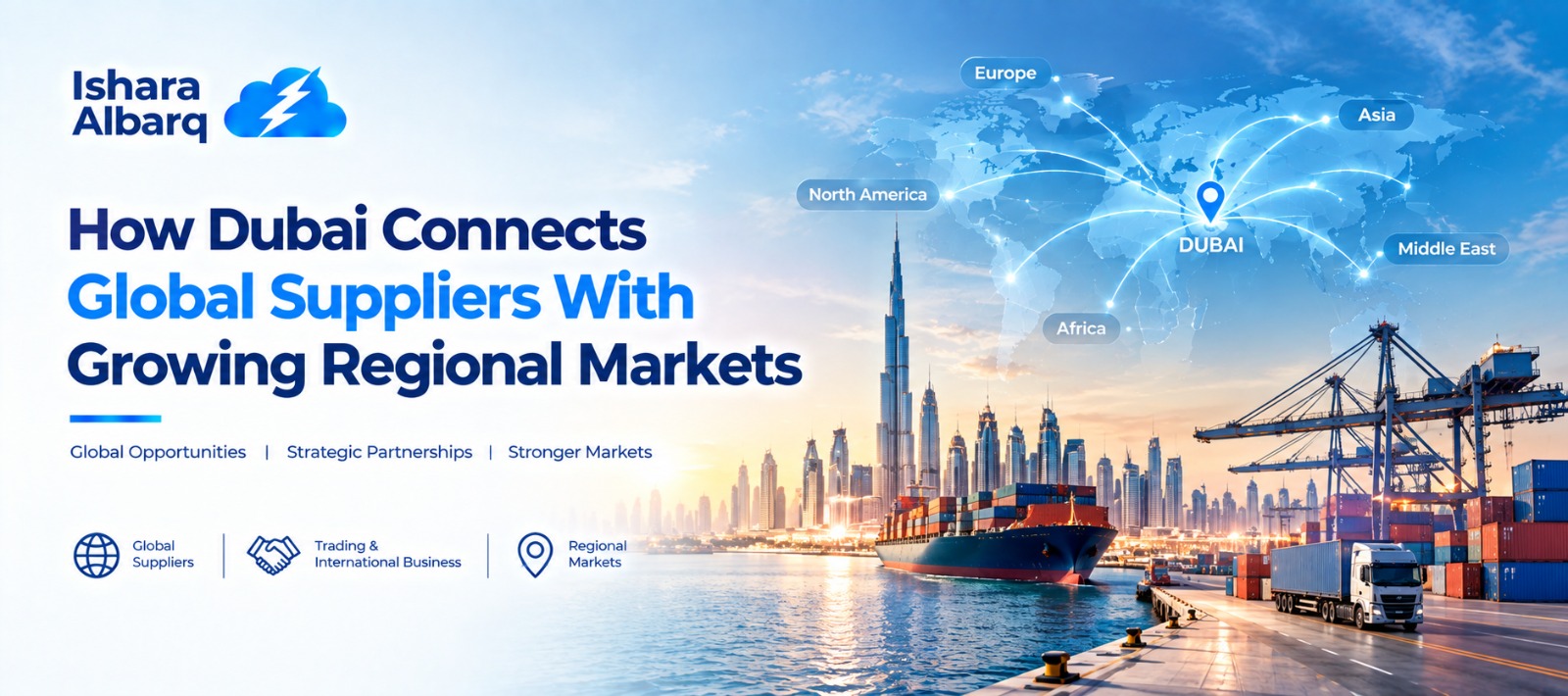
Dubai has developed into an important business and trading centre connecting suppliers, distributors, manufacturers, and buyers across different international markets.
For businesses looking to source products from countries such as China, Turkey, India, Europe, and other global manufacturing hubs, Dubai can provide access to a broad commercial ecosystem covering procurement, logistics, distribution, finance, and international trade.
But Dubai's role is not simply about moving products from one country to another. It is also about connecting global supply with regional business demand.
For growing businesses across the UAE and wider Middle East, this connection can create opportunities to access international products while operating closer to their customers and regional markets.
Dubai as a Link Between Global Supply and Regional Demand
International trade often involves a long chain:
Manufacturer → Exporter → Trading Company → Distributor → Regional Buyer → End Customer
Dubai can serve as one of the commercial points within this chain.
A business may source products internationally, bring them into the UAE, manage logistics and distribution, and then supply customers across regional markets.
This creates an ecosystem where global suppliers can reach regional buyers more efficiently, while businesses in the region can explore products and suppliers from international markets.
Why Dubai Matters to International Trading Businesses
Several factors contribute to Dubai's role in international business.
These include:
-
International connectivity
-
Established logistics infrastructure
-
A diverse business environment
-
Access to regional markets
-
International supplier networks
-
Trading and distribution capabilities
-
Business-focused infrastructure
-
Availability of professional services
Together, these elements support companies involved in importing, exporting, sourcing, distribution, and regional trade.
1. Access to Global Suppliers
One of the biggest advantages for businesses operating in Dubai is access to international supplier networks.
Businesses can explore suppliers based in:
-
China
-
Turkey
-
India
-
Europe
-
Southeast Asia
-
North America
-
Other international markets
Different sourcing markets can provide different advantages.
For example, one market may be strong in manufacturing capacity, another in specialized technology, while another may offer particular materials or products.
The key is to identify suppliers based on quality, specifications, cost, availability, lead time, and business requirements rather than simply choosing a country because it offers lower prices.
2. Dubai Provides Access to Regional Markets
Dubai is not only a destination for imported products.
It can also function as a base for businesses serving customers across the wider region.
Depending on the business model and applicable regulations, companies can use Dubai as part of their strategy for reaching markets across:
-
The UAE
-
Gulf countries
-
Middle Eastern markets
-
African markets
-
South Asian markets
This creates opportunities for businesses that want to build a regional presence while maintaining international supplier relationships.
3. Strong Logistics Supports International Trade
International sourcing depends heavily on logistics.
A product may be competitively priced at the supplier's location, but the sourcing decision also needs to consider how the product will reach the final customer.
The journey may involve:
Supplier → Factory → Export Documentation → International Transport → UAE Entry → Customs → Warehouse → Regional Distribution
Each stage needs coordination.
Efficient logistics can help businesses manage:
-
Transportation
-
Warehousing
-
Inventory
-
Documentation
-
Customs processes
-
Regional distribution
-
Delivery planning
For trading businesses, logistics is therefore not simply an operational function—it can be an important part of the overall sourcing strategy.
4. International Procurement Requires More Than Finding a Supplier
Finding a supplier online is relatively easy.
Finding a supplier that can consistently meet business requirements is much more difficult.
Businesses should evaluate:
Product Quality
Does the supplier meet the required specifications?
Production Capacity
Can the supplier handle the required quantity?
Lead Time
Can products be produced and delivered within the required timeframe?
Documentation
Can the supplier provide the necessary commercial and technical documents?
Compliance
Does the product meet applicable requirements for the target market?
Communication
Can the supplier communicate clearly and respond effectively?
A strong sourcing process should evaluate all these factors before significant commitments are made.
5. Dubai Can Help Businesses Bring Global and Regional Teams Together
International trading often involves people and companies operating in different countries.
A typical transaction may involve:
-
A manufacturer in Asia
-
A sourcing or trading company in Dubai
-
A logistics provider
-
A regional distributor
-
A customer in another Middle Eastern market
Dubai's international business environment can support coordination between these different participants.
This is particularly useful when businesses need to manage procurement, logistics, documentation, supplier communication, and regional distribution as part of one commercial process.
6. Trading Companies Can Simplify International Sourcing
Not every business has the resources to manage international procurement independently.
A trading or sourcing partner can potentially help with activities such as:
-
Supplier identification
-
Supplier communication
-
Product sourcing
-
Quotation comparison
-
Commercial negotiations
-
Quality coordination
-
Documentation
-
Logistics coordination
-
Delivery management
This can be valuable for businesses that have strong product demand but limited experience with international procurement.
The right approach depends on the product, market, supplier, and business requirements.
7. Technology and Infrastructure Are Important Trading Categories
Dubai's business ecosystem includes demand for products related to:
-
Telecommunications
-
Networking
-
IT infrastructure
-
Electrical systems
-
Construction
-
Industrial equipment
-
Security technology
-
Business technology
For these categories, sourcing requires more than comparing prices.
Businesses may need to evaluate:
-
Technical specifications
-
Product compatibility
-
Certifications
-
Product lifecycle
-
Warranty
-
Availability
-
Installation requirements
-
After-sales support
This is why technical knowledge can be an important part of international procurement.
8. Quality Verification Helps Protect International Purchases
When products are sourced internationally, quality verification becomes especially important.
Before shipment, businesses may consider appropriate checks such as:
-
Sample approval
-
Product inspection
-
Quantity verification
-
Technical testing
-
Packaging inspection
-
Documentation verification
The level of inspection should depend on the product's value, complexity, risk, and intended application.
For high-value or project-critical products, quality verification can help identify potential issues before products reach the final destination.
9. Product Availability Can Influence Trading Decisions
A supplier may offer an attractive price, but that does not automatically make it the right sourcing option.
Businesses should also consider:
-
Current availability
-
Production lead time
-
Supplier capacity
-
Minimum order quantity
-
Shipping time
-
Product lifecycle
-
Regional demand
-
Availability of alternatives
For example, a slightly more expensive product that is readily available may sometimes fit a project's timeline better than a lower-priced product requiring a much longer lead time.
Procurement decisions should therefore consider cost, quality, and delivery together.
10. Dubai Can Support Regional Distribution Strategies
For businesses serving multiple markets, regional distribution can become an important part of their growth strategy.
Instead of managing separate sourcing processes for every market, businesses may develop a more coordinated approach involving:
International Supplier → Dubai Trading/Distribution Base → Regional Markets
This can help businesses organize purchasing and distribution around a broader regional strategy.
However, the most appropriate structure depends on the products, target countries, regulatory requirements, inventory model, and commercial objectives.
11. International Trade Depends on Documentation
Successful international trade requires accurate documentation.
Depending on the transaction, businesses may need to manage documents related to:
-
Commercial invoices
-
Packing lists
-
Certificates
-
Shipping
-
Customs
-
Product specifications
-
Origin
-
Insurance
-
Import requirements
Documentation errors can cause unnecessary delays.
This makes documentation management an important part of professional international sourcing.
12. Building Reliable Supplier Relationships Matters
International sourcing should not always be treated as a series of individual transactions.
Long-term supplier relationships can provide better visibility into:
-
Production capacity
-
Product availability
-
Pricing
-
Lead times
-
Upcoming product changes
-
Demand planning
Regular communication can also make it easier to address quality or delivery issues.
However, long-term relationships should still be supported by clear specifications, commercial agreements, performance monitoring, and appropriate quality controls.
13. Dubai's Trading Ecosystem Creates Opportunities for Growing Businesses
For a growing company, international sourcing can seem complicated.
There are questions around:
Who should we source from?
How do we verify suppliers?
How do we manage quality?
How do we handle international logistics?
How do we control procurement costs?
How do we deliver products to regional customers?
A mature trading ecosystem can provide businesses with access to suppliers, logistics providers, professional services, distributors, and other commercial partners.
This can help businesses build a more structured approach to international trade.
A Practical International Sourcing Process
Businesses looking to connect global suppliers with regional demand can follow a structured process:
Step 1: Define the Requirement
Clearly document product specifications, quantity, quality, budget, and delivery requirements.
Step 2: Identify Global Suppliers
Explore appropriate sourcing markets and suppliers.
Step 3: Evaluate Suppliers
Review capabilities, experience, quality, capacity, documentation, and commercial terms.
Step 4: Compare Total Costs
Consider product price, shipping, duties, handling, inspection, storage, and other relevant costs.
Step 5: Verify Quality
Use samples, inspections, testing, or other appropriate quality-control measures.
Step 6: Plan Logistics
Coordinate production, shipping, customs, warehousing, and final delivery.
Step 7: Manage Regional Distribution
Develop an appropriate strategy for supplying customers in the UAE or wider regional markets.
Step 8: Review Supplier Performance
Track quality, delivery, pricing, responsiveness, and overall reliability.
Global Suppliers + Regional Markets = New Business Opportunities
The relationship between international suppliers and regional markets is continuously evolving.
Businesses are increasingly looking beyond their local markets to identify:
-
New products
-
Specialized technology
-
Alternative suppliers
-
Competitive manufacturing sources
-
New distribution opportunities
At the same time, international manufacturers are looking for ways to reach customers in growing regional markets.
This creates an important role for businesses that understand both sides of the supply chain.
They need to understand what international suppliers can provide and what regional customers actually require.
What Businesses Should Consider Before Expanding International Sourcing
Before entering a new sourcing market, businesses should ask:
Supplier
-
Is the supplier properly evaluated?
-
Can it meet expected volumes?
-
Does it have relevant experience?
Product
-
Does the product meet technical and quality requirements?
-
Is it suitable for the target market?
Cost
-
What is the total landed cost?
-
Are logistics and other expenses included?
Delivery
-
What is the realistic lead time?
-
Is there sufficient supply capacity?
Compliance
-
What import, product, labelling, certification, or customs requirements apply?
Risk
-
Is there a backup supplier?
-
What happens if the supplier cannot deliver?
These questions can help businesses move from opportunistic purchasing to structured international sourcing.
Final Thoughts
Dubai's position within international trade is closely connected to its ability to bring together global suppliers, regional buyers, logistics networks, trading businesses, and supporting services.
For businesses, the opportunity is not simply about importing products into the UAE.
It is about creating a reliable connection between international supply and regional demand.
Successful international sourcing requires careful supplier evaluation, clear specifications, quality verification, realistic delivery planning, documentation, logistics management, and an understanding of regional customer requirements.
For businesses involved in technology, telecommunications, infrastructure, procurement, trading, and international sourcing, this approach can create a more structured foundation for regional growth.
Global suppliers may provide the products—but strong sourcing and trading strategies help connect those products with the markets that need them.