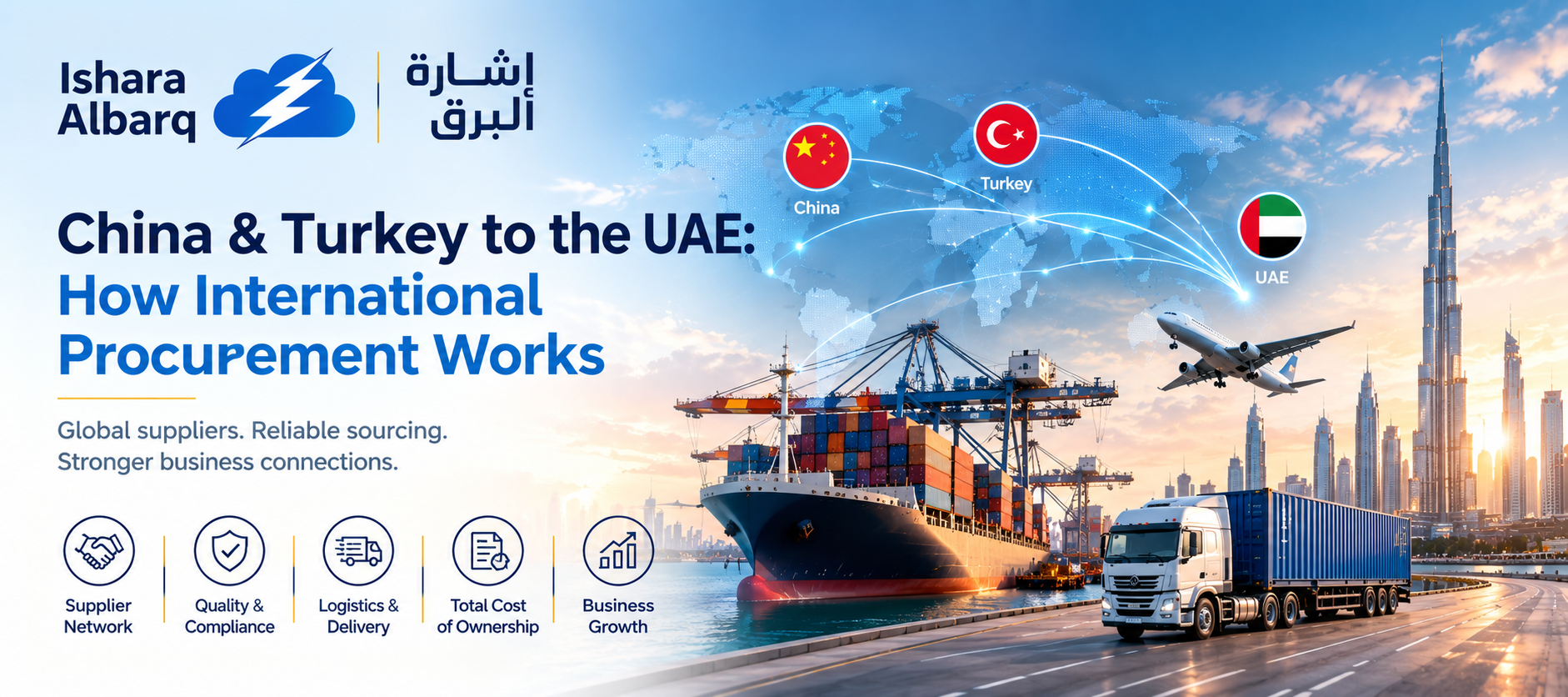
The UAE has become an important commercial link between manufacturers, suppliers, distributors, and businesses across international markets.
For many UAE companies, international procurement is an essential part of doing business. Products and equipment may be sourced from China, Turkey, Europe, India, and other global manufacturing markets, then imported into the UAE for local use, distribution, projects, or re-export.
Among these sourcing markets, China and Turkey offer different strengths for UAE businesses.
China has a vast manufacturing ecosystem covering electronics, telecommunications, industrial equipment, machinery, components, consumer products, and many other categories.
Turkey offers strong manufacturing capabilities across areas such as industrial products, construction-related materials, machinery, textiles, furniture, food products, and other sectors.
But international procurement is not simply about finding a supplier overseas.
A successful procurement process involves supplier identification, verification, product specifications, commercial negotiation, quality control, shipping, customs, documentation, compliance, and delivery.
Understanding how these stages work can help UAE businesses make better sourcing decisions and reduce unnecessary risks.
What Is International Procurement?
International procurement is the process of purchasing products, equipment, materials, or services from suppliers located outside the buyer's home country.
For a UAE business, this could mean:
UAE Buyer → International Supplier → Shipping → UAE Customs → UAE Warehouse/Project → Final Customer
The process becomes more complex when products are technically specialized, high-value, customized, or subject to regulatory requirements.
International procurement therefore requires coordination between several functions:
-
Procurement
-
Supplier management
-
Technical teams
-
Quality control
-
Logistics
-
Finance
-
Customs
-
Compliance
-
Sales and project teams
When these functions work together, international sourcing can become a strategic advantage rather than simply a purchasing activity.
Why Do UAE Businesses Source Internationally?
Businesses may look beyond the UAE for several reasons.
Access to Manufacturing Capacity
International markets can provide access to manufacturers with large production capabilities and specialized facilities.
Product Variety
Global supplier networks give businesses access to a wider range of products and technologies.
Competitive Commercial Options
International competition can provide businesses with additional options when comparing prices, specifications, lead times, and commercial terms.
Specialized Expertise
Some manufacturers have deep experience in particular technologies, industries, or product categories.
Supply Chain Diversification
Working with suppliers in multiple markets can reduce excessive dependence on a single source.
However, international sourcing should always be evaluated based on total value and suitability, rather than price alone.
China and Turkey: Different Supplier Strengths
China and Turkey should not necessarily be viewed as interchangeable sourcing markets.
Their manufacturing ecosystems, supplier structures, geographic advantages, product specializations, and commercial environments can differ significantly.
China
China has developed an extensive manufacturing ecosystem serving both domestic and international markets.
Depending on the industry, UAE buyers can find suppliers for:
-
Telecommunications equipment
-
Electronics
-
Electrical components
-
Machinery
-
Industrial equipment
-
Fiber-optic products
-
Network hardware
-
Construction products
-
Consumer goods
-
Manufacturing components
One major advantage can be the depth of the supplier ecosystem.
Businesses may be able to compare multiple manufacturers offering similar products, specifications, and production capabilities.
However, this also means supplier selection requires careful evaluation.
A large supplier market creates opportunity—but it also makes due diligence important.
Turkey
Turkey has a strong and diversified manufacturing base and is geographically positioned between Europe, Asia, and the Middle East.
Depending on the sector, UAE businesses may source:
-
Industrial products
-
Machinery
-
Construction materials
-
Electrical products
-
Furniture
-
Textiles
-
Food products
-
Automotive-related products
-
Specialized manufacturing products
For certain businesses, Turkey can provide an attractive combination of manufacturing capability and geographic proximity to the Middle East and European markets.
Again, the right sourcing country depends on the specific product, technical requirement, quantity, quality expectations, logistics model, and commercial objectives.
Step 1: Define Exactly What You Need
The international procurement process should begin with a clear requirement.
Before contacting suppliers, a UAE business should define:
-
Product description
-
Technical specifications
-
Required quantity
-
Quality standards
-
Certifications
-
Packaging requirements
-
Delivery location
-
Target delivery date
-
Warranty requirements
-
Installation requirements
-
After-sales expectations
For technical products, this becomes even more important.
For example, if a business is sourcing telecommunications equipment, the requirement may need to specify:
-
Interface types
-
Capacity
-
Compatibility
-
Operating environment
-
Power requirements
-
Network standards
-
Physical dimensions
-
Required accessories
A vague requirement can result in suppliers quoting products that appear similar but are not actually equivalent.
Good procurement starts with a good specification.
Step 2: Identify Potential Suppliers
Once the requirement is defined, businesses can begin supplier discovery.
Potential suppliers can be identified through:
-
Industry networks
-
Manufacturer directories
-
Trade exhibitions
-
Supplier platforms
-
Business referrals
-
Industry associations
-
Existing supplier relationships
-
Sourcing partners
The goal should be to build a shortlist of relevant suppliers, rather than selecting the first company that responds.
A useful shortlist can include several suppliers so the buyer can compare:
Capability + Quality + Price + Lead Time + Support + Commercial Terms
Step 3: Verify the Supplier
Supplier verification is one of the most important stages of international procurement.
A professional-looking website or attractive quotation does not automatically prove that a company is the right supplier.
Businesses should conduct appropriate due diligence based on the value and risk of the transaction.
This may include reviewing:
-
Company information
-
Manufacturing capability
-
Product portfolio
-
Certifications
-
Export experience
-
Quality systems
-
Production capacity
-
References
-
Facility information
-
Warranty terms
-
Financial and commercial information
For larger or technically important purchases, businesses may also consider supplier audits, factory visits, or independent inspections.
The objective is to establish confidence that the supplier can actually deliver what has been promised.
Step 4: Request and Compare Quotations
After identifying suitable suppliers, businesses can request formal quotations.
But quotations should be compared carefully.
A supplier quotation may include differences in:
-
Product specifications
-
Quantity
-
Packaging
-
Delivery terms
-
Payment terms
-
Warranty
-
Lead time
-
Shipping responsibility
-
Certification
-
Installation or support
A lower quotation may not represent better value if it excludes important requirements.
The best approach is to create a structured comparison.
Example
| Evaluation Area | Supplier A | Supplier B | Supplier C |
|---|---|---|---|
| Product specification | ✓ | ✓ | ✓ |
| Quality requirements | ✓ | ✓ | — |
| Lead time | Short | Medium | Short |
| Warranty | Strong | Standard | Strong |
| Price | Medium | Low | High |
| Support | Strong | Standard | Strong |
This allows commercial decisions to be based on more than price.
Step 5: Negotiate Commercial Terms
International procurement often involves negotiation.
Important commercial terms can include:
-
Unit price
-
Minimum order quantity
-
Payment terms
-
Production lead time
-
Delivery terms
-
Packaging
-
Warranty
-
Replacement policy
-
Quality requirements
-
Documentation
-
After-sales support
Businesses should also establish responsibilities clearly.
For international shipments, the agreed Incoterms® can determine how responsibilities for transportation, costs, and risk are allocated between buyer and seller.
Clear terms reduce the possibility of misunderstandings later.
Step 6: Quality Control Before Shipment
One of the biggest challenges in international sourcing is discovering a quality problem only after the shipment reaches the UAE.
By that point, correcting the problem can be expensive and time-consuming.
Depending on the product and risk level, businesses may use:
-
Product samples
-
Pre-production approvals
-
Factory inspections
-
Product testing
-
Quality inspections
-
Pre-shipment inspections
-
Documentation verification
For specialized technical equipment, quality assurance should confirm that the delivered product meets the agreed specification—not simply that the product looks correct.
Quality should be managed before shipment, not only after delivery.
Step 7: Shipping From China or Turkey to the UAE
Once the order is ready, logistics becomes the next major stage.
The appropriate transportation method depends on factors such as:
-
Product type
-
Shipment size
-
Required delivery time
-
Cost
-
Destination
-
Packaging
-
Cargo characteristics
Businesses may evaluate different shipping options, including sea freight and air freight, depending on the circumstances.
Sea freight can be suitable for larger shipments where transit time allows.
Air freight may be considered when speed is more important or when the shipment is smaller or more time-sensitive.
The important point is that logistics should be planned before the purchase order is finalized.
Step 8: Customs and Documentation
International procurement requires accurate documentation.
Depending on the shipment and applicable requirements, documentation may include:
-
Commercial invoice
-
Packing list
-
Certificate of origin
-
Transport documents
-
Product documentation
-
Relevant certificates
-
Customs information
The exact requirements depend on the product, shipment, origin, destination, and applicable UAE regulations.
Businesses should establish these requirements early to help avoid unnecessary delays.
A shipment can be physically ready but still face delays if documentation is incomplete or inaccurate.
Step 9: Calculate the Total Landed Cost
A supplier's quoted price is only one part of the final cost.
Businesses should consider the Total Landed Cost.
A simplified calculation can be:
Product Cost + Freight + Insurance + Duties/Taxes + Customs Costs + Inspection + Local Transport + Other Applicable Costs
For example:
A supplier may offer a product at a very competitive price, but if the product requires expensive shipping, special handling, additional inspection, or significant local costs, the final commercial outcome may be less attractive.
This is why professional procurement compares landed cost, not simply supplier price.
Step 10: Delivery Into the UAE
Once the shipment clears the necessary procedures, goods can move to their final destination.
Depending on the business model, this could be:
-
A UAE warehouse
-
A project site
-
A distribution center
-
A retail location
-
A customer
-
A regional logistics facility
At this stage, businesses should verify the shipment against the original order.
Checks can include:
-
Quantity
-
Product model
-
Packaging condition
-
Documentation
-
Visible damage
-
Accessories
-
Product specifications
For high-value or technical shipments, additional inspection may be appropriate.
Common Risks in International Procurement
International procurement creates opportunities, but it also introduces risks.
Supplier Risk
The supplier may lack the required production capacity, experience, or reliability.
Quality Risk
Products may not meet the agreed specifications.
Logistics Risk
Shipments can experience delays or unexpected transportation issues.
Documentation Risk
Incomplete or inaccurate documents can create customs or delivery problems.
Currency Risk
Exchange-rate changes can affect the final cost.
Compliance Risk
Products may be subject to specific regulatory or technical requirements.
Concentration Risk
Depending heavily on one supplier or one country can create vulnerability if circumstances change.
Effective procurement does not eliminate every risk.
It identifies, evaluates, and manages those risks before they become expensive problems.
Why Supplier Diversification Matters
One supplier may provide an excellent product at a competitive price.
But relying entirely on one source can create business risk.
A diversified supplier strategy might involve:
Primary Supplier + Secondary Supplier + Alternative Sourcing Market
For example, a business could evaluate suitable suppliers in both China and Turkey where the product category and technical requirements allow it.
This does not mean every company needs two suppliers for every product.
Instead, businesses should identify which products are strategically important and where supply continuity matters most.
International Procurement for Telecommunications
Supplier networks become particularly important when sourcing specialized telecommunications products.
Telecommunications projects can require a combination of:
-
Fiber-optic equipment
-
Optical networking products
-
Network switches
-
Routers
-
Transmission equipment
-
Cabinets
-
Connectivity components
-
Testing equipment
-
Passive infrastructure products
For these products, procurement decisions cannot be based solely on price.
Businesses also need to consider:
Technical compatibility + Quality + Standards + Reliability + Availability + Support + Lifecycle
A product that cannot integrate properly into the existing network may create more cost than it saves.
This is why technical expertise and procurement expertise should work together.
The Role of a Supplier Network
A strong supplier network can give businesses more than access to products.
It can provide access to:
-
Multiple manufacturers
-
Alternative products
-
Market intelligence
-
Production capacity
-
Technical expertise
-
Pricing benchmarks
-
Alternative sourcing options
-
Supply-chain flexibility
For a UAE-based business, developing relationships across markets such as China and Turkey can create additional sourcing options.
The value comes from having qualified and relevant suppliers, not simply having a long supplier list.
Dubai as a Procurement Connection Point
Dubai can play an important role in connecting international suppliers with UAE and regional businesses.
A sourcing model can look like:
China / Turkey → UAE → Regional Distribution → Customers
For businesses operating across the Middle East, the UAE can therefore function as more than the final destination for imported products.
It can also act as a commercial and distribution platform connecting international supply with regional demand.
This can be particularly relevant for businesses involved in telecommunications, technology, industrial equipment, infrastructure, and specialized products.
Technology Is Making Procurement Smarter
International procurement is also becoming more digital.
Businesses can use technology to manage:
-
Supplier databases
-
RFQs and quotations
-
Purchase orders
-
Inventory
-
Shipment tracking
-
Supplier performance
-
Documentation
-
Spend analysis
-
Delivery schedules
Data can help procurement teams compare supplier performance over time.
For example, organizations can track:
On-time delivery + Quality performance + Price competitiveness + Responsiveness + Defect rates
This turns procurement from a largely transactional activity into a more measurable and strategic function.
From International Purchasing to Strategic Sourcing
There is an important difference between buying internationally and strategic international sourcing.
International purchasing asks:
“Where can we buy this product?”
Strategic sourcing asks:
“Which supplier, market, commercial model, and supply-chain structure will provide the best long-term value and resilience?”
That difference matters.
Strategic sourcing considers not only today's order but also:
-
Future demand
-
Supplier relationships
-
Product lifecycle
-
Alternative sources
-
Quality
-
Logistics
-
Risk
-
Commercial terms
-
Business growth
This broader approach can help organizations build stronger procurement strategies.
The Future of UAE International Procurement
Global supply chains are becoming more connected, but also more complex.
Businesses are increasingly looking for procurement strategies that provide:
-
Reliable suppliers
-
Competitive total cost
-
Faster delivery
-
Better quality visibility
-
Supply-chain resilience
-
Technical compatibility
-
Greater transparency
-
Alternative sourcing options
For UAE businesses, international supplier networks can become an important competitive resource.
China and Turkey are two examples of major sourcing markets, but the best procurement strategy should always be based on the specific product, business requirement, risk profile, and long-term objective.
Final Thoughts
International procurement is much more than placing an overseas order.
It is a process that connects supplier capability, technical requirements, commercial decisions, quality assurance, logistics, customs, and final delivery.
For UAE businesses sourcing from China, Turkey, or other international markets, a structured procurement approach can help turn global supplier access into a genuine business advantage.
The goal should not simply be to find the cheapest supplier.
It should be to find the right supplier, the right product, the right commercial terms, and the right supply-chain strategy.
At Ishara Al Barq, supplier network expertise means connecting businesses with international sourcing opportunities while considering the technical and commercial requirements behind every procurement decision.
Global suppliers. Local understanding. Smarter procurement.
Ishara Al Barq
Connecting UAE businesses to reliable international supplier networks.
Key Takeaways
-
International procurement connects UAE businesses with manufacturers and suppliers around the world.
-
China and Turkey offer different manufacturing and sourcing opportunities.
-
Supplier selection should consider capability, quality, price, lead time, support, and reliability.
-
Clear technical specifications are essential, particularly for specialized products.
-
Supplier verification and due diligence help reduce procurement risk.
-
Quality control should happen before shipment whenever practical.
-
Logistics, customs, documentation, and compliance are important parts of the procurement process.
-
Total landed cost provides a more realistic basis for comparing suppliers.
-
Supplier diversification can improve supply-chain resilience.
-
Telecommunications procurement requires both technical and commercial evaluation.
-
A strong supplier network provides businesses with flexibility, alternatives, and market access.
-
Strategic sourcing focuses on long-term value rather than individual purchase prices.