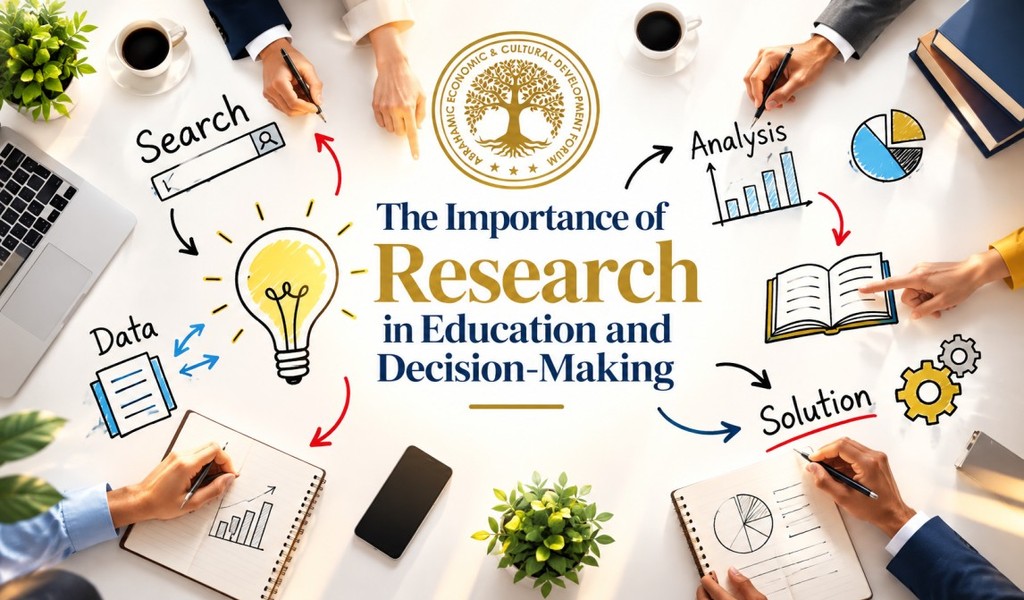
Good decisions begin with reliable information.
Good decisions rarely happen by chance. Whether a student is choosing a career, a teacher is improving classroom methods, a business owner is planning an investment, or a policymaker is developing a public program, reliable information can make the difference between an informed choice and an avoidable mistake.
Research helps people move beyond assumptions and understand the reasons behind a problem. It provides a structured way to ask questions, collect information, examine evidence, and identify possible solutions. In education, research can improve teaching and learning. In professional life, it can support planning, innovation, and responsible leadership.
Today, people have access to more information than ever before. However, not all information is accurate, complete, or relevant. The ability to evaluate evidence and distinguish reliable findings from unsupported opinions has therefore become an important skill for students, educators, professionals, entrepreneurs, and decision-makers.
Research is not limited to laboratories or academic institutions. It is a practical tool for learning, solving problems, and making decisions with greater clarity and confidence.
Understanding its value can help individuals and organizations approach challenges more thoughtfully and contribute to sustainable social and economic development.
1. What Is Research, and Why Does It Matter?
Research is a systematic process of investigating a question, examining available information, gathering evidence, and drawing conclusions based on what the evidence supports.
It can take many forms. A student may review academic publications for a project. A teacher may compare different classroom approaches. A business owner may study customer preferences before introducing a new service. A government department may evaluate whether a training programme is meeting its objectives.
Although these activities differ in scale and method, they share a common purpose: to understand a situation more accurately before deciding what to do.
Research Helps Replace Assumptions With Evidence
Assumptions can influence decisions without being carefully examined. Sometimes they are correct, but they can also be incomplete or misleading.
For example, a school may believe that students are struggling because the course material is too difficult. Further investigation might reveal that the main problem is limited access to learning resources, unclear instructions, or insufficient opportunities to practise.
Without research, the school might change the curriculum without addressing the real issue.
By asking questions and examining evidence, educators can better understand the problem and consider more appropriate responses.
Research does not eliminate uncertainty, but it helps people recognize what is known, what remains unclear, and what should be investigated further.
2. The Importance of Research in Education
Education involves more than delivering information. It requires understanding how people learn, identifying barriers to progress, evaluating teaching methods, and preparing learners for real-world challenges.
Research can help educators and institutions make decisions based on students' needs rather than relying entirely on habit or personal opinion.
Improving Teaching and Learning
Teachers can use research to examine whether their teaching methods are helping students understand concepts and apply their knowledge.
For example, an educator who notices that students perform well in written exercises but struggle with practical tasks might investigate whether lessons provide enough opportunities for applied learning.
The educator could then introduce projects, group discussions, demonstrations, or additional practice and review the results.
This process encourages continuous improvement. Rather than assuming that one teaching method works equally well for everyone, educators can examine the evidence and adapt their approach.
Developing Relevant Educational Programmes
Educational institutions must decide what students should learn and how programmes should prepare them for future opportunities.
Research can help institutions explore changes in professional requirements, emerging technologies, community needs, and student experiences.
For instance, a vocational training centre planning a digital marketing course could consult employers, review relevant job requirements, and speak with potential learners before finalizing the curriculum.
This can help the institution develop a programme that connects theoretical knowledge with practical skills.
Supporting Students' Research Skills
Students benefit when they learn how to investigate questions independently.
Research activities can develop their ability to:
-
Ask clear and relevant questions.
-
Find and evaluate credible sources.
-
Compare different viewpoints.
-
Interpret information carefully.
-
Identify patterns and limitations.
-
Present conclusions clearly.
-
Support arguments with evidence.
These abilities are useful beyond formal education. They can help young people evaluate information online, prepare for employment, understand public issues, and make more informed personal and professional decisions.
3. Research Encourages Critical Thinking and Independent Learning
Critical thinking involves examining information carefully instead of accepting every claim at face value. Research provides a practical way to develop this ability.
A learner conducting research must decide which sources are credible, whether the evidence supports a claim, and whether alternative explanations should be considered.
Learning to Ask Better Questions
Good research often begins with a focused question.
A broad question such as "How can education improve?" may be difficult to investigate. A more specific question, such as "What challenges prevent adult learners from completing online training courses?", provides a clearer direction.
A focused question helps researchers identify relevant evidence and avoid collecting information that does not contribute to the investigation.
Understanding Different Perspectives
Research also encourages people to consider viewpoints that may differ from their own.
When examining a social, economic, or educational issue, researchers may find that different groups experience the same situation in different ways.
Listening to these perspectives can reveal factors that might otherwise be overlooked.
For students, this supports intellectual independence. For professionals and leaders, it can improve discussions, reduce premature conclusions, and encourage more balanced decisions.
4. Research in Decision-Making: From Information to Action
Decision-making often involves choosing between several possible options, each with its own benefits, costs, and risks.
Research helps decision-makers understand these options before committing resources.
A useful process involves identifying the problem, gathering relevant information, comparing alternatives, evaluating risks, and reviewing the outcome.
Example: A Business Considering a New Service
Imagine a small business that wants to introduce an online service.
Before investing in a website, software, and marketing, the owner could investigate customer demand, competitor offerings, expected operating costs, technical requirements, and possible risks.
The findings may support the original plan, suggest changes, or indicate that another option would be more suitable.
This does not guarantee success. Customer behaviour and market conditions can change. However, research can help the owner make a more informed decision and identify assumptions that need further testing.
Example: A Community Development Programme
A community organization planning a youth training initiative might begin by asking young people which skills they want to develop and what prevents them from accessing existing programmes.
It could also consult employers, educators, and local service providers.
The findings could help the organization select relevant topics, choose suitable training times, and identify practical barriers to participation.
Research makes planning more responsive to actual needs instead of relying only on what programme organizers assume people require.
5. Research Supports Better Leadership and Governance
Leaders make decisions that affect people, resources, institutions, and long-term priorities. Research can help them understand the likely consequences of different choices and explain the reasoning behind their decisions.
Evidence-Informed Leadership
Evidence-informed leadership combines research findings with professional experience, ethical judgment, and an understanding of the situation.
A leader should not automatically accept a research finding simply because it appears in a report. The quality of the study, the relevance of its findings, and the context in which it was conducted all matter.
For example, a training programme that works well for experienced employees may not be suitable for young people entering the workforce for the first time.
Leaders need to consider whether the available evidence applies to the people and circumstances involved.
Transparency and Accountability
Research can also help leaders explain why a decision was made and how its results will be evaluated.
When institutions establish clear objectives and examine outcomes, they can identify areas for improvement and communicate their progress more responsibly.
This is especially important in public programmes, educational initiatives, community projects, and organizations using limited resources.
Accountability does not mean that every decision will produce the intended result. It means being willing to examine the evidence, acknowledge limitations, and make necessary adjustments.
6. Research and Entrepreneurship: Understanding Opportunities Before Investing
Entrepreneurs often operate with limited time, money, and information. Research can help them understand customers, assess competition, evaluate risks, and determine whether a proposed business idea is practical.
Market Research
Market research involves gathering information about potential customers, competing products or services, pricing, and industry conditions.
A young entrepreneur planning to launch an educational app, for example, could interview students and teachers, review existing platforms, and test a basic version with a small group of users.
The feedback may reveal which features are genuinely useful and which are unnecessary.
Research Helps Businesses Learn From Experience
Research does not end when a business launches a product.
Businesses can review customer feedback, sales patterns, service complaints, and operating costs to understand what is working and what needs attention.
These findings can inform decisions about pricing, customer service, product development, and future investment.
For smaller businesses, this process can begin with simple tools such as customer interviews, surveys, sales records, and carefully maintained financial data.
The key is to gather information that answers a specific business question and use it thoughtfully.
7. Research Helps Address Social and Economic Challenges
Many development challenges involve several connected factors. Education, employment, public health, environmental sustainability, and economic opportunity cannot always be understood through a single source of information.
Research can help communities and institutions investigate these relationships and identify areas where action may be useful.
Understanding Local Needs
Consider a community experiencing difficulties with youth employment.
Possible factors could include limited access to vocational training, a mismatch between qualifications and available jobs, transport difficulties, or a lack of information about career opportunities.
Research involving young people, employers, educational institutions, and community organizations can help identify which factors are most relevant locally.
The resulting findings can guide the design of more appropriate initiatives.
Evaluating Development Programmes
Launching a programme is only one part of development work. Organizations also need to understand whether the programme is reaching its intended participants and producing useful results.
Evaluation may examine participation, learning outcomes, feedback, costs, and changes in the conditions the programme aims to address.
The methods should match the programme's objectives, and findings should be interpreted carefully. A positive result does not always prove that a programme alone caused the change.
By evaluating outcomes, organizations can learn from experience and improve future decisions.
8. Digital Information, Artificial Intelligence, and Research Literacy
Digital tools have made information easier to access, but accessibility should not be confused with reliability.
Online articles, social media posts, videos, and AI-generated answers may contain useful information, but they can also include errors, missing context, outdated claims, or unsupported conclusions.
Research literacy helps people evaluate the quality of information before using it.
How to Assess a Source
Before relying on a claim, consider the following questions:
-
Who created the information, and what relevant expertise do they have?
-
Is the source based on evidence that can be examined?
-
Is the publication date appropriate for the topic?
-
Does the source explain its methods and limitations?
-
Do independent, credible sources support the main claim?
-
Is the information relevant to the question being investigated?
For important decisions, it is particularly useful to consult primary research, official documents, reputable professional sources, and independent evaluations where available.
Using Artificial Intelligence Responsibly
AI tools can assist with brainstorming research questions, organizing notes, summarizing material, and identifying topics for further investigation.
However, their outputs should not be treated as verified evidence without checking the underlying sources.
Researchers should verify references, confirm factual claims, protect confidential information, and follow relevant academic or professional rules on AI use.
AI can support the research process, but responsibility for evaluating evidence and presenting accurate conclusions remains with the person using it.
9. Ethical Research and Responsible Use of Information
Research must be conducted responsibly if its findings are to be useful and trustworthy.
Ethical research considers how information is collected, whose interests are affected, and how participants and data are protected.
Protecting Participants and Information
When research involves people, researchers should consider informed consent, privacy, confidentiality, and the potential consequences of collecting or publishing sensitive information.
For example, an educational study involving students should use appropriate safeguards and follow the relevant institutional requirements.
Research involving personal data should collect only what is necessary, protect it appropriately, and comply with applicable laws and professional standards.
Reporting Findings Honestly
Researchers should present results accurately, including findings that do not support their original expectations.
They should not invent data, hide important limitations, or present uncertain conclusions as established facts.
A responsible report explains what the evidence indicates, what it does not establish, and where further investigation may be needed.
These practices matter because decisions based on misleading research can waste resources, damage trust, and lead to inappropriate actions.
10. Building a Research Culture in Educational Institutions and Organizations
Research becomes more useful when it is part of everyday learning and organizational practice rather than an activity reserved for specialists.
Schools can encourage students to ask questions and investigate problems. Universities can support collaboration between researchers and communities. Businesses can review customer feedback and evaluate new approaches. Community organizations can examine local needs before designing programmes.
Practical Ways to Encourage Research
Institutions can:
-
Provide access to reliable learning resources.
-
Teach research methods and source evaluation.
-
Encourage project-based learning.
-
Support collaboration between students and professionals.
-
Create opportunities to discuss findings.
-
Evaluate programmes and workplace practices.
-
Recognize the value of honest reporting and constructive criticism.
A research culture also requires openness to new evidence. If findings challenge an established practice, institutions should be willing to examine the reasons and consider whether a change is necessary.
The objective is not to research every small decision extensively. It is to match the depth of investigation to the importance, uncertainty, and potential consequences of the decision.
AECD Forum Perspective
The importance of research in education and decision-making connects closely with the broader interests of the Abrahamic Economic & Cultural Development (AECD) Forum, particularly education, research, skills development, leadership, professional development, entrepreneurship, economic development, and international cooperation.
Research can help educational institutions understand learning needs, training providers design more relevant programmes, and organizations assess whether their initiatives are achieving meaningful outcomes.
For young people, developing research skills can strengthen critical thinking and prepare them to evaluate information independently. For professionals and entrepreneurs, research can support planning, innovation, and responsible decision-making. For community organizations and policymakers, it can provide a more structured way to understand local challenges and assess possible responses.
AECD Forum's wider interest in dialogue and cooperation also makes knowledge exchange relevant. Researchers, educators, business leaders, policymakers, and community representatives can contribute different perspectives to shared challenges.
A constructive approach brings research together with practical experience and ethical judgment. Evidence should inform decisions, while openness, accountability, and respect for different perspectives help ensure that those decisions remain responsible.
By encouraging research-minded learning and evidence-informed discussion, institutions can support better planning, more relevant education, and sustainable development.
Practical Action Points
-
Start with a clear question. Define the problem you want to understand before collecting information.
-
Use credible sources. Look for relevant research, official documents, reputable publications, and evidence that can be checked.
-
Compare different perspectives. Examine alternative explanations instead of relying on a single viewpoint.
-
Check the quality of evidence. Consider the source, date, methods, limitations, and relevance of the information.
-
Apply findings carefully. Use research to compare options, assess risks, and guide decisions without assuming that one result fits every situation.
-
Protect research participants and data. Follow appropriate consent, privacy, confidentiality, and professional requirements.
-
Review the outcome. After implementing a decision, examine what happened, what can be learned, and whether further changes are needed.
Research is an important part of education, professional development, and responsible decision-making. It helps people investigate questions, evaluate information, understand challenges, and consider solutions based on evidence rather than assumptions alone.
In education, research can support better teaching, more relevant programmes, and stronger critical-thinking skills. In business, it can inform customer understanding, investment, and innovation. In leadership and community development, it can help institutions assess needs, evaluate outcomes, and use resources more responsibly.
However, research is valuable only when it is conducted and interpreted carefully. Reliable sources, appropriate methods, ethical practices, and honest reporting all matter. Evidence should inform decisions, not replace judgment or ignore the circumstances of the people affected.
As information continues to circulate rapidly across digital platforms, the ability to ask thoughtful questions and assess evidence becomes increasingly important.
A stronger research culture begins when people remain curious, examine information carefully, and are willing to revise their decisions when new evidence emerges.
By making research an active part of learning and decision-making, individuals and institutions can build knowledge, strengthen accountability, and contribute to more informed and sustainable progress.
#ImportanceOfResearch #EducationalResearch #CriticalThinking #ResearchSkills #EvidenceBasedDecisionMaking #Education #Leadership #ProfessionalDevelopment #KnowledgeSharing #SustainableDevelopment #AECDForum