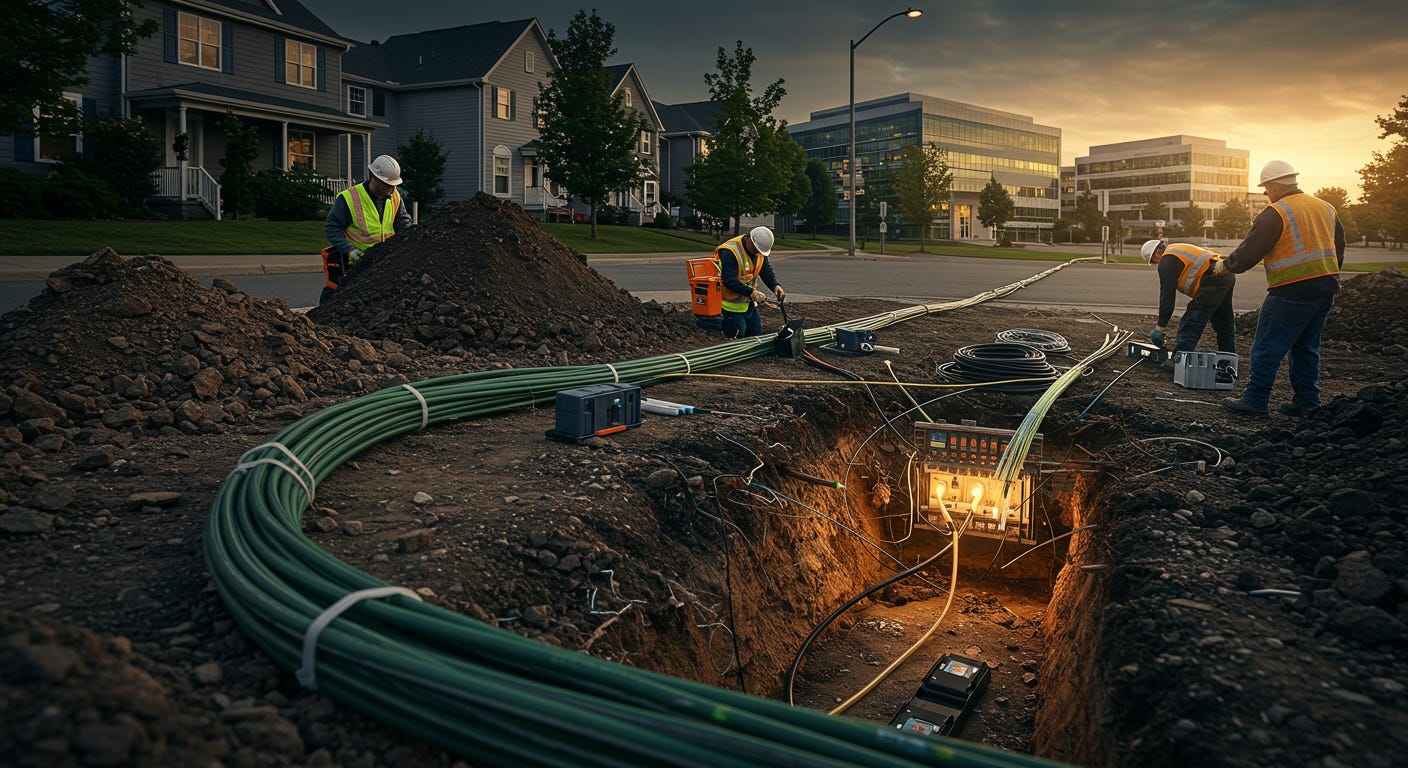
Underground vs Aerial Fiber: Which Infrastructure Approach Is Right for Your Project?
Fiber optic infrastructure has become an important part of modern telecommunications and digital infrastructure. Businesses, residential developments, industrial facilities, data networks and smart-city projects increasingly depend on reliable high-capacity connectivity.
But installing fiber is not simply a matter of choosing the cable.
One of the first infrastructure decisions is how the fiber will be deployed: underground or aerial.
Both approaches can provide effective connectivity when properly designed and installed. However, each has different considerations related to cost, environment, accessibility, maintenance, protection and future expansion.
For businesses planning a fiber infrastructure project, understanding these differences can help them make a more informed decision.
What Is Underground Fiber?
Underground fiber infrastructure involves installing fiber optic cables below ground.
Depending on the project, cables may be installed through:
-
Underground ducts
-
Conduits
-
Direct-buried systems
-
Existing utility pathways
-
Manholes and handholes
-
Microduct systems
The exact method depends on the site, engineering requirements, local regulations and the type of network being developed.
Advantages of Underground Fiber
One of the biggest benefits of underground fiber is physical protection.
Because the cables are below the surface, they are generally less exposed to accidental contact, vehicles, severe weather and other external factors.
Underground infrastructure can also provide a cleaner visual environment, which can be particularly important in commercial developments, urban areas, premium communities and locations where overhead infrastructure is undesirable.
Another advantage is that underground pathways can be planned with future network expansion in mind.
If ducts and pathways are properly designed, additional cables may be installed later without rebuilding the entire route.
What Is Aerial Fiber?
Aerial fiber infrastructure involves installing fiber optic cables above ground, generally using poles or other supporting structures.
The cables may be attached to existing utility infrastructure or purpose-built support systems, depending on project requirements and local regulations.
Aerial deployment can be particularly useful where underground construction would be difficult, expensive or impractical.
Advantages of Aerial Fiber
One of the main advantages of aerial fiber is deployment efficiency.
Where suitable poles and supporting infrastructure already exist, aerial installation can sometimes reduce the amount of excavation and civil work required.
This can make aerial deployment attractive for certain projects, particularly where speed and access are important considerations.
Maintenance and fault identification can also be more accessible in some environments because the network is physically visible and easier to reach.
However, aerial networks require careful consideration of environmental exposure and structural requirements.
Underground vs Aerial Fiber: Key Differences
There is no universal answer to which method is better.
The right choice depends on the project.
| Factor | Underground Fiber | Aerial Fiber |
|---|---|---|
| Physical protection | Generally higher | More exposed |
| Civil construction | Usually greater | Often lower |
| Visual impact | Low | More visible |
| Installation conditions | Requires suitable underground pathway | Requires suitable supporting structures |
| Maintenance access | May require access points | Can be easier in some locations |
| Weather exposure | Lower | Higher |
| Expansion planning | Can be excellent with spare ducts | Depends on available infrastructure |
| Project suitability | Urban, premium and protected routes | Suitable routes with poles/support structures |
These are general considerations. Actual project performance and cost depend on design, location, regulations and installation standards.
Cost Is Not the Only Factor
When businesses compare underground and aerial fiber, cost is often one of the first considerations.
However, looking only at the initial installation price can lead to an incomplete decision.
A proper assessment should consider:
Installation + Civil Work + Infrastructure + Maintenance + Protection + Future Expansion
An aerial network may have lower initial construction requirements in some locations, but exposure to environmental conditions and physical damage needs to be considered.
Similarly, underground fiber may require greater upfront civil work but can provide a protected pathway and potentially simplify future expansion if the duct infrastructure is properly planned.
The most economical solution is therefore not necessarily the one with the lowest initial installation cost.
Location Changes the Decision
The physical environment plays a major role.
A dense urban development may have different requirements from an industrial facility, highway corridor, rural area or large commercial campus.
For example, a project in a highly developed urban environment may have limited space for new aerial infrastructure, making underground pathways more practical.
On the other hand, locations with existing utility poles and suitable rights of way may make aerial deployment more attractive.
Every project needs to be evaluated individually.
Planning for Future Connectivity
Fiber infrastructure can remain part of a network for many years.
Therefore, today's installation should not be designed only around today's bandwidth requirements.
Businesses should consider future needs such as:
-
Cloud computing
-
Data-intensive applications
-
IoT connectivity
-
Smart buildings
-
Video surveillance
-
Business communication
-
Data centers
-
Artificial intelligence applications
-
Network expansion
A well-planned fiber pathway can provide a foundation for future network growth.
This is why infrastructure planning is just as important as cable selection.
Protection and Maintenance
Fiber optic cables are designed for high-performance communication, but the infrastructure surrounding them is equally important.
Underground systems can reduce exposure to many forms of physical interference, but maintenance may require specialized access to ducts, manholes or other network points.
Aerial systems provide easier visual access in many situations, but cables and supporting structures can be exposed to environmental conditions, accidental damage and other external factors.
The right maintenance strategy should therefore be considered during the initial design stage.
Why Technical Expertise Matters
Fiber deployment is not simply a product-supply exercise.
A successful project requires consideration of:
-
Route planning
-
Network design
-
Cable selection
-
Duct and pathway requirements
-
Structural considerations
-
Installation methods
-
Testing
-
Documentation
-
Maintenance
-
Future scalability
This is where technical expertise becomes valuable.
A knowledgeable infrastructure partner can help businesses evaluate the environment, understand project requirements and select an approach that balances performance, reliability, practicality and long-term value.
Ishara Al Barq: A Broader Infrastructure Perspective
Ishara Al Barq General Trading LLC operates across several interconnected business areas, including IT, telecommunications, technical solutions, general trading and infrastructure-related requirements.
This diversified capability provides a broader perspective when approaching technology and connectivity projects.
Fiber infrastructure does not exist independently.
It connects with telecommunications networks, IT systems, technical infrastructure and the broader operational requirements of a business.
Understanding these connections can help organizations make better infrastructure decisions.
With more than 17 years of business experience in Dubai, Ishara Al Barq has developed its business within a market where technology, telecommunications and infrastructure continue to evolve rapidly.
Which One Is Right for Your Project?
The answer depends on your specific requirements.
Choose underground fiber when factors such as physical protection, visual appearance, long-term pathway planning and the surrounding environment make underground deployment appropriate.
Consider aerial fiber when existing supporting structures, deployment conditions, accessibility and project economics make an overhead solution practical.
In some projects, the best solution may even involve a combination of underground and aerial infrastructure.
The important point is not to choose based on a single factor.
A professional assessment should consider the complete project—from the route and environment to installation, maintenance and future expansion.
Building Fiber Networks for the Future
Connectivity requirements will continue to increase as businesses adopt cloud services, artificial intelligence, IoT, smart infrastructure and other digital technologies.
That makes fiber infrastructure a long-term strategic asset.
Whether a project requires underground deployment, aerial installation or a combination of both, careful planning can help create a network that is reliable, scalable and suitable for future requirements.
Ishara Al Barq General Trading LLC brings together experience across IT, telecommunications, technical solutions, trading and infrastructure-related business to support organizations navigating these evolving requirements.
The Right Infrastructure Starts with the Right Decision
There is no single fiber deployment method that works for every project.
Underground or aerial? The right answer begins with understanding the project.
Evaluate the environment.
Understand the requirements.
Plan for the future.
Choose the infrastructure accordingly.
Ishara Al Barq — Supporting smarter connectivity and stronger infrastructure for modern business.
#IsharaAlBarq #FiberInfrastructure #UndergroundFiber #AerialFiber #FiberOptic #FiberOpticNetwork #Telecommunications #NetworkInfrastructure #DigitalInfrastructure #InfrastructureSolutions #ITSolutions #TechnicalSolutions #DubaiTechnology #DubaiBusiness #UAEBusiness #SmartInfrastructure #Connectivity #FiberNetwork #TelecomInfrastructure #DigitalTransformation #UAE #Dubai