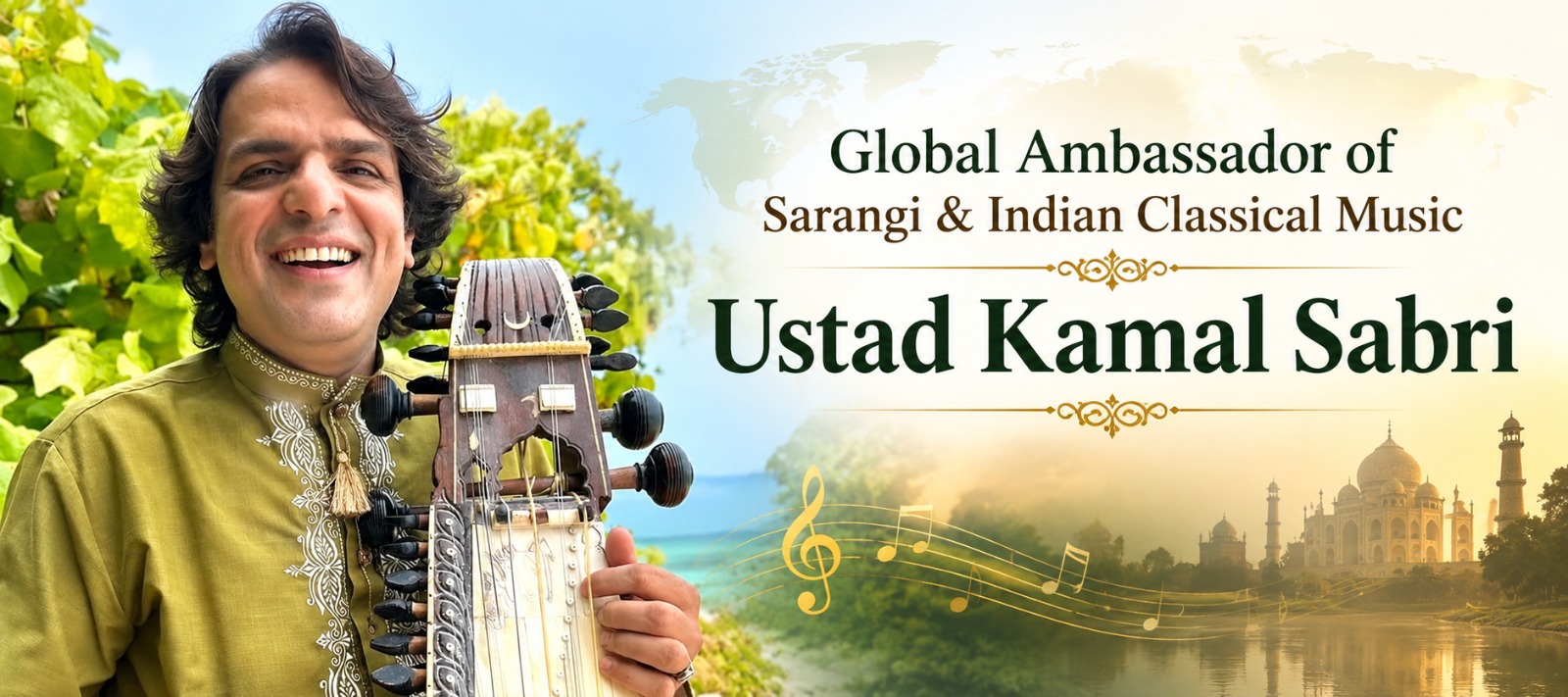
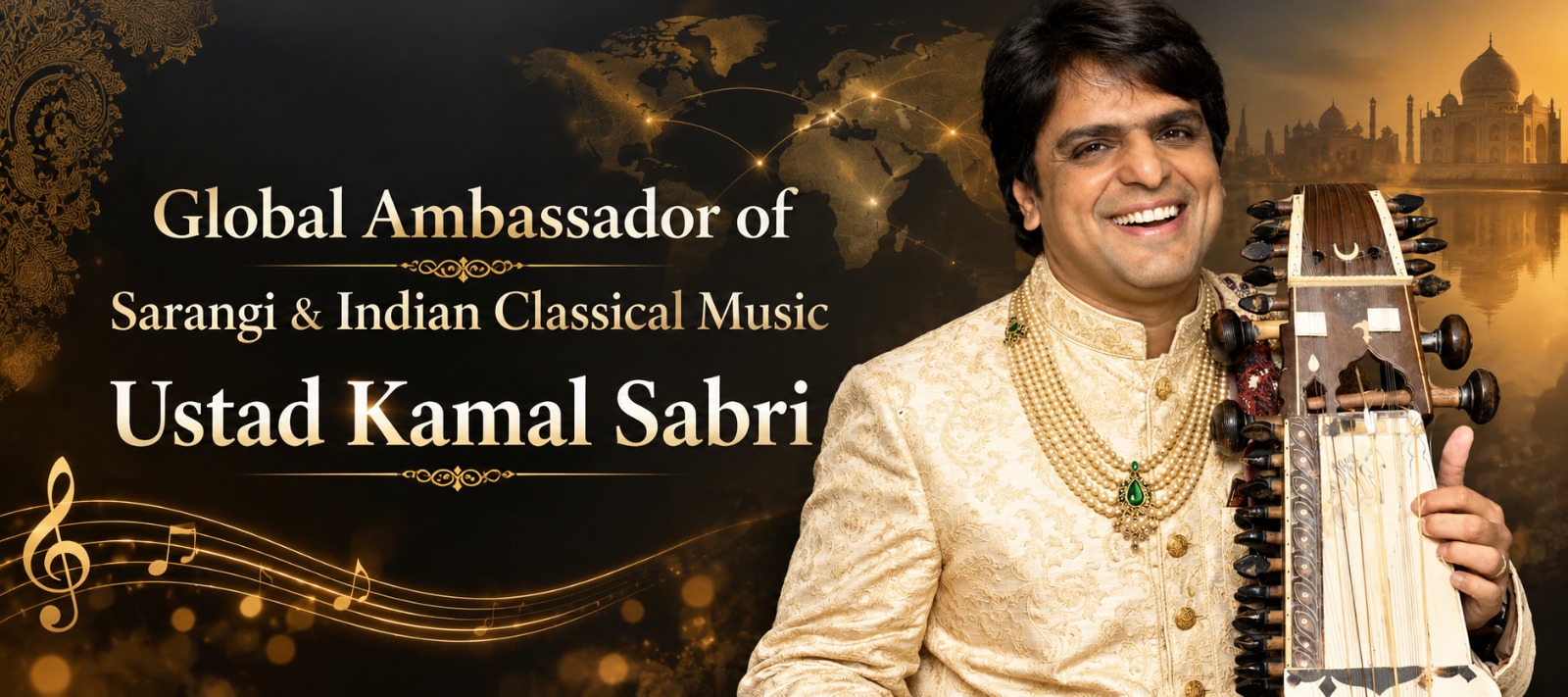
Ustad Kamal Sabri – International Sarangi Maestro, Composer and Cultural Ambassador
Ustad Kamal Sabri is an internationally acclaimed Sarangi maestro, composer, educator and cultural ambassador of Indian classical music. Representing a distinguished musical lineage associated with the Senia tradition of the Moradabad Gharana, he belongs to the seventh generation of a family that has devoted generations to the art of the Sarangi.
The son and disciple of the legendary Sarangi exponent Ustad Sabri Khan, Kamal Sabri has built a career that combines the discipline of Hindustani classical music with an openness to world music, contemporary composition and intercultural collaboration. His work has taken the Sarangi from traditional concert platforms to international festivals, universities, recording studios and multidisciplinary collaborations.
What distinguishes Kamal Sabri's journey is his effort to preserve the traditional character of the Sarangi while exploring its possibilities in new musical environments. His collaborations have included Indian classical musicians, jazz artists, world-music performers and contemporary musicians, allowing the instrument to reach audiences far beyond its traditional setting.
A Seventh-Generation Sarangi Tradition
Kamal Sabri comes from one of India's notable hereditary Sarangi traditions. His father, Ustad Sabri Khan, was one of the most respected Sarangi players of the twentieth century and received major national honours including the Padma Shri and Padma Bhushan. Kamal inherited not only his father's musical knowledge but also the responsibility of carrying the family's Sarangi tradition into a new generation.
Institutional biographies describe Kamal Sabri as having been initiated into music by his father at the age of five. He subsequently developed into a highly accomplished Sarangi player, accompanying eminent Hindustani vocalists before establishing an international identity of his own.
His musical journey demonstrates an interesting balance between guru-shishya parampara and experimentation. While his foundation remains firmly rooted in Hindustani classical music, his career has also embraced fusion, contemporary composition and international collaboration.
The Sarangi as a Global Voice
The Sarangi is one of the most expressive bowed instruments of North Indian classical music. Its ability to reproduce subtle nuances of the human voice makes it particularly suited to the detailed melodic expression of Hindustani music.
For Kamal Sabri, however, the Sarangi is not confined to one musical category.
His work has explored the instrument in classical ragas, fusion projects, ambient music, contemporary compositions and international collaborations. His album Sarangi Funk, for example, experimented with jazz, folk, Western and cross-cultural influences while retaining the Sarangi as its central musical voice.
He has also explored innovations in the construction and playing of the instrument. Sources documenting his career note his experimentation with the addition of a cello string to the Sarangi, reflecting his continuing interest in expanding its tonal possibilities.
International Performances and Cultural Diplomacy
Over several decades, Kamal Sabri has performed in India and internationally, appearing at festivals, concert halls, cultural institutions and diplomatic events.
His international career has included performances and collaborations across Europe, North America, Asia and other parts of the world. He has represented Indian classical music at major international cultural events and has appeared before prominent political and cultural figures.
Among the international dignitaries associated with his performances are the King of Norway, the President of China, former Presidents of India, and other senior political and diplomatic figures, according to artist and festival biographies.
His performance career has also included appearances at major cultural venues and festivals, including events associated with the international world-music circuit.
One particularly notable milestone came at “Les 24 heures du raga” in Paris, where Kamal Sabri was described as the youngest Indian musician participating in the 24-hour millennium concert. He reportedly performed nine concerts accompanying different vocalists during the event.
Collaborations with International Musicians
Kamal Sabri's career extends well beyond the conventional boundaries of Indian classical performance.
He has worked with internationally recognized musicians including Ustad Zakir Hussain, Ustad Fateh Ali Khan, Hossam Ramzy, Jan Garbarek, Jukka Tolonen, Ricky Niles and other musicians from the global music community.
His association with Norwegian saxophonist Jan Garbarek is particularly notable. Artist biographies document their collaboration, including a performance connected with the King of Norway.
Kamal Sabri has also been associated with recordings involving international projects such as Massive Attack and One Giant Leap, demonstrating the adaptability of the Sarangi within contemporary and cross-cultural music.
These collaborations have helped introduce the sound of the Sarangi to listeners who may have had little previous exposure to Indian classical music.
Composer, Recording Artist and Film Musician
Kamal Sabri is not only a performing instrumentalist. His career also encompasses composition, recording, film music and contemporary musical production.
His discography includes projects such as:
-
Best of Sarangi
-
The Sabri Family
-
Dance of the Desert
-
Sarangi Funk
-
Sarangi Redefined
-
Samaagam
-
Rivayat
-
Prince of Sarangi
-
Meditation on Strings
-
Sarangi Meditation
-
Swar Alankar
-
Hum Kalaam
-
Ru Ba Ru
-
The Generation Series
His recordings have appeared through labels including ARC Music, Music Today, Times Music, Saregama, Bihaan Music and Virgin Music, among others.
His digital catalogue has continued to expand in recent years. Streaming listings include works such as “Sajna Mein,” “Dil Da Jaani,” “Baaten Dilon Ki,” “Meditation with Sarangi,” “Mand (The Desert Ballad)” and “Tore Bina Shyam.”
His 2025 release Tore Bina Shyam subsequently became part of his international award journey, with the song being associated with his 2026 Intercontinental Music Award recognition.
Music for Film, Television and International Productions
Kamal Sabri has also contributed his musical abilities to film and documentary projects.
His documented screen credits include The Republic of Love and The Big Question, while artist biographies also associate his music and compositions with documentary, theatre and dance productions.
His work for contemporary productions illustrates another dimension of his artistry: using the emotional character of the Sarangi within cinematic and atmospheric music while retaining its Indian classical identity.
Earlier coverage of his career also highlighted his involvement with projects connected to films and documentaries concerning subjects including Mother Teresa and Sufi traditions.
An Educator and Advocate for Indian Classical Music
For Kamal Sabri, performing is only one part of preserving a musical tradition. Education has been equally important.
Over the years, he has conducted workshops, masterclasses, lecture-demonstrations and educational programmes in different countries, introducing students and musicians to Indian classical music, the Sarangi and the principles of raga and tala.
His international teaching activities have extended to institutions in countries including the United Kingdom, Finland, Denmark, Norway, the United States, Pakistan, Poland and the Netherlands.
His academic and educational work reflects an important aspect of his philosophy: Indian classical music can remain faithful to its tradition while entering into meaningful dialogue with musicians and audiences from different cultures.
He is currently listed as a Professor of Practice at Swami Vivekanand Subharti University, Meerut, where the university describes him as an internationally renowned Sarangi maestro and seventh-generation representative of the Moradabad tradition.
Awards and International Recognition
Kamal Sabri's career has received recognition in India and abroad.
Among the documented honours associated with his career are the Young Maestro Award, Young Ustad title, Best Instrumentalist Award, Surmani and Sangeet Bhushan Award.
He was also recognised in Nashville in 2016 as International Artist of the Year through the Nashville Music City Awards, in recognition of his contribution to music and intercultural collaboration.
In 2023, he received recognition connected with World Music Artist of the Year in Uzbekistan, while his composition “Sajna Mein” was recognised in connection with the MID-DAY Icons of India awards.
In 2024, he received the Dadasaheb Phalke Icon Films International Award in Dubai, where he was recognised as an Iconic World Music Artist.
Global Iconic Artist Award 2026
One of his most recent international honours came in London in 2026.
At the World Heart Beat Awards 2026, held during a Peace Through Music concert at World Heart Beat in London, Kamal Sabri and tabla maestro Ustad Tari Khan jointly received the Global Iconic Artist Award for their contribution to the global heritage of world music.
The recognition was also reported by The Times of India, which quoted Sabri describing the award as a responsibility to carry his musical tradition forward and represent India's cultural heritage internationally.
Intercontinental Music Award 2026
In another significant development in 2026, Kamal Sabri received the Intercontinental Music Award USA. The Times of India reported that he had previously been shortlisted as a finalist in the Bollywood Music category for Asia for “Tore Bina Shyam,” his collaboration with Anup Jalota.
Sabri described the recognition in terms of responsibility: preserving musical tradition, introducing the Sarangi to younger generations and using music to build connections between cultures.
A Bridge Between Tradition and Modern Music
Perhaps the most defining feature of Kamal Sabri's career is his ability to operate in two musical worlds.
On one side is the rigorous tradition of Hindustani classical music, raga, tala and guru-shishya parampara. On the other is a world of jazz, contemporary music, film scoring, world music, fusion and international collaboration.
Rather than treating these worlds as opposites, Sabri has explored ways of allowing them to interact.
His work with musicians from different countries and genres demonstrates how an instrument deeply rooted in Indian musical history can participate in a contemporary global conversation without losing its identity.
This philosophy is particularly visible in projects such as Sarangi Funk and in his collaborations with international musicians.
The Sabri Musical Legacy
Kamal Sabri's story is also part of a larger family history.
His father, Ustad Sabri Khan, was an internationally respected Sarangi maestro whose career helped introduce the instrument to audiences in Europe, North America and elsewhere. Kamal has continued that work while developing his own artistic language.
The next generation of the family has also continued the tradition. His son Suhail Yusuf Khan represents another generation of Sarangi musicians and has pursued classical music alongside contemporary and interdisciplinary projects.
The continuity of this tradition—from Ustad Sabri Khan to Kamal Sabri and the generations that followed—makes the Sabri family an important part of the living history of the Sarangi.
Kamal Sabri and the Future of the Sarangi
The story of Ustad Kamal Sabri is ultimately a story about continuity and evolution.
He inherited a centuries-old musical vocabulary, but he did not confine it to the past. Through concerts, recordings, collaborations, teaching and international cultural exchange, he has continued to introduce the Sarangi to new generations of listeners.
His artistic journey demonstrates that traditional music can remain deeply rooted while still being open to new ideas.
Whether performing a classical raga, collaborating with a jazz musician, composing for film, recording a contemporary project or teaching students about Indian music, Kamal Sabri continues to place the Sarangi at the centre of his musical identity.
For audiences around the world, his work offers an opportunity to encounter the Sarangi not simply as an instrument from India's musical heritage, but as a living and evolving voice capable of communicating across languages, cultures and generations.
Ustad Kamal Sabri – Quick Profile
-
Name: Ustad Kamal Sabri
-
Profession: Sarangi Maestro, Composer, Music Educator and Cultural Ambassador
-
Instrument: Sarangi
-
Musical Tradition: Hindustani Classical Music
-
Gharana/Tradition: Senia / Moradabad tradition
-
Lineage: Seventh generation of Sarangi musicians
-
Guru: Ustad Sabri Khan
-
Base: Delhi, India
-
Known for: Sarangi performance, Indian classical music, world music collaborations, composition and music education
-
International collaborations: Zakir Hussain, Jan Garbarek, Fateh Ali Khan, Hossam Ramzy and other Indian and international musicians
-
Notable contemporary projects: Sarangi Funk, Sajna Mein, Dil Da Jaani, Tore Bina Shyam and other recordings
-
2026 recognition: Global Iconic Artist Award, World Heart Beat Awards, London
-
2026 recognition: Intercontinental Music Award, USA
-
Academic role: Professor of Practice, Swami Vivekanand Subharti University
#KamalSabri #UstadKamalSabri #Sarangi #SarangiMaestro #SarangiSultan #IndianClassicalMusic #HindustaniClassicalMusic #IndianMusic #IndianMusician #IndianClassical #WorldMusic #WorldMusicArtist #IndianHeritage #MusicalHeritage #MoradabadGharana #SabriKhan #SarangiPlayer #SarangiArtist #IndianCulture #CulturalAmbassador #GlobalCulturalAmbassador #MusicDiplomacy #IndianMusicGlobal #MusicAroundTheWorld #ClassicalMusic #Raga #Tala #GuruShishyaParampara #IndianArt #MusicEducation #Composer #WorldMusicFusion #LiveMusic #MusicLegend #IndianArtists #GlobalArtist #MusicAndCulture #PreservingTradition #GlobalMusic #MusicWithoutBorders #lowkot