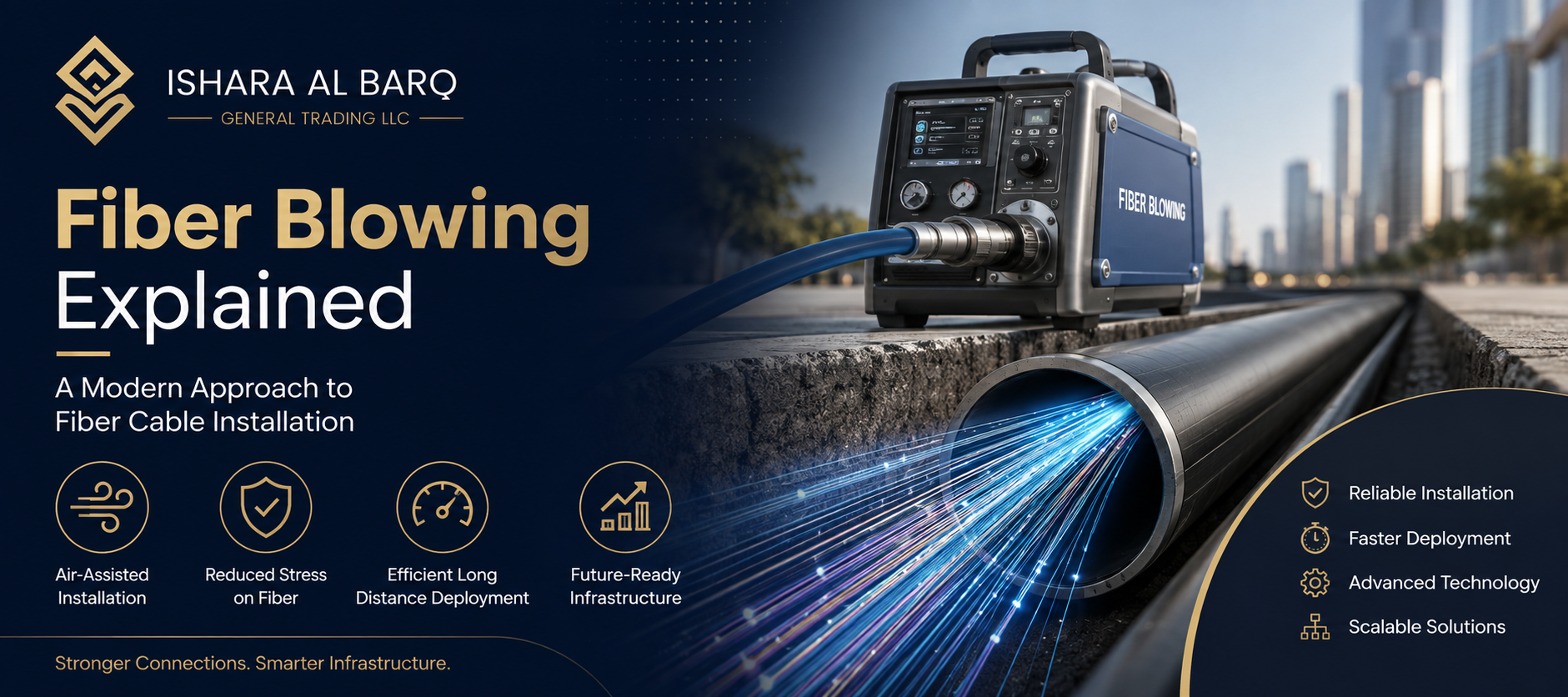
Fiber Blowing Explained: A Modern Approach to Fiber Cable Installation
Fiber optic networks are becoming increasingly important for modern businesses, telecommunications providers, smart infrastructure, data centers and large-scale developments.
But building a reliable fiber network involves much more than selecting the right fiber cable.
How the cable is installed matters.
One of the modern techniques used for fiber optic cable deployment is fiber blowing, also known as fiber cable blowing or air-assisted fiber installation.
Unlike traditional cable pulling, fiber blowing uses compressed air to help move the fiber through a prepared duct. When properly planned and executed, this method can provide an efficient approach for deploying fiber over significant distances while helping protect the cable during installation.
For companies involved in telecommunications and infrastructure projects, understanding fiber blowing is an important part of understanding modern network construction.
What Is Fiber Blowing?
Fiber blowing is an installation technique in which compressed air is used to assist the movement of a fiber optic cable through a duct or microduct.
Instead of relying entirely on mechanical pulling force, specialized equipment pushes the cable forward while airflow creates a supporting force along the cable.
In simple terms:
Prepared Duct → Fiber Cable → Blowing Equipment → Compressed Air → Controlled Installation
The technique is particularly useful when installing fiber over long routes or when minimizing mechanical stress on the cable is important.
The exact installation method depends on the cable type, duct design, route length, equipment and project specifications.
How Does Fiber Blowing Work?
Although the process can appear simple, successful fiber blowing requires careful preparation.
1. Duct Preparation
Before the fiber is installed, the duct pathway needs to be inspected and prepared.
The installation team may check for:
-
Blockages
-
Duct condition
-
Internal cleanliness
-
Pathway continuity
-
Bends and route characteristics
-
Appropriate duct dimensions
A properly prepared pathway is essential for a successful installation.
2. Fiber Cable Preparation
The fiber cable must be compatible with the selected installation method and equipment.
Important considerations can include:
-
Cable diameter
-
Cable weight
-
Cable construction
-
Duct-to-cable ratio
-
Route length
-
Maximum installation forces
-
Environmental conditions
Selecting the correct combination of cable and duct is an important engineering decision.
3. Blowing Equipment Setup
Specialized fiber blowing equipment is positioned at the installation point.
The equipment controls the movement of the cable while compressed air is introduced into the duct.
The objective is to maintain controlled installation conditions rather than simply pushing the cable as quickly as possible.
4. Controlled Fiber Installation
During installation, the cable moves through the duct with assistance from the airflow.
Installation speed and air pressure need to be controlled according to the cable, duct and project requirements.
Professional monitoring is important because excessive force, unsuitable pressure or poor preparation can affect the installation.
5. Testing and Documentation
After installation, the network should be checked and documented according to the project's technical requirements.
Depending on the project, testing may include optical measurements and inspection of the installed route.
Proper documentation also makes future maintenance and troubleshooting easier.
Fiber Blowing vs Traditional Cable Pulling
Traditional fiber installation often involves pulling the cable through a duct using mechanical force.
Fiber blowing takes a different approach by using compressed air to assist cable movement.
| Factor | Fiber Blowing | Traditional Pulling |
|---|---|---|
| Installation method | Air-assisted movement | Mechanical pulling |
| Long-distance deployment | Can be highly suitable | May require careful force management |
| Mechanical stress | Can reduce pulling forces | Greater reliance on pulling force |
| Installation speed | Potentially efficient | Depends on route and conditions |
| Equipment | Specialized blowing equipment | Pulling equipment |
| Route requirements | Requires suitable duct system | Requires suitable duct system |
| Project planning | Critical | Critical |
Neither method is automatically better for every project.
The appropriate installation method depends on the cable, route, duct infrastructure, project requirements and technical specifications.
Why Fiber Blowing Is Becoming Important
As fiber networks expand, installation teams are looking for methods that can improve efficiency while maintaining proper cable handling.
Fiber blowing can offer several potential advantages.
1. Reduced Mechanical Stress
One of the key benefits of air-assisted installation is the ability to reduce dependence on direct pulling force.
This can be particularly valuable when installing fiber over longer routes.
Reducing unnecessary mechanical stress helps support proper cable handling and installation quality.
2. Efficient Long-Distance Installation
Fiber blowing can be particularly useful for longer duct routes.
Depending on the equipment, cable and route design, significant distances can potentially be covered from a single installation setup.
The actual achievable distance varies considerably from project to project.
3. Better Use of Duct Infrastructure
A well-designed duct network can support fiber deployment and future network expansion.
Microduct systems can also allow smaller fiber cables to be installed efficiently within dedicated pathways.
This makes duct planning an important part of modern fiber infrastructure.
4. Suitable for Network Expansion
One of the major advantages of duct-based infrastructure is that it can provide flexibility for future expansion.
A business or telecommunications operator may initially deploy one fiber cable while keeping additional duct capacity available for future requirements.
As bandwidth demand increases, additional fiber can potentially be installed without reconstructing the entire pathway.
What Makes a Fiber Blowing Project Successful?
Fiber blowing is not simply a matter of putting a cable into a machine and switching on the air compressor.
Several technical factors need to work together.
Duct Quality
The duct needs to provide a suitable pathway for the cable.
Damaged, blocked or poorly prepared ducts can create installation problems.
Cable Compatibility
The cable must be appropriate for the duct and installation method.
Cable diameter, weight, construction and specifications all matter.
Route Design
Long routes with excessive bends or unsuitable pathway characteristics can affect installation performance.
Route planning should therefore happen before installation begins.
Air Pressure and Flow
Compressed air needs to be controlled according to the equipment and installation conditions.
Too little airflow may reduce installation efficiency, while inappropriate operating conditions can create unnecessary risks.
Equipment
Professional fiber blowing requires specialized equipment designed for the specific cable and duct application.
Skilled Technicians
Perhaps most importantly, equipment alone does not guarantee a successful installation.
Technical knowledge, preparation, monitoring and experience are critical.
The Importance of Duct and Microduct Design
Fiber blowing also highlights an important principle in telecommunications infrastructure:
The network pathway is just as important as the cable.
A properly designed duct system can make future fiber deployment easier and more flexible.
Microduct technology is particularly useful for projects where multiple fiber routes or future network expansion are anticipated.
Instead of treating infrastructure as a one-time installation, businesses can design pathways with future requirements in mind.
This approach can be particularly valuable for:
-
Smart buildings
-
Commercial developments
-
Telecommunications networks
-
Industrial facilities
-
Data centers
-
Large campuses
-
Infrastructure projects
-
Broadband networks
Common Mistakes to Avoid
Fiber installation problems can often be traced back to preparation rather than the fiber cable itself.
Some common issues include:
Poor duct preparation
Debris, blockages or damaged ducts can interfere with installation.
Incorrect cable selection
A cable that is not suitable for the duct or installation method can create unnecessary complications.
Ignoring route characteristics
Bends, elevation changes and long distances need to be considered during planning.
Uncontrolled installation conditions
Improper equipment settings can affect cable movement.
Insufficient testing
Installation should not be considered complete simply because the cable has reached its destination.
A professional approach considers the entire process from design to installation to testing.
Fiber Blowing and the Future of Connectivity
The demand for network capacity continues to grow.
Cloud computing, artificial intelligence, Internet of Things devices, video communications, smart infrastructure and data-intensive applications are all increasing the importance of high-capacity networks.
As these technologies develop, fiber infrastructure will remain a critical foundation for connectivity.
Efficient installation methods such as fiber blowing can help infrastructure projects deploy fiber through appropriately designed duct systems while maintaining a focus on controlled installation and future scalability.
Where Ishara Al Barq Fits In
Ishara Al Barq General Trading LLC has developed its business capabilities across IT, telecommunications, technical solutions, general trading and infrastructure-related requirements.
This combination gives the company a broader perspective on how technology and physical infrastructure support modern business.
Fiber infrastructure sits directly at the intersection of these areas.
A fiber network is not simply a telecommunications product. It is part of a larger infrastructure ecosystem involving network pathways, technical requirements, connectivity, equipment and future expansion.
With more than 17 years of business experience in Dubai, Ishara Al Barq understands the importance of adapting to changing technology and business requirements.
Its diversified capabilities allow the company to approach infrastructure requirements from a broader commercial and technical perspective.
The Bigger Picture: Build Once, Plan for the Future
A successful fiber project should not be designed only around today's connectivity requirements.
Businesses should also ask:
What will our network need five years from now?
Future requirements may include:
-
Higher bandwidth
-
Additional fiber capacity
-
New buildings
-
IoT networks
-
Smart infrastructure
-
Cloud connectivity
-
Data-intensive applications
-
Additional telecommunications services
Good infrastructure planning considers these possibilities before construction begins.
That is why duct design, cable selection, installation techniques and future expansion should all be considered together.
Final Thoughts
Fiber blowing represents an important development in modern fiber optic installation.
By using controlled compressed air to assist cable movement through prepared ducts, the technique can provide an efficient alternative to traditional pulling methods for suitable projects.
But the technology itself is only one part of the equation.
Good planning + suitable infrastructure + the right equipment + skilled installation = a stronger fiber network.
As businesses and cities become increasingly connected, the importance of reliable fiber infrastructure will continue to grow.
For organizations planning telecommunications or infrastructure projects, understanding modern installation methods is the first step toward making better technical decisions.
Ishara Al Barq — supporting the technology, telecommunications and infrastructure needs of a connected future.
#IsharaAlBarq #FiberBlowing #FiberOptic #FiberOpticInstallation #FiberInfrastructure #FiberCable #Telecommunications #TelecomInfrastructure #NetworkInfrastructure #Microduct #FiberNetwork #DigitalInfrastructure #TechnicalSolutions #ITSolutions #InfrastructureSolutions #DubaiTechnology #DubaiBusiness #UAEBusiness #SmartInfrastructure #Connectivity #UAE #Dubai