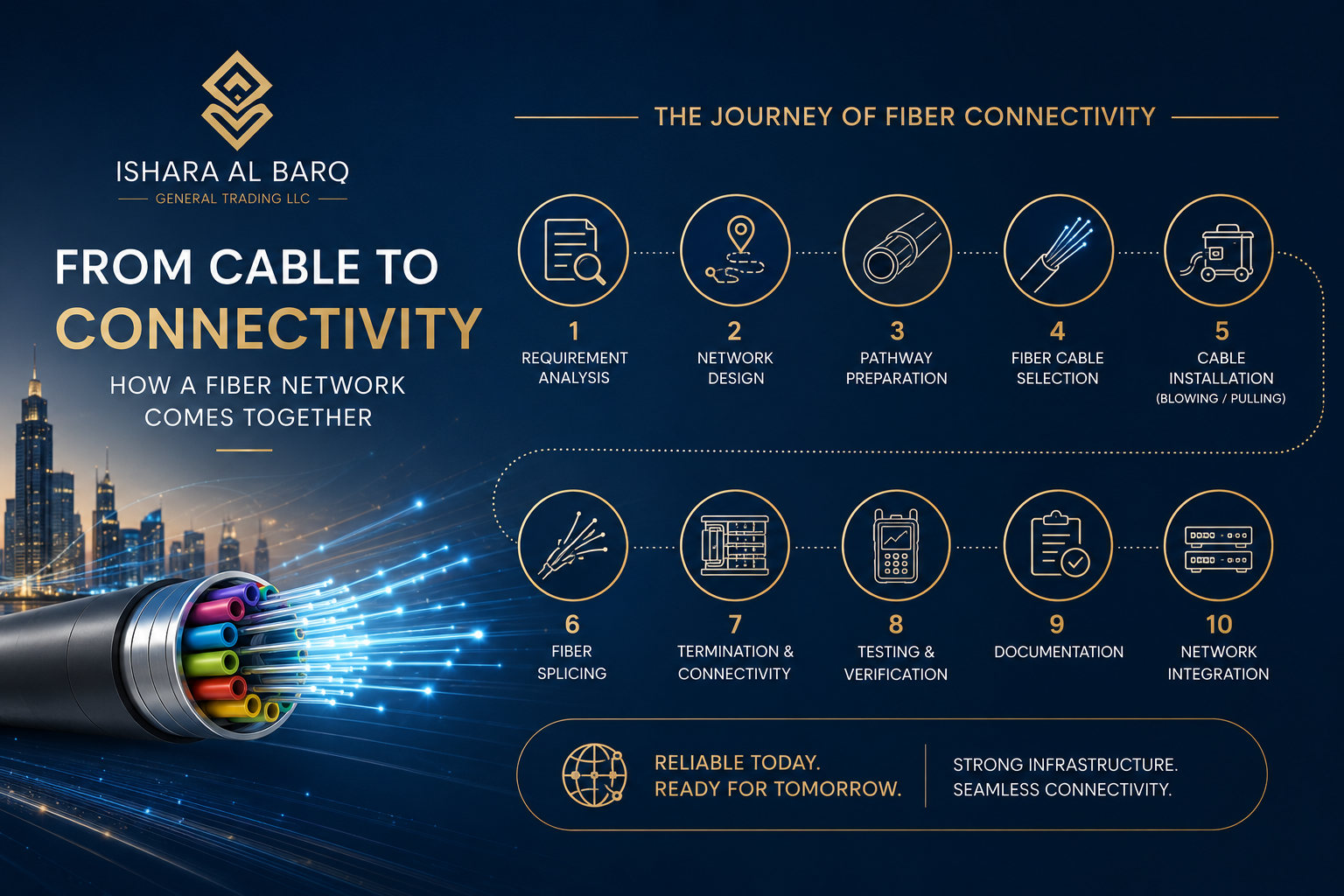
From Cable to Connectivity: How a Fiber Network Comes Together
When people think about a fiber optic network, they often think about the cable itself.
But a successful fiber network is much more than a cable running from one location to another.
Behind reliable connectivity is a complete infrastructure system involving network planning, ducts and pathways, fiber cables, termination, splicing, distribution equipment, testing and ongoing maintenance.
Every component has a role.
When these components are properly planned and installed, they work together to create the connectivity that modern businesses, telecommunications networks, smart buildings and digital infrastructure depend on.
For companies involved in IT and telecommunications infrastructure, understanding this complete journey is essential.
What Is a Fiber Network?
A fiber network is a communication infrastructure that uses fiber optic technology to transmit information using light.
Fiber can carry large amounts of data over long distances and is widely used for applications such as:
-
Business connectivity
-
Telecommunications
-
Broadband networks
-
Data centers
-
Cloud connectivity
-
Smart buildings
-
Security and surveillance systems
-
Industrial communication
-
Large commercial developments
However, the fiber cable is only one part of the complete network.
The real performance of a fiber network depends on how the entire infrastructure is designed, installed, connected, tested and maintained.
Step 1: Understanding the Project Requirements
Every fiber project begins with a requirement.
Before any cable is installed, the project team needs to understand what the network is expected to achieve.
Important questions may include:
-
How many locations need connectivity?
-
How much bandwidth is required?
-
What distance needs to be covered?
-
Is the network for a building, campus, industrial site or wider area?
-
How much future expansion is expected?
-
What environmental conditions exist?
-
Will the network be underground, aerial or a combination?
-
What standards and regulations apply?
This initial assessment provides the foundation for the network design.
Good fiber infrastructure begins with good planning.
Step 2: Designing the Fiber Route
Once the requirements are understood, the physical route needs to be planned.
The route determines how the fiber will travel from the source to the destination.
Depending on the project, the route may involve:
Buildings → Ducts → Manholes → Handholes → Distribution Points → Network Equipment
Route planning needs to consider distance, bends, access points, existing infrastructure, obstacles and future expansion.
A poorly planned route can create unnecessary installation and maintenance challenges later.
That is why route design should be treated as an engineering decision rather than simply a construction activity.
Step 3: Preparing the Pathway
The fiber cable needs a suitable pathway.
For underground networks, this may involve ducts, conduits or microduct systems.
For aerial networks, suitable poles or supporting structures may be required.
Before installation, the pathway should be checked for issues such as:
-
Blockages
-
Damage
-
Debris
-
Water or environmental concerns
-
Excessive bends
-
Accessibility problems
A clean and properly prepared pathway can make fiber installation significantly more manageable.
Step 4: Selecting the Right Fiber Cable
Not every fiber cable is designed for every application.
Cable selection depends on factors such as:
-
Installation environment
-
Required fiber count
-
Distance
-
Mechanical requirements
-
Indoor or outdoor application
-
Duct or aerial installation
-
Future capacity requirements
For example, a cable designed for an outdoor route may have different construction characteristics from one intended for an indoor environment.
The objective is not simply to select a cable with high capacity.
The cable needs to be appropriate for the complete infrastructure and installation method.
Step 5: Installing the Fiber Cable
Once the pathway and cable are ready, installation can begin.
Different projects may use different installation methods.
One approach is fiber blowing, where controlled compressed air assists the movement of fiber through a prepared duct.
Another method is traditional cable pulling, where mechanical force is used to move the cable through the pathway.
The appropriate method depends on the cable, duct, route and project requirements.
Professional installation is important because fiber optic cables need to be handled carefully to avoid excessive mechanical stress or damage.
Step 6: Fiber Splicing
Large fiber networks often require multiple cable sections to be connected.
This is where fiber splicing becomes important.
Splicing creates a permanent connection between two optical fibers.
One widely used technique is fusion splicing, which aligns the fiber ends and joins them using controlled heat.
High-quality splicing is essential because poor connections can introduce optical loss and affect network performance.
This is one reason why technical skill and precision are important during fiber installation.
Step 7: Termination and Connectivity
Fiber cables eventually need to connect to network equipment or distribution systems.
This process involves appropriate termination components and connectivity hardware.
Depending on the network design, the infrastructure may include:
-
Fiber distribution frames
-
Patch panels
-
Connectors
-
Adapters
-
Enclosures
-
Distribution boxes
-
Network equipment
These components create an organized transition between the physical fiber infrastructure and the active network.
Good organization at this stage can also make future maintenance and troubleshooting easier.
Step 8: Testing the Network
Installing the cable does not mean the project is finished.
Testing is a critical part of fiber deployment.
Testing can help verify whether the installed network meets the required optical and performance characteristics.
Depending on the project, technicians may use specialized equipment to measure factors such as:
-
Optical loss
-
Signal performance
-
Continuity
-
Splice quality
-
Reflection and fault locations
Testing can identify problems before the network becomes operational.
A fiber network should be measured, verified and documented—not simply installed.
Step 9: Documentation
Professional fiber infrastructure should also be properly documented.
Documentation can include information about:
-
Cable routes
-
Fiber identification
-
Splice locations
-
Distribution points
-
Connection information
-
Test results
-
Network diagrams
Accurate documentation becomes extremely valuable when the network needs to be expanded, repaired or upgraded.
Without proper records, technicians may spend unnecessary time trying to understand an existing network.
Step 10: Connecting the Active Network
After the passive fiber infrastructure has been installed and tested, it can be integrated with active network equipment.
This is where the physical infrastructure becomes a working communication network.
Depending on the application, the network may connect to:
-
Switches
-
Routers
-
Servers
-
Data centers
-
Telecommunications systems
-
Internet connectivity
-
Security systems
-
Cloud infrastructure
The fiber provides the physical communication pathway, while active equipment manages the transmission and routing of data.
Step 11: Maintenance and Future Expansion
A fiber network is a long-term infrastructure investment.
Once operational, it still requires appropriate monitoring, maintenance and documentation.
Businesses should also consider future requirements.
Network demand can increase because of:
-
Business expansion
-
Cloud computing
-
Artificial intelligence
-
Internet of Things devices
-
Video surveillance
-
Smart buildings
-
Higher data usage
-
New facilities
This is why infrastructure should ideally be designed with scalability in mind.
A properly planned duct system, sufficient fiber capacity and organized distribution infrastructure can make future expansion easier.
The Complete Fiber Journey
It helps to think of a fiber network as a complete chain:
Requirement
↓
Network Design
↓
Route Planning
↓
Duct & Pathway Preparation
↓
Fiber Cable Selection
↓
Cable Installation
↓
Splicing & Termination
↓
Testing
↓
Documentation
↓
Network Equipment Integration
↓
Connectivity
↓
Maintenance & Expansion
Every stage contributes to the final result.
A weakness in one part of the chain can affect the overall network.
Why End-to-End Thinking Matters
One of the biggest mistakes in infrastructure projects is looking at each component separately.
A cable supplier may focus on the cable.
A construction team may focus on the pathway.
A technician may focus on installation.
An IT team may focus on network equipment.
But a successful project requires these elements to work together.
Fiber infrastructure is an ecosystem.
The cable, pathway, installation method, splicing, termination, testing and network equipment all need to support the same objective.
This is why businesses can benefit from working with partners who understand the broader relationship between IT, telecommunications and physical infrastructure.
Where Ishara Al Barq Fits In
Ishara Al Barq General Trading LLC has developed capabilities across IT, telecommunications, technical solutions, general trading and infrastructure-related requirements.
This diversified experience allows the company to approach technology and infrastructure from a broader perspective.
Fiber connectivity is not an isolated technology.
It connects telecommunications infrastructure with IT systems, technical requirements and the wider operational needs of modern businesses.
With more than 17 years of business experience in Dubai, Ishara Al Barq understands the importance of reliability, technical knowledge and adaptability in a rapidly changing business environment.
The company's broader capabilities support its understanding of the interconnected nature of modern infrastructure.
Fiber Networks Are Built for the Future
Today's network requirements may look very different from tomorrow's.
A business that currently needs connectivity for basic communication may eventually require infrastructure for cloud computing, AI applications, IoT systems, smart facilities or large-scale data transmission.
That is why fiber infrastructure should be viewed as a long-term strategic asset.
The goal is not simply to install a cable.
The goal is to create a reliable infrastructure foundation that can support the business as its technology requirements evolve.
Final Thoughts
A fiber network may look simple from the outside.
But behind every reliable connection is a carefully coordinated infrastructure system.
From planning and route design to cable installation, splicing, testing and network integration, every stage matters.
The cable is only the beginning.
The real value comes from how the complete infrastructure comes together.
As digital connectivity becomes increasingly important to businesses and cities, organizations need to think beyond individual components and focus on building infrastructure that is reliable, scalable and ready for the future.
Ishara Al Barq — Connecting Technology, Infrastructure and Business.
#IsharaAlBarq #FiberNetwork #FiberInfrastructure #FiberOptic #FiberOpticNetwork #FiberInstallation #FiberSplicing #FiberBlowing #Telecommunications #TelecomInfrastructure #NetworkInfrastructure #DigitalInfrastructure #ITSolutions #TechnicalSolutions #InfrastructureSolutions #Connectivity #SmartInfrastructure #DubaiTechnology #DubaiBusiness #UAEBusiness #UAE #Dubai