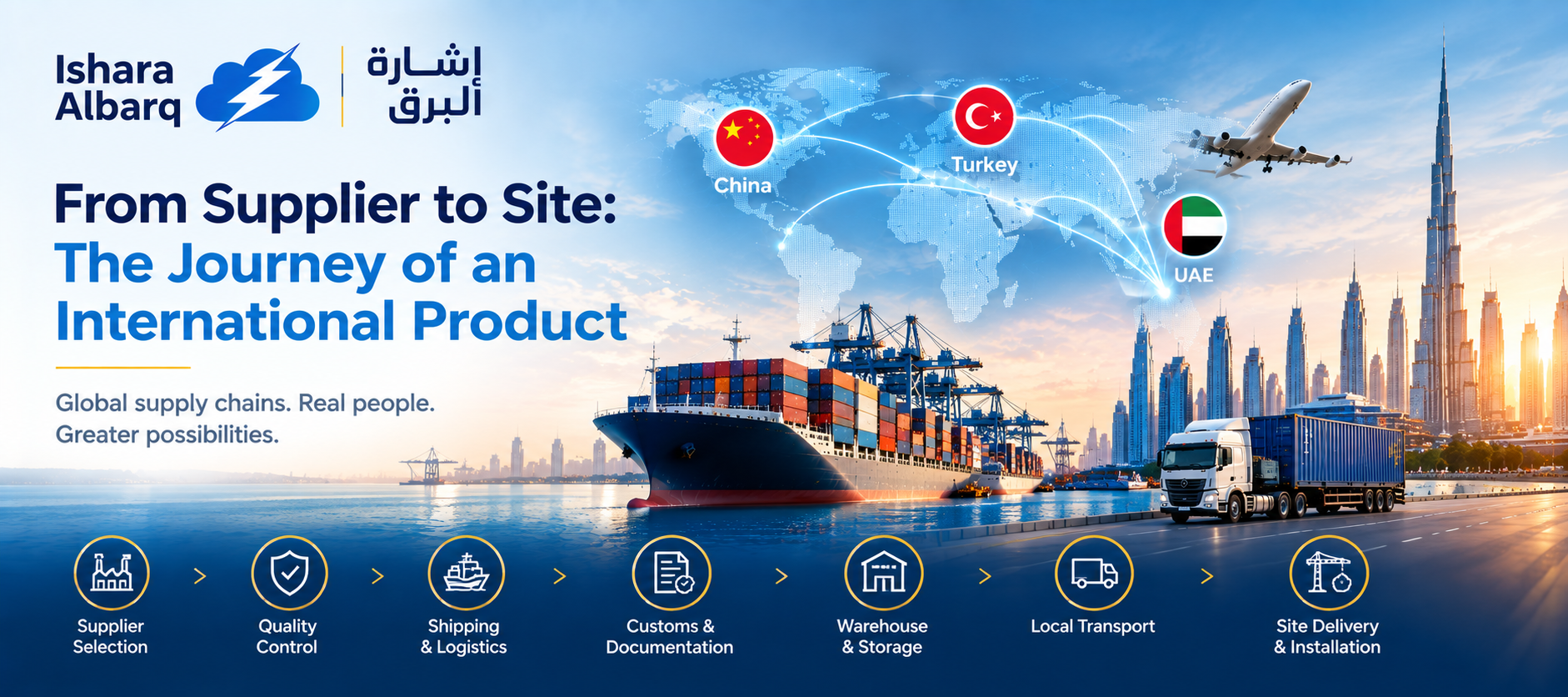
How International Products Reach the UAE
Supply-Chain Storytelling | Industry Education
A product may begin its journey thousands of kilometers away from the business that ultimately uses it.
A telecommunications component manufactured in China.
An industrial product produced in Turkey.
A technology system sourced from Europe.
Before any of these products reach a UAE warehouse, project site, or customer, they pass through a complex chain of people, decisions, documents, inspections, and transportation processes.
From the first supplier conversation to final delivery, international procurement is a journey.
And every stage matters.
A competitive supplier is important. A good product is important. Efficient logistics are important.
But the real value comes from making sure all these pieces work together.
Where the Journey Begins
Every successful international procurement journey starts with a requirement.
A business first identifies what it needs, why it needs it, and what the product must achieve.
This may sound simple, but a clear requirement is one of the most important foundations of procurement.
A requirement can include:
-
Product type
-
Technical specifications
-
Quantity
-
Quality standards
-
Certifications
-
Packaging requirements
-
Delivery location
-
Required delivery date
-
Warranty
-
Installation requirements
-
After-sales support
For technical products, the specification becomes even more important.
A telecommunications project, for example, may require equipment with specific interfaces, capacity, compatibility, environmental ratings, or network standards.
The journey from supplier to site begins long before the product is manufactured.
It begins with understanding the requirement.
Step 1: Finding the Right Supplier
Once the requirement is clear, businesses begin searching for suitable suppliers.
This is where an international supplier network can become valuable.
Depending on the product, businesses may explore suppliers in:
-
China
-
Turkey
-
India
-
Europe
-
Southeast Asia
-
North America
-
Other international manufacturing markets
But finding a supplier is not the same as finding the right supplier.
Businesses should evaluate factors such as:
-
Manufacturing capability
-
Product expertise
-
Quality systems
-
Production capacity
-
Export experience
-
Certifications
-
Lead times
-
Commercial terms
-
References
-
Technical support
A supplier should be assessed against the actual business requirement.
The cheapest quotation is not automatically the best option.
Step 2: Understanding the Supplier
Once a potential supplier has been identified, the next question is:
Can this supplier deliver what they are promising?
Supplier verification can help businesses understand the company's capabilities and reduce procurement risks.
Depending on the transaction, businesses may review:
-
Company information
-
Manufacturing facilities
-
Product portfolio
-
Quality certifications
-
Production capacity
-
Export history
-
Customer references
-
Warranty policies
-
Technical documentation
For high-value or technically important purchases, businesses may also consider factory visits, supplier audits, product testing, or independent inspections.
The objective is not to create unnecessary complexity.
It is to create confidence before making a significant commercial commitment.
Step 3: Turning a Requirement Into an Order
After the supplier is selected, technical and commercial discussions begin to take shape.
The buyer and supplier may agree on:
-
Product specifications
-
Quantity
-
Unit price
-
Production timeline
-
Packaging
-
Quality requirements
-
Payment terms
-
Delivery terms
-
Warranty
-
Documentation
At this stage, clarity is critical.
A product specification that is misunderstood at the beginning can create problems much later.
This is why professional procurement focuses on documenting what has actually been agreed.
What is written clearly today can prevent costly disagreements tomorrow.
Step 4: Production Begins
The order then moves into production.
For a simple product, this stage may be relatively straightforward.
For customized or technically complex products, however, production can involve multiple stages.
These may include:
Raw Materials → Manufacturing → Assembly → Testing → Quality Inspection → Packaging
During this stage, communication between the buyer and supplier can be important.
Changes to specifications, production schedules, packaging, or quantities need to be managed carefully.
For project-based procurement, even a small delay at the manufacturing stage can affect the delivery schedule at the final site.
Step 5: Quality Control Before Shipment
One of the most important moments in the product journey happens before the goods leave the supplier.
Why?
Because fixing a problem at the factory is usually easier than fixing it after the product has traveled thousands of kilometers.
Depending on the product, quality control can include:
-
Sample approval
-
Factory inspection
-
Product testing
-
Specification verification
-
Quantity checks
-
Packaging inspection
-
Pre-shipment inspection
-
Documentation review
For telecommunications and technical equipment, testing may need to verify that products meet agreed technical requirements.
Quality is therefore not simply an inspection activity.
It is a risk-management process.
Step 6: Preparing the Shipment
Once the product passes the required checks, it needs to be prepared for international transportation.
Packaging becomes important here.
Good packaging should protect the product during:
-
Handling
-
Loading
-
Transportation
-
Unloading
-
Temporary storage
The shipment also needs the appropriate documentation.
Depending on the product and transaction, this may include:
-
Commercial invoice
-
Packing list
-
Certificate of origin
-
Transport documentation
-
Product documentation
-
Applicable certificates
A shipment is not ready simply because the products are packed.
The physical goods and the documentation need to be ready together.
Step 7: Choosing the Transportation Method
Now the product begins its physical journey.
The transportation method depends on several factors.
Sea Freight
Often considered for larger or heavier shipments where delivery time allows.
Air Freight
Can be useful when speed is more important or when shipments are relatively small or time-sensitive.
Road Transport
May become important for regional movement and final delivery.
The decision involves balancing:
Cost + Speed + Product Requirements + Risk + Delivery Schedule
Choosing transportation based only on the lowest freight price can be a mistake.
A delayed shipment can create costs far beyond the transportation bill.
Step 8: The International Journey
Once shipped, the product is no longer simply a procurement order.
It becomes part of a logistics chain.
Different parties may be involved, including:
-
Supplier
-
Freight forwarder
-
Shipping carrier
-
Customs representatives
-
Importer
-
Warehouse
-
Local transport provider
-
Final customer
Each handover creates another point where information and coordination matter.
Shipment tracking and timely communication can provide greater visibility throughout the journey.
For businesses managing project deliveries, this visibility can be particularly valuable.
Step 9: Customs and Import Procedures
When the shipment reaches the UAE, it may need to go through applicable customs and import procedures.
The exact requirements depend on the product, origin, shipment structure, and applicable UAE regulations.
Documentation can play an important role.
Incorrect or incomplete information may cause delays, additional costs, or administrative complications.
This is why import and compliance requirements should be considered before the goods are shipped, rather than after they arrive.
A smooth procurement process anticipates these requirements.
Step 10: Arrival at the Warehouse
After the necessary import procedures are completed, the product may move to a warehouse or distribution facility.
At this point, another important check takes place.
The business may verify:
-
Quantity received
-
Product model
-
Packaging condition
-
Visible damage
-
Accessories
-
Documentation
-
Purchase-order details
For project-specific products, the warehouse may also need to coordinate delivery according to the project's schedule.
The product may have completed its international journey—but its journey to the final site may still be ahead.
Step 11: From Warehouse to Project Site
This is where supply-chain planning connects directly with project execution.
Imagine a telecommunications project waiting for a particular piece of equipment.
The equipment may have been:
Manufactured → Inspected → Packed → Shipped → Imported → Stored
But if it does not reach the project site when required, the project can still be affected.
This demonstrates an important principle:
Procurement success is not measured only by purchasing the product. It is measured by delivering the right product to the right place at the right time.
Site delivery therefore needs to consider:
-
Site readiness
-
Delivery windows
-
Access requirements
-
Local transportation
-
Handling
-
Storage conditions
-
Installation schedule
Step 12: The Product Becomes Part of Something Bigger
When the product finally reaches the site, its journey does not necessarily end.
It becomes part of a larger system.
For example:
A fiber-optic component becomes part of a telecommunications network.
A network device becomes part of an enterprise infrastructure.
Industrial equipment becomes part of a production facility.
A construction product becomes part of a completed building.
The product's value is ultimately determined by how effectively it performs its intended role.
This is why procurement, engineering, logistics, and project teams need to work together.
The Hidden Supply Chain Behind One Product
A single international product can involve a surprisingly large network of activities.
Consider the journey:
Business Requirement
↓
Supplier Identification
↓
Supplier Verification
↓
Quotation & Negotiation
↓
Purchase Order
↓
Manufacturing
↓
Quality Control
↓
Packaging & Documentation
↓
International Shipping
↓
Customs & Import
↓
Warehouse
↓
Local Transportation
↓
Project Site
↓
Installation / Final Use
Every stage creates potential opportunities—and potential risks.
The strength of the supply chain depends on how well these stages connect.
Why Communication Matters
International supply chains involve multiple organizations, countries, time zones, and business cultures.
Communication can therefore have a major impact on execution.
Important information includes:
-
Order status
-
Production progress
-
Quality results
-
Expected shipment date
-
Documentation status
-
Transportation updates
-
Customs requirements
-
Delivery schedule
A small communication gap can become a major operational issue.
Strong procurement is therefore not only about negotiating prices.
It is also about managing information effectively.
The Importance of Total Landed Cost
The supplier's product price is only one part of the financial picture.
The final cost can include:
Product Cost + Packaging + Inspection + Freight + Insurance + Duties/Taxes + Customs + Local Transport + Other Applicable Costs
This is known as the landed cost concept.
Understanding landed cost allows businesses to compare sourcing options more realistically.
A supplier with a slightly higher factory price could potentially provide better overall value if it offers stronger quality, shorter lead times, better packaging, or more efficient logistics.
Managing Risk Along the Journey
Every stage of international procurement introduces different risks.
| Stage | Potential Risk |
|---|---|
| Supplier selection | Supplier capability |
| Negotiation | Unclear terms |
| Production | Manufacturing delays |
| Quality control | Product defects |
| Shipping | Transit delays |
| Documentation | Missing or inaccurate documents |
| Customs | Import complications |
| Warehouse | Damage or inventory issues |
| Site delivery | Scheduling problems |
The solution is not to eliminate every risk.
That is rarely possible.
Instead, businesses should identify important risks early and establish practical controls.
Building Supply-Chain Resilience
A resilient supply chain can adapt when circumstances change.
Businesses can strengthen resilience through measures such as:
-
Supplier diversification
-
Alternative sourcing markets
-
Backup transportation options
-
Appropriate inventory planning
-
Supplier performance monitoring
-
Clear documentation
-
Strong communication
-
Contingency planning
For strategically important products, having an alternative supplier can provide valuable flexibility.
This is especially relevant when a business depends on a single manufacturer, country, transportation route, or component.
Technology and Supply-Chain Visibility
Modern procurement is becoming increasingly digital.
Businesses can use technology to track:
-
Purchase orders
-
Supplier performance
-
Production status
-
Inventory
-
Shipment location
-
Delivery schedules
-
Documentation
Better visibility allows procurement and project teams to identify potential problems earlier.
For example, knowing that a shipment has been delayed several days before the expected delivery date provides more time to adjust the project schedule.
Visibility creates the opportunity to act before a delay becomes a disruption.
Why the Final Mile Matters
The international journey often receives most of the attention.
But the final delivery can be just as important.
A product can successfully travel from a factory in China or Turkey to the UAE and still fail to meet the business requirement if it arrives at the wrong location or at the wrong time.
This is why the final mile should be planned as part of the procurement process.
The question should not simply be:
“When will the product arrive in the UAE?”
It should be:
“When will the product be ready for use at the required site?”
That distinction can make a significant difference in project planning.
From Procurement to Partnership
The strongest international procurement relationships often go beyond individual purchase orders.
Over time, businesses can build strategic relationships with suppliers based on:
-
Consistent quality
-
Reliable delivery
-
Technical collaboration
-
Transparent communication
-
Fair commercial terms
-
Continuous improvement
A reliable supplier network can become a strategic asset.
It can provide access to new products, alternative manufacturing capacity, technical knowledge, and better supply-chain flexibility.
The Future of International Supply Chains
Global supply chains are becoming increasingly connected and data-driven.
Businesses are placing greater emphasis on:
-
Supply-chain visibility
-
Supplier diversification
-
Digital procurement
-
Quality assurance
-
Sustainability
-
Faster delivery
-
Risk management
-
Data-driven decision-making
Artificial intelligence and advanced analytics are also likely to play a growing role in forecasting demand, monitoring suppliers, optimizing logistics, and identifying potential disruptions.
But technology alone cannot create a strong supply chain.
It needs to be supported by good supplier relationships, clear processes, technical understanding, and experienced decision-making.
Final Thoughts
The journey of an international product is much longer than the distance between a factory and a project site.
Behind every shipment is a chain of decisions:
Who should supply it?
Does the product meet the requirement?
Can the supplier deliver?
Has the product passed quality checks?
Are the documents correct?
How should it be transported?
What happens at customs?
Where will it be stored?
When does the project actually need it?
When these questions are managed effectively, international procurement becomes more than buying products from overseas.
It becomes a coordinated supply-chain strategy.
At Ishara Al Barq, supplier network and procurement expertise is about connecting international supply with real business requirements—from supplier selection and technical evaluation to logistics and final site delivery.
Because a product's journey does not end when it leaves the factory.
It ends when the right product reaches the right site, at the right time, ready to deliver value.
Ishara Al Barq
Connecting suppliers, supply chains, and opportunities.
Key Takeaways
-
International procurement is a complete journey, not simply an overseas purchase.
-
Clear product specifications provide the foundation for successful sourcing.
-
Supplier verification helps businesses reduce procurement risk.
-
Quality control before shipment can prevent costly problems later.
-
Logistics and documentation should be planned early.
-
Total landed cost is more meaningful than supplier price alone.
-
Customs and import requirements need to be considered before shipment.
-
Warehouse and final-mile delivery are important parts of project execution.
-
Supply-chain visibility helps businesses respond to potential delays.
-
Supplier diversification can improve resilience.
-
Strong supplier relationships can create long-term commercial value.
-
The ultimate objective is delivering the right product, to the right site, at the right time.