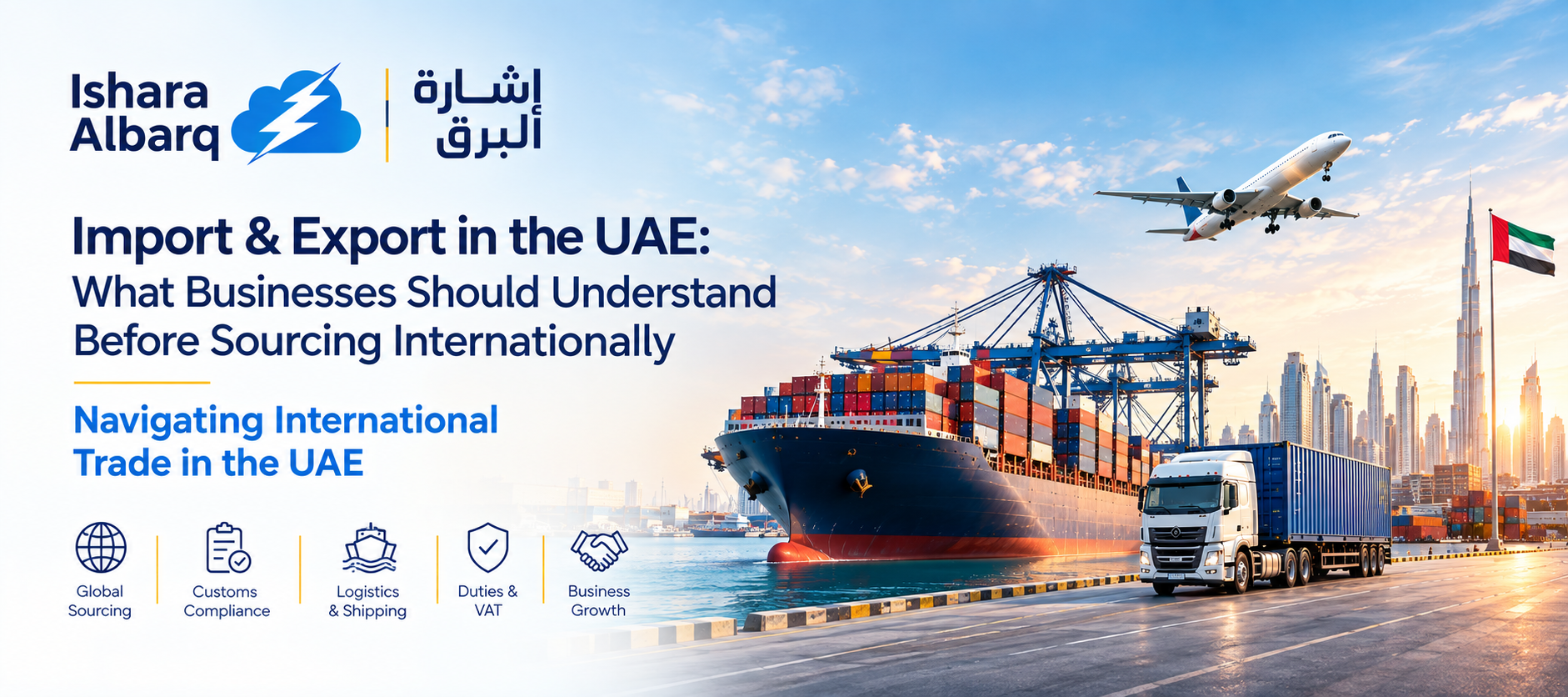
Understanding the UAE Import & Export Process
UAE Trading & Customs | Industry Education
International trade has become an essential part of the UAE business environment.
From telecommunications equipment and industrial machinery to electronics, construction materials, technology products, and consumer goods, businesses across the UAE source products from international markets every day.
But bringing a product into the UAE—or sending it from the UAE to another market—is more than arranging transportation.
Import and export involve licensing, customs registration, product classification, documentation, permits, taxes, logistics, and compliance.
For businesses sourcing internationally, understanding this process before placing an order can help reduce delays, unexpected costs, and compliance problems.
The UAE Government confirms that businesses can import and export through airports, seaports, and land routes, provided they comply with applicable laws and customs procedures. (U.AE)
What Is Import and Export?
At its simplest:
Import means bringing goods into the UAE from another country or, depending on the customs regime, moving goods between free zones and onshore locations while meeting applicable legal requirements.
Export involves sending goods from the UAE to another country or moving goods between relevant UAE customs regimes.
The UAE's official import and export procedures guide highlights an important starting point: businesses acting as importers need an appropriate UAE trade licence and registration with the relevant Customs department. (U.AE)
This means international sourcing should begin with understanding whether the business is properly set up to conduct the intended trade activity.
Why Businesses Need to Understand the Process
Imagine a UAE company finds a manufacturer overseas offering exactly the equipment it needs.
The company negotiates the price, places the order, and arranges shipping.
But then the shipment arrives and an issue appears:
-
The product classification is incorrect.
-
Required documentation is incomplete.
-
A permit is missing.
-
The importer is not properly registered.
-
The product falls under a restricted category.
-
The declared value does not match supporting documents.
-
Taxes or customs charges were not properly planned.
The result can be delays, additional costs, or complications during clearance.
This is why customs and compliance should be considered before the purchase order—not after the shipment arrives.
1. Start With the Correct Business Licence
Before importing or exporting commercially, businesses need to understand whether their existing business licence covers the intended activity.
The UAE Government explains that establishing a business involves selecting an appropriate business activity and obtaining the relevant trade licence. (U.AE)
For international sourcing, this is particularly important.
A company should make sure that its licensed activities align with what it intends to buy, sell, distribute, or trade.
The exact licensing requirements can vary according to the business activity and emirate.
2. Customs Registration Is an Important Step
Having a trade licence is not necessarily the end of the process.
Businesses conducting customs transactions need to understand registration with the relevant Customs authority.
For example, Dubai Customs states that businesses using its customs services need to register, and its business registration service allows businesses to transact officially with Dubai Customs. (Dubai Customs)
The UAE operates customs authorities at the emirate level, including authorities serving Abu Dhabi, Dubai, Sharjah, Ajman, Umm Al Quwain, Ras Al Khaimah, and Fujairah. (U.AE)
Therefore, businesses should identify the relevant customs authority for their shipment and customs location.
3. Know Your Product Before You Import It
One of the most important steps in international trade is understanding exactly what is being imported.
This includes knowing:
-
Product description
-
Country of origin
-
Intended use
-
Quantity
-
Value
-
Technical specifications
-
Applicable standards
-
Whether the product is restricted
-
Whether special approvals are required
-
Correct customs classification
This information influences customs procedures and may affect duties, permits, and other requirements.
For technical products, a vague description can create unnecessary problems.
For example, simply describing something as "network equipment" may not provide enough information for accurate classification.
A detailed and accurate product description is much more useful.
4. HS Codes: Why Product Classification Matters
Internationally traded goods are generally classified using Harmonized System (HS) codes.
The classification of a product can affect:
-
Customs treatment
-
Applicable duty
-
Restrictions
-
Required permits
-
Trade statistics
-
Documentation
Dubai Customs currently provides Al Munasiq, an HS-code classification and search platform designed to help identify commodity classifications and provide information such as applicable duty rates and prohibition or restriction status. (Dubai Customs)
The key lesson is simple:
Do not guess the classification of a product simply because its name sounds familiar.
For complex products, businesses should obtain appropriate classification guidance before shipment.
5. Prepare the Right Documents
Documentation is one of the foundations of successful customs clearance.
For Dubai Customs' customs declaration service, listed documents include:
-
Invoice
-
Packing list
-
Certificate of Origin
-
Permit from relevant restricted authorities, where applicable (Dubai Customs)
The exact documentation required can vary depending on the shipment, product, customs regime, and applicable regulations.
The UAE's official import/export guide also identifies documents such as the bill of lading, commercial invoice, packing list, and certificate of origin for relevant sea-import processes. (U.AE)
Good documentation should tell a consistent story:
What is being shipped?
Who is shipping it?
Who is receiving it?
What is its value?
Where did it originate?
How much is being shipped?
What permits or approvals apply?
6. Commercial Invoice: More Than a Piece of Paper
The commercial invoice is an important document in international trade.
It provides information about the transaction and goods being shipped.
Depending on the transaction, it can contain details such as:
-
Seller
-
Buyer
-
Product description
-
Quantity
-
Unit price
-
Total value
-
Currency
-
Country of origin
-
Delivery terms
The information should be accurate and consistent with the actual shipment.
Incorrect declarations can create questions during customs processing and may lead to additional review.
7. Packing List and Certificate of Origin
A packing list provides information about how the goods are physically packaged.
It can help identify:
-
Number of packages
-
Package contents
-
Weight
-
Dimensions
-
Marks and numbers
A Certificate of Origin provides evidence of where the goods originate.
These documents can be particularly important when shipments contain multiple products, packages, or product categories.
Clear documentation helps customs authorities and logistics providers understand the shipment more efficiently.
8. Restricted and Regulated Goods
Not every product can be imported or exported under the same conditions.
Some goods may require approvals from specific authorities.
Dubai Customs explicitly notes that certain goods require special approval from restricted authorities before they can be released. (Dubai Customs)
Depending on the product, businesses may need to investigate requirements relating to areas such as:
-
Telecommunications
-
Food
-
Healthcare
-
Chemicals
-
Agriculture
-
Electrical products
-
Controlled technologies
-
Environmental requirements
The exact authority and approval depend on the product and applicable UAE regulations.
This is why product compliance should be checked before ordering.
9. Understand Customs Duty
Customs duty is an important part of the import cost.
Dubai Customs' current FAQ states that the general customs duty rate in Dubai is 5% of CIF value, subject to exceptions and applicable rules. (Dubai Customs)
CIF refers to:
Cost + Insurance + Freight
However, businesses should not automatically apply one rate to every product.
Duty treatment can vary according to classification, origin, customs regime, trade arrangements, and specific exemptions or exceptions.
The correct duty should therefore be checked for the specific product and transaction.
10. Don't Forget VAT
Import costs can also involve VAT.
The Federal Tax Authority explains that VAT is a transaction-based indirect tax applied throughout the supply chain. (Federal Tax Authority)
For importers, the VAT treatment depends on the business's tax status and the circumstances of the import.
The FTA's VAT Importers User Guide explains the process for declaring imports and dealing with import VAT through the relevant systems. (Federal Tax Authority)
Businesses should therefore consider both:
Customs Duty + Applicable VAT
when calculating their expected import cost.
11. Calculate the Total Landed Cost
One of the most common procurement mistakes is looking only at the supplier's price.
Suppose a supplier quotes:
Product price = AED 100,000
That does not necessarily mean the product will cost the business AED 100,000 by the time it reaches its warehouse.
The business may also have:
-
Freight
-
Insurance
-
Customs duty
-
VAT
-
Customs-related charges
-
Inspection costs
-
Documentation costs
-
Port or handling charges
-
Local transportation
-
Warehousing
-
Other applicable expenses
Therefore, businesses should calculate the Total Landed Cost before making purchasing decisions.
A simple framework is:
Product Cost + Freight + Insurance + Duty + Taxes + Clearance + Local Delivery + Other Applicable Costs = Landed Cost
This gives decision-makers a more realistic picture of procurement economics.
12. Choosing the Right Incoterm
International suppliers often quote using Incoterms®.
These rules help define responsibilities between buyers and sellers for aspects such as transportation, delivery, costs, and risk.
For a UAE buyer, understanding the agreed Incoterm is important because it can influence:
-
Who arranges transportation
-
Who bears certain costs
-
When risk transfers
-
Insurance responsibilities
-
Delivery obligations
A quotation should therefore never be evaluated purely on the headline product price.
Businesses should understand what the quoted price actually includes.
13. Shipping and Freight Planning
Once the supplier and commercial terms are confirmed, transportation needs to be planned.
The appropriate method depends on:
-
Shipment size
-
Product type
-
Urgency
-
Cost
-
Destination
-
Handling requirements
-
Delivery schedule
Sea Freight
Often suitable for larger shipments where transit time can be planned.
Air Freight
Can be considered when speed is important or when the shipment is relatively small or time-sensitive.
Road Transport
Can be important for regional movement and final delivery.
The right choice balances:
Cost + Speed + Reliability + Product Requirements
14. Customs Declaration
The shipment eventually reaches the relevant customs point.
At this stage, a customs declaration needs to be submitted under the applicable customs regime.
Dubai Customs currently supports declarations for several regimes, including:
-
Import
-
Export
-
Transit
-
Transfer
-
Temporary Admission (Dubai Customs)
The correct declaration depends on the movement of the goods.
For businesses, understanding the intended customs regime in advance can make the process more predictable.
15. Free Zone vs. Mainland: Why It Matters
The UAE's free zones are an important part of the country's international trade environment.
However, businesses need to understand the difference between:
Free Zone → Free Zone
Free Zone → Mainland
Mainland → Free Zone
UAE → International Market
Different movements can involve different customs procedures.
Dubai Customs notes, for example, that when a free-zone company sells goods to the mainland, an appropriate customs declaration must be processed. (Dubai Customs)
Therefore, the location of the buyer, seller, warehouse, and final destination can influence the customs process.
16. Exporting From the UAE
Importing is only one side of international trade.
The UAE also functions as an important base for businesses that distribute products into international markets.
Export procedures require businesses to provide the appropriate declaration and documentation.
For relevant Dubai export processes, Dubai Customs identifies documents such as:
-
Export invoice
-
Packing list
-
Export permit where required for restricted goods (Dubai Customs)
The specific requirements depend on the type of export and destination.
17. Re-Export Is Different From a Simple Export
Some businesses import goods into the UAE and later send them to another country.
This can be an important business model for trading and distribution companies.
However, re-export can involve a different customs treatment from exporting goods that were produced locally.
Businesses using Dubai or another UAE emirate as a regional distribution hub should understand the applicable customs regime before moving goods.
This is particularly relevant for companies sourcing from countries such as China and Turkey and then distributing products across Middle Eastern or international markets.
18. Working With Customs Brokers and Logistics Providers
Businesses do not always manage every customs process themselves.
They may work with:
-
Customs brokers
-
Freight forwarders
-
Logistics providers
-
Shipping agents
-
Warehousing companies
A customs broker or clearing agent can help with documentation and customs procedures, but the importer should still understand its own responsibilities.
Dubai Customs states that companies with a Customs business code can submit declarations, while appropriately licensed and authorized clearing agents can also clear cargo on behalf of consignees. (Dubai Customs)
A good logistics partner should therefore be viewed as part of the supply-chain strategy—not simply as a company that moves boxes.
19. Keep Product and Customs Data Consistent
One of the simplest ways to reduce avoidable problems is to maintain consistency across documents.
The following should align:
Purchase Order → Commercial Invoice → Packing List → Shipping Documents → Customs Declaration
Pay particular attention to:
-
Product description
-
Quantity
-
Value
-
Country of origin
-
HS classification
-
Consignee details
-
Shipment information
Inconsistencies can lead to additional questions and delays.
20. Think About Compliance Before Procurement
A common mistake is to treat compliance as a final step.
A better approach is:
Compliance Check → Supplier Selection → Purchase → Quality Control → Shipping → Customs
This allows businesses to identify potential issues before money is committed or goods are shipped.
For regulated or specialized products, early compliance checks can be particularly important.
Import & Export for Telecommunications Equipment
For Ishara Al Barq's sector, international trade can be particularly relevant to telecommunications and technology equipment.
A procurement shipment could contain:
-
Optical networking equipment
-
Fiber-optic products
-
Routers
-
Network switches
-
Transmission equipment
-
Cabinets
-
Connectivity components
-
Testing equipment
-
Power systems
-
Passive infrastructure products
For these products, businesses need to consider more than customs requirements.
They also need to evaluate:
Technical compatibility + Quality + Standards + Certifications + Product reliability + Supplier capability
A product that clears customs successfully but does not meet the project's technical requirements is still a procurement failure.
This is why technical expertise and international procurement knowledge should work together.
Common Mistakes UAE Businesses Should Avoid
1. Choosing a Supplier Only on Price
The lowest quotation may not produce the lowest landed cost.
2. Ignoring Product Classification
Incorrect HS classification can affect customs treatment.
3. Checking Regulations Too Late
Discovering a required permit after shipment can cause avoidable delays.
4. Underestimating Logistics Costs
Freight and local delivery can significantly change the final cost.
5. Inconsistent Documentation
Differences between invoices, packing lists, and declarations can create complications.
6. Assuming Every Product Has the Same Duty
Duty treatment depends on the specific product and applicable rules.
7. Treating Customs as Only a Logistics Issue
Customs compliance is also a commercial and risk-management issue.
A Practical UAE Import Checklist
Before placing an international order, businesses can ask:
Business Setup
-
Is the business licence appropriate?
-
Is the business registered with the relevant Customs authority?
Product
-
What exactly is being purchased?
-
What is the correct HS classification?
-
Is the product restricted or regulated?
-
Are additional approvals required?
Supplier
-
Has the supplier been verified?
-
Are the specifications clearly documented?
-
Are quality requirements agreed?
Commercial
-
What is the Incoterm?
-
What are the payment terms?
-
What is the total landed cost?
Logistics
-
Which shipping method is appropriate?
-
Who is responsible for freight?
-
What is the expected delivery timeline?
Documentation
-
Commercial invoice?
-
Packing list?
-
Certificate of origin?
-
Bill of lading or other transport document?
-
Required permits or certificates?
UAE Arrival
-
Which Customs authority will handle the shipment?
-
Is the declaration ready?
-
Are applicable duties and taxes understood?
-
Is the final delivery location prepared?
This checklist can help businesses identify gaps before the shipment leaves the supplier.
Building a More Reliable Import & Export Strategy
International trade should not be treated as a one-time transaction.
Businesses that source internationally can benefit from developing structured processes around:
-
Supplier management
-
Customs compliance
-
Product classification
-
Documentation
-
Quality control
-
Logistics
-
Landed-cost analysis
-
Inventory planning
-
Risk management
Over time, this can turn procurement into a strategic capability.
The goal is not merely to move goods across borders.
It is to create a supply chain that is predictable, compliant, cost-effective, and resilient.
The Future of UAE International Trade
The UAE's position as a global business and logistics hub creates significant opportunities for companies engaged in international sourcing and distribution.
As businesses become more connected to global suppliers, the importance of:
-
Digital customs processes
-
Supplier transparency
-
Data-driven procurement
-
Supply-chain visibility
-
Compliance management
-
Alternative sourcing
-
Regional distribution
is likely to continue increasing.
Dubai Customs is already expanding digital capabilities, including its Al Munasiq platform for HS classification and customs-related information. (Dubai Customs)
For businesses, the direction is clear:
International trade is becoming more connected—but successful sourcing still depends on getting the fundamentals right.
Final Thoughts
Importing and exporting in the UAE can create enormous opportunities for businesses looking to access global suppliers and international markets.
But successful international trade requires more than finding a supplier and arranging shipping.
It requires understanding:
Licensing → Customs Registration → Product Classification → Supplier Documentation → Compliance → Shipping → Customs Declaration → Duties & Taxes → Final Delivery
When these elements are planned together, businesses can reduce uncertainty and make international procurement more efficient.
For companies sourcing technology, telecommunications equipment, industrial products, or other specialized goods, the combination of supplier network expertise, technical understanding, and knowledge of international trade processes can be especially valuable.
At Ishara Al Barq, international sourcing is about more than connecting buyers with suppliers.
It is about understanding the journey from global manufacturer to UAE business—and making that journey more structured, transparent, and reliable.
Global sourcing. UAE connectivity. Smarter trade.
Ishara Al Barq
Connecting businesses to international supply opportunities.
Key Takeaways
-
UAE businesses need the appropriate business licensing and customs registration for commercial import and export activities. (U.AE)
-
The relevant Customs authority depends on where and how goods enter, leave, or move within the UAE. (U.AE)
-
Correct product classification and HS codes are important for customs treatment.
-
Some products require approvals from specific regulatory authorities. (Dubai Customs)
-
Commercial invoices, packing lists, certificates of origin, and relevant permits are important parts of customs documentation. (Dubai Customs)
-
Customs duty should be checked according to the specific product and applicable rules; Dubai Customs states a general 5% CIF rate subject to exceptions. (Dubai Customs)
-
Import VAT should be considered alongside customs costs. (Federal Tax Authority)
-
Free-zone and mainland movements can have different customs procedures.
-
Re-export can involve different customs treatment from ordinary export.
-
Total landed cost provides a better basis for procurement decisions than supplier price alone.
-
Compliance should be checked before the shipment leaves the supplier.
-
For technical products, customs compliance and technical suitability should both be evaluated.