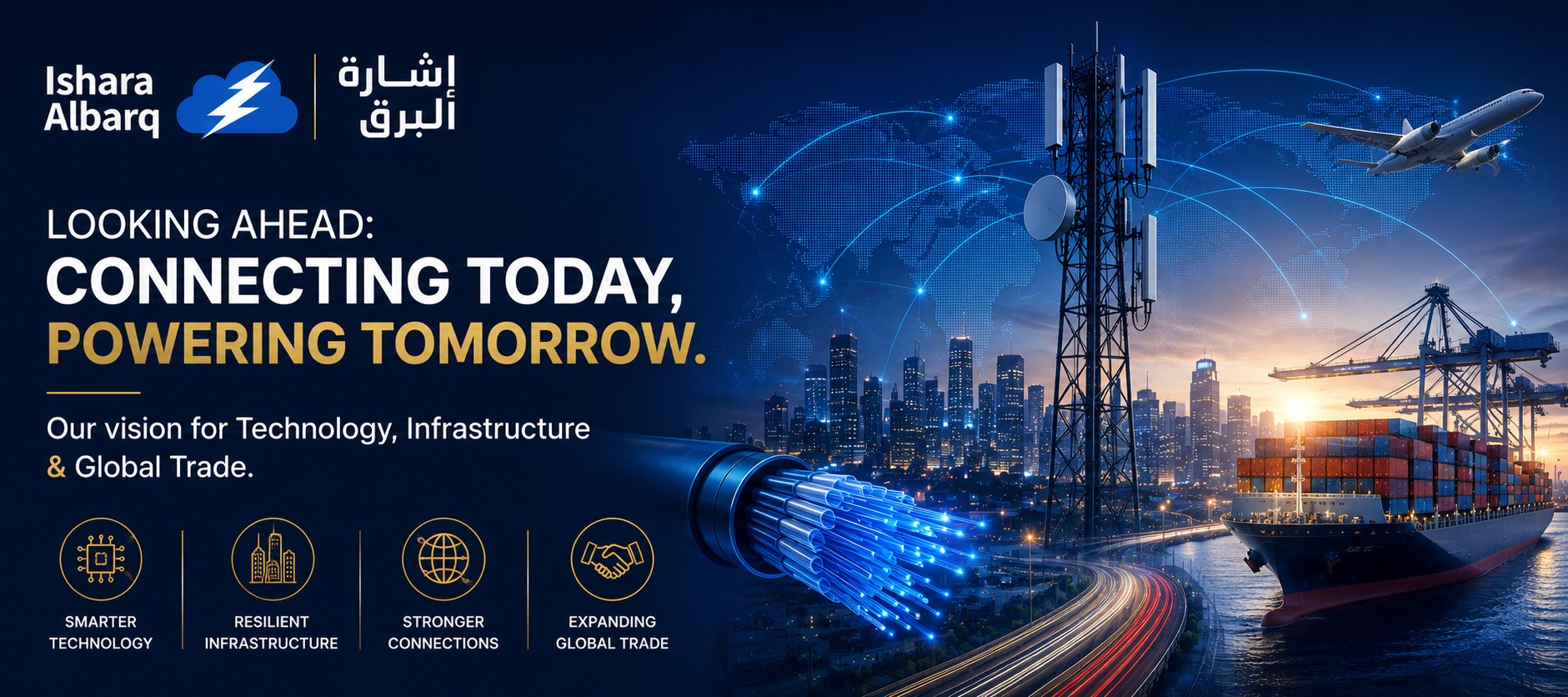
Looking Ahead: Ishara Al Barq — Building Connections for What Comes Next.
Future + Brand Positioning | Industry Insight
The world is entering an era where technology, infrastructure, and global trade are becoming more closely connected than ever before.
Businesses no longer compete only on products or prices. They compete on speed, connectivity, resilience, access to markets, and their ability to adapt to technological change.
At Ishara Al Barq, we see this transformation as an opportunity to think beyond today’s infrastructure and look toward what the next decade of global connectivity and commerce could require.
Our vision is built around a simple idea:
Build stronger connections today to create better opportunities tomorrow.
A Future Built on Connectivity
Technology has fundamentally changed how businesses operate.
Cloud platforms, artificial intelligence, 5G, automation, digital payments, IoT, and real-time data are creating new ways for organizations to communicate, trade, manufacture, and serve customers.
But technology cannot operate in isolation.
Behind every digital service is infrastructure.
Networks need reliable connectivity. Data centers need power and cooling. Businesses need secure communication channels. Supply chains need efficient logistics. International trade needs physical and digital infrastructure working together.
The future will therefore belong to ecosystems where technology and infrastructure work together seamlessly.
Infrastructure Is Becoming a Strategic Advantage
Infrastructure was once viewed primarily as a supporting function.
Today, it is increasingly becoming a strategic business asset.
Reliable infrastructure can help organizations improve operational efficiency, reduce disruption, expand into new markets, and respond faster to changing customer expectations.
This includes infrastructure such as:
-
Fiber-optic networks
-
Telecommunications systems
-
Data centers
-
Cloud connectivity
-
Smart infrastructure
-
Transportation and logistics networks
-
Energy systems
-
Digital platforms
-
Cross-border communication networks
As global demand for digital services continues to grow, organizations will need infrastructure that is not only fast, but also resilient, scalable, secure, and adaptable.
Technology Will Reshape Global Trade
Global trade is also undergoing a major transformation.
Traditional trade depends on physical movement of goods, but modern commerce increasingly depends on digital systems operating alongside physical supply chains.
Businesses now use technology for:
Market intelligence → Procurement → Inventory management → Logistics → Payments → Customer communication → Analytics
Artificial intelligence and automation can help organizations analyze information faster and improve decision-making. Digital platforms can make cross-border transactions more efficient. Connected logistics systems can provide greater visibility across supply chains.
This does not mean physical trade is becoming less important.
Instead, digital technology is making physical trade smarter.
The companies that successfully combine technology with infrastructure and trade capabilities will be better positioned to operate in an increasingly interconnected global economy.
Resilience Will Define the Next Generation
The last few years have demonstrated how quickly disruptions can affect international business.
Supply chain interruptions, infrastructure failures, geopolitical developments, energy challenges, extreme weather events, and rapidly changing technology can all create operational risks.
As a result, resilience is becoming an essential part of long-term infrastructure planning.
Future-ready organizations will increasingly ask:
-
How quickly can we recover from disruption?
-
Are our infrastructure routes sufficiently diversified?
-
Can our systems scale as demand changes?
-
How dependent are we on a single supplier or pathway?
-
Can technology help us identify risks earlier?
-
Are our operations prepared for the next generation of digital services?
These questions are moving resilience from an operational concern to a strategic priority.
The Rise of Intelligent Infrastructure
The infrastructure of tomorrow will not simply be larger.
It will be smarter.
Sensors, automation, analytics, artificial intelligence, edge computing, and connected systems can provide greater visibility into infrastructure performance.
Instead of responding only after a problem occurs, intelligent infrastructure can help organizations identify potential issues earlier and make more informed decisions.
This shift from reactive infrastructure management to predictive and data-driven management could significantly influence how networks, facilities, logistics systems, and critical assets are operated.
Sustainability Must Be Part of the Future
Technology and infrastructure growth also comes with an important responsibility: sustainability.
Data centers, telecommunications networks, transportation systems, and industrial infrastructure require significant resources.
Future infrastructure development will therefore need to consider:
-
Energy efficiency
-
Renewable energy integration
-
Responsible resource use
-
Equipment lifecycle management
-
Infrastructure optimization
-
Reduced operational waste
-
Long-term environmental impact
Sustainability is increasingly becoming part of responsible infrastructure strategy rather than a separate initiative.
The objective is not simply to build more infrastructure, but to build efficient infrastructure that can support long-term growth.
From Local Infrastructure to Global Opportunity
One of the most important opportunities ahead lies in connecting infrastructure development with global trade.
Strong infrastructure can make it easier for businesses to reach customers, suppliers, partners, and markets across borders.
For regions positioned at important commercial and logistical crossroads, investments in telecommunications, digital connectivity, transportation, energy, and technology can contribute to broader economic opportunities.
This creates an important connection:
Better infrastructure → Better connectivity → Greater business access → Stronger trade opportunities
Ishara Al Barq’s future-oriented perspective is rooted in this broader ecosystem.
Our Vision: Connecting What Comes Next
The future will not be shaped by one technology or one industry.
It will be shaped by how different systems connect.
Technology connects people.
Infrastructure connects markets.
Trade connects economies.
Innovation connects today's possibilities with tomorrow's opportunities.
At Ishara Al Barq, the vision is to contribute to this connected future by focusing on the relationship between technology, infrastructure, connectivity, and global commerce.
The opportunity is not simply to follow technological change.
It is to understand where the world is heading and prepare the infrastructure required to support it.
Looking Ahead
The next generation of global business will demand more than connectivity.
It will demand reliability, intelligence, resilience, scalability, and responsible innovation.
As technology continues to evolve, infrastructure will remain the foundation that turns digital possibilities into real-world capabilities.
And as global trade becomes increasingly connected to digital technology, the organizations that understand this relationship will be better positioned to create lasting value.
The future is connected.
The opportunity is global.
The infrastructure starts today.
Ishara Al Barq — Building Connections for What Comes Next.
#IsharaAlBarq #Technology #Infrastructure #GlobalTrade #DigitalInfrastructure #Connectivity #Telecommunications #SmartInfrastructure #DigitalTransformation #Innovation #FutureOfTechnology #GlobalConnectivity #InfrastructureDevelopment #BusinessInnovation #FutureReady #TechnologyTrends #TradeAndTechnology #IndustryInsights #SustainableInfrastructure #BuildingTheFuture #lowkot