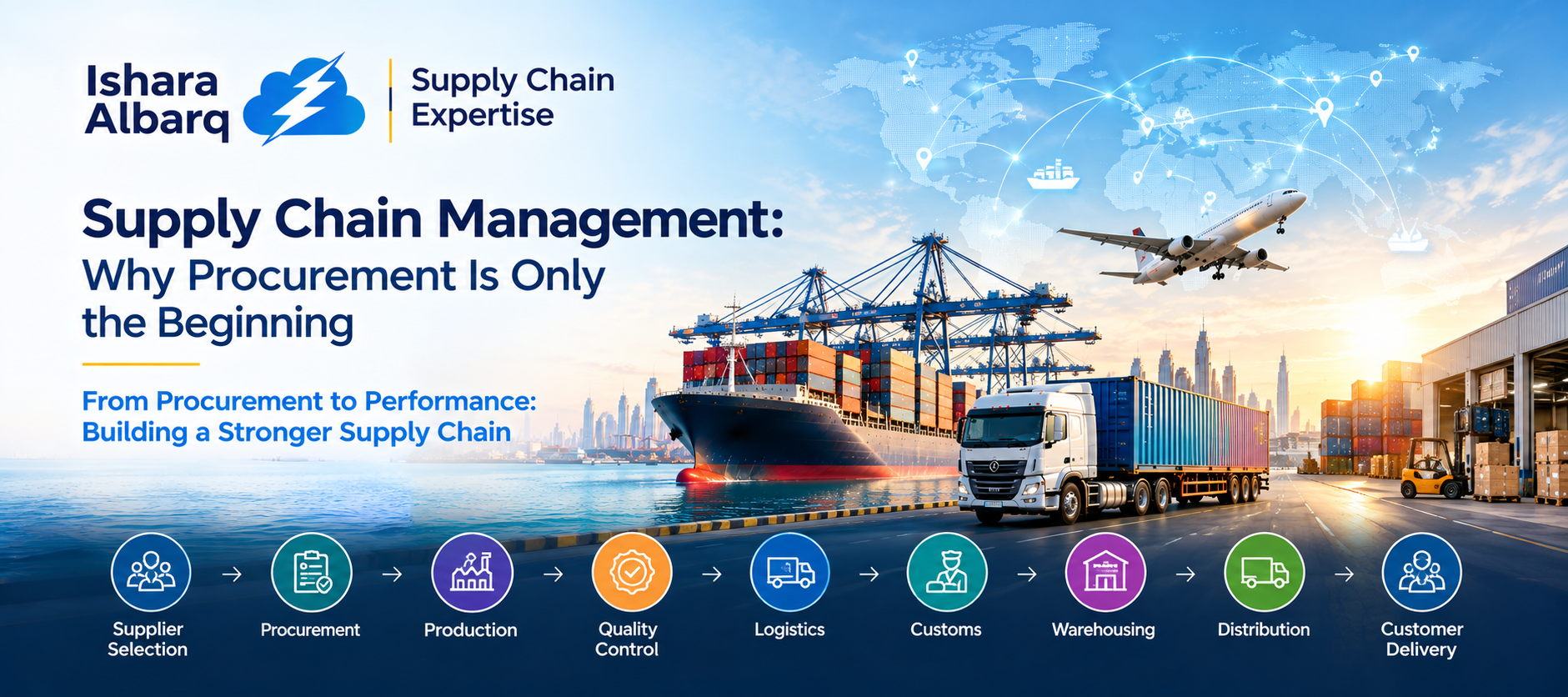
Beyond Buying: Managing the Complete Supply Chain
Supply-Chain Expertise | Industry Education
When businesses think about procurement, the first question is often simple:
“Where can we buy the product at the right price?”
But successful supply chain management goes much further than purchasing.
Finding a supplier is only the beginning. After an order is placed, the business still needs to manage production, quality, inventory, transportation, customs, warehousing, delivery, supplier relationships, and ultimately the customer's requirements.
This is why procurement and supply chain management should not be treated as the same thing.
Procurement gets the product into the supply chain. Supply chain management makes sure that product continues moving efficiently until it creates value.
For businesses operating in telecommunications, technology, infrastructure, industrial equipment, and international trade, understanding this difference can have a significant impact on cost, reliability, and long-term growth.
What Is Supply Chain Management?
Supply chain management is the coordination of activities involved in moving products, materials, information, and resources from their original source to their final destination.
A simplified supply chain can look like:
Supplier → Procurement → Production → Quality Control → Logistics → Customs → Warehouse → Distribution → Customer
Every stage is connected.
A delay at one point can affect everything that follows.
For example, if an international supplier delays production by two weeks, the impact may extend to:
-
Shipping schedules
-
Warehouse planning
-
Project timelines
-
Customer commitments
-
Installation schedules
-
Revenue
-
Cash flow
This is why supply chain management requires a broader perspective than purchasing alone.
Procurement vs. Supply Chain Management
The two functions are closely connected, but they have different responsibilities.
Procurement
Procurement primarily focuses on obtaining the required products, materials, equipment, or services.
It may involve:
-
Supplier identification
-
Supplier evaluation
-
Negotiation
-
Purchasing
-
Contracts
-
Purchase orders
-
Pricing
-
Payment terms
Supply Chain Management
Supply chain management looks at the entire flow.
It can involve:
-
Demand planning
-
Procurement
-
Supplier management
-
Production
-
Inventory
-
Warehousing
-
Transportation
-
Customs
-
Distribution
-
Risk management
-
Customer delivery
In simple terms:
Procurement asks, “How do we source it?”
Supply chain management asks, “How do we make the entire journey work efficiently?”
Procurement Is Only the First Link
Imagine a UAE company needs telecommunications equipment for a major infrastructure project.
The procurement team identifies an international supplier, negotiates a competitive price, and places the order.
At first, the procurement process appears successful.
But then several questions arise:
-
When will production be completed?
-
Has the product passed quality checks?
-
When will it be shipped?
-
What documents are required?
-
When will it arrive in the UAE?
-
Will customs clearance be completed on time?
-
Where will the equipment be stored?
-
When does the project site need it?
-
Who will transport it to the site?
-
What happens if the shipment is delayed?
The purchase order answers only part of these questions.
Supply chain management connects the remaining pieces.
1. Demand Planning Comes Before Procurement
Good supply chain management often begins before the purchase order.
Businesses need to understand future demand.
This could involve forecasting:
-
Customer requirements
-
Project demand
-
Seasonal demand
-
Inventory requirements
-
Replacement requirements
-
Expansion plans
Without proper planning, businesses can experience two opposite problems:
Overstocking
Too much inventory can tie up capital and increase storage costs.
Stockouts
Too little inventory can result in missed sales, project delays, and dissatisfied customers.
The goal is to find the right balance.
The best supply chain does not simply move more products. It moves the right products when they are needed.
2. Supplier Selection Is About More Than Price
Supplier selection is one of the most important procurement decisions.
However, price should not be the only consideration.
Businesses should also evaluate:
-
Product quality
-
Manufacturing capacity
-
Lead time
-
Reliability
-
Technical capability
-
Certifications
-
Communication
-
Warranty
-
After-sales support
-
Financial stability
-
Export experience
A supplier offering a very low price but consistently missing delivery schedules may ultimately cost the business more.
This is why supplier evaluation should focus on total value and reliability.
3. Supplier Relationship Management
Once a supplier is selected, the relationship should not end with the purchase order.
Strong businesses monitor supplier performance over time.
Useful performance indicators can include:
-
On-time delivery
-
Defect rate
-
Response time
-
Order accuracy
-
Lead-time consistency
-
Warranty performance
-
Documentation accuracy
This creates a supplier-performance history.
Over time, businesses can identify which suppliers are consistently reliable and which require closer management.
A supplier network becomes more valuable when it is measured, managed, and continuously improved.
4. Production Visibility Matters
For internationally sourced products, businesses often need visibility into the production process.
Knowing that an order has been accepted is not enough.
The buyer may need to know:
Order Confirmed → Production Started → Production Completed → Quality Checked → Packed → Ready for Shipment
This information allows supply chain teams to plan transportation, warehouse capacity, and project delivery more effectively.
Without visibility, businesses may discover delays only when the expected delivery date is already approaching.
5. Quality Management Protects the Supply Chain
Quality problems can travel through the supply chain just as quickly as good products.
If defective products leave the factory, the business may face:
-
Return costs
-
Replacement costs
-
Shipping expenses
-
Project delays
-
Customer complaints
-
Reputation damage
Quality control should therefore be built into the supply chain.
Depending on the product, this can involve:
-
Sample approval
-
Factory inspections
-
Product testing
-
Pre-shipment inspection
-
Specification verification
-
Packaging checks
For technical products, quality management is especially important.
A product can be delivered on time and still fail if it does not meet the required technical specifications.
6. Inventory Is a Strategic Decision
Inventory is not simply a collection of products sitting in a warehouse.
It represents money invested in future demand.
Businesses need to determine:
-
How much inventory to maintain
-
When to reorder
-
Which products require safety stock
-
Which products move quickly
-
Which products have long lead times
-
Which products are critical to operations
For example, a telecommunications company may need to keep certain critical components available because waiting several weeks for international replenishment could affect a project.
This is where inventory planning and procurement strategy need to work together.
7. Logistics Connects Suppliers to Markets
Once goods are ready, they need to move.
International logistics can involve:
Factory → Port/Airport → International Transport → UAE → Customs → Warehouse → Project Site
Businesses need to consider:
-
Shipping method
-
Transit time
-
Freight costs
-
Packaging
-
Insurance
-
Handling
-
Delivery schedules
-
Local transportation
The cheapest transportation option is not always the most efficient.
A low-cost shipment that arrives too late can create greater business costs than a faster option.
8. Customs Is Part of Supply Chain Planning
For international businesses, customs should not be treated as a separate activity that happens after shipping.
Product classification, documentation, permits, and applicable duties or taxes can influence the overall supply chain.
Businesses should consider these requirements before goods leave the supplier.
This is particularly important for specialized or regulated products.
A shipment can be physically ready but unable to move forward efficiently if the required documentation or approvals have not been properly planned.
9. Warehousing Creates the Bridge to Delivery
After goods arrive in the UAE, they may move into a warehouse or distribution facility.
Warehousing provides more than storage.
It can support:
-
Inventory control
-
Order preparation
-
Product inspection
-
Packaging
-
Consolidation
-
Distribution
-
Project scheduling
For businesses handling multiple international suppliers, a well-organized warehouse can become an important control point.
It provides visibility into what has arrived, what is available, and what still needs to be delivered.
10. The Final Mile Is Where Supply Chain Performance Becomes Visible
A product can successfully pass through every previous stage and still fail to create value if it does not reach the customer or project site on time.
This is why the final mile matters.
For project-based businesses, final delivery may need to coordinate with:
-
Site readiness
-
Installation schedules
-
Access permissions
-
Project milestones
-
Equipment availability
-
Local transportation
The ultimate question is not:
“Did we purchase the product?”
It is:
“Did the product arrive where it was needed, when it was needed, and in the condition required?”
11. Technology Is Transforming Supply Chain Management
Modern supply chains increasingly depend on digital tools.
Businesses can use technology to improve visibility across:
-
Procurement
-
Purchase orders
-
Supplier performance
-
Inventory
-
Shipments
-
Warehouses
-
Deliveries
Real-time or near-real-time information can help businesses identify potential issues earlier.
For example, if a supplier reports a production delay, the business may be able to adjust transportation plans or inform the project team before the delay affects the final delivery.
Better information leads to better decisions.
12. Data Helps Businesses Improve Procurement
Supply chain data can reveal patterns that are difficult to see from individual transactions.
Businesses can analyze:
-
Supplier lead times
-
Purchase prices
-
Freight costs
-
Inventory turnover
-
Delivery performance
-
Product defects
-
Order frequency
-
Stockout frequency
This allows procurement teams to move from:
“We think this supplier performs well.”
to:
“Our data shows this supplier consistently delivers on time and meets quality requirements.”
That difference can improve decision-making significantly.
13. Total Cost Matters More Than Purchase Price
One of the biggest misconceptions in procurement is that the supplier offering the lowest price is automatically the best option.
Consider two suppliers.
Supplier A
Lower product price but:
-
Longer lead time
-
Higher defect rate
-
Expensive freight
-
Limited support
Supplier B
Slightly higher product price but:
-
Better quality
-
Faster delivery
-
Lower defect rate
-
Stronger technical support
-
More predictable logistics
Supplier B could potentially provide better overall value.
This is why businesses should consider Total Cost of Ownership and Total Landed Cost, rather than looking only at the purchase price.
14. Supply Chain Risk Management
Every supply chain faces risks.
These may include:
-
Supplier failure
-
Production delays
-
Transportation disruptions
-
Port congestion
-
Customs issues
-
Currency fluctuations
-
Quality failures
-
Demand changes
-
Geopolitical developments
-
Single-source dependency
The objective is not to eliminate every possible risk.
Instead, businesses should identify their most important vulnerabilities and create practical contingency plans.
15. Supplier Diversification Builds Resilience
Relying completely on one supplier can create significant exposure.
If that supplier experiences a major production problem, the buyer may have few immediate alternatives.
Supplier diversification can provide additional flexibility.
Depending on the product, a business might develop:
Primary Supplier + Secondary Supplier + Alternative Sourcing Market
For example, UAE businesses may evaluate suitable suppliers across different international manufacturing markets, including China, Turkey, India, Europe, and other regions.
However, diversification should be strategic.
Maintaining multiple suppliers for every product may increase complexity and reduce purchasing efficiency.
The goal is to identify where alternative supply really matters.
16. Cash Flow Is Part of Supply Chain Management
Supply chains also have a financial dimension.
Businesses need to manage the relationship between:
Supplier Payments → Inventory → Sales → Customer Payments
If a company purchases large quantities long before customers need the products, capital may remain tied up in inventory.
On the other hand, insufficient inventory can lead to lost business opportunities.
Effective supply chain management therefore considers both product flow and cash flow.
17. Sustainability Is Becoming More Important
Businesses are increasingly evaluating the environmental impact of their supply chains.
Areas of consideration can include:
-
Transportation efficiency
-
Packaging
-
Supplier practices
-
Waste reduction
-
Energy consumption
-
Product lifecycle
-
Consolidated shipments
Sustainability does not necessarily mean choosing the most expensive option.
In many cases, reducing waste, improving transportation efficiency, and optimizing inventory can provide both operational and environmental benefits.
Supply Chain Management in Telecommunications
For telecommunications businesses, supply chain management can be especially complex.
Projects may depend on products such as:
-
Fiber-optic equipment
-
Optical networking systems
-
Routers
-
Network switches
-
Transmission equipment
-
Cabinets
-
Connectivity components
-
Power systems
-
Testing equipment
-
Passive infrastructure
A delay in one critical component can affect an entire project schedule.
This makes supply chain coordination particularly important.
Procurement teams need to work closely with:
Engineering + Suppliers + Logistics + Warehousing + Project Management + Customers
The objective is to make sure technical requirements and delivery requirements remain aligned.
A Simple Supply Chain Example
Consider a UAE infrastructure project that requires specialized network equipment.
The journey could look like:
1. Project Requirement
The technical team defines the equipment specifications.
2. Supplier Search
Procurement identifies qualified international manufacturers.
3. Supplier Evaluation
The company compares quality, price, lead time, and technical capability.
4. Purchase Order
Commercial terms are finalized and the order is placed.
5. Production
The supplier manufactures the equipment.
6. Quality Control
Products are tested and inspected.
7. International Shipping
The shipment moves toward the UAE.
8. Customs
The goods go through applicable import procedures.
9. Warehouse
The equipment is received and checked.
10. Site Delivery
The equipment reaches the project site according to the installation schedule.
11. Installation
The equipment becomes part of the operational network.
Procurement is involved at the beginning.
Supply chain management connects every stage.
The Importance of Communication
A supply chain can have excellent suppliers and logistics providers and still experience problems if communication is poor.
Important information needs to move between:
-
Procurement
-
Suppliers
-
Freight providers
-
Customs representatives
-
Warehouses
-
Project teams
-
Customers
Everyone should understand:
What is being delivered?
When will it arrive?
Where will it go?
What could delay it?
Who is responsible for the next step?
Clear communication reduces uncertainty and improves coordination.
From Reactive to Proactive Supply Chain Management
A reactive supply chain waits for problems.
A proactive supply chain looks for problems before they happen.
Reactive approach:
“Why hasn't the shipment arrived?”
Proactive approach:
“The supplier's production schedule has slipped by five days. How does this affect transportation and the project delivery date?”
That difference can have a major impact on business performance.
Proactive supply chain management uses data, communication, forecasting, and contingency planning to stay ahead of disruptions.
Measuring Supply Chain Performance
Businesses cannot improve what they do not measure.
Useful supply chain KPIs can include:
| KPI | What It Measures |
|---|---|
| On-Time Delivery | Delivery reliability |
| Supplier Lead Time | Time from order to delivery |
| Inventory Turnover | How efficiently inventory is used |
| Order Accuracy | Correctness of delivered orders |
| Defect Rate | Product quality |
| Stockout Rate | Frequency of inventory shortages |
| Freight Cost | Transportation efficiency |
| Supplier Response Time | Communication efficiency |
The right KPIs depend on the business model and industry.
But measurement provides the foundation for continuous improvement.
What Does a Strong Supply Chain Look Like?
A strong supply chain is not necessarily the one with the most suppliers or the lowest purchasing cost.
It is one that can consistently provide:
Right Product + Right Quality + Right Quantity + Right Time + Right Location + Right Cost
It should also be capable of adapting when circumstances change.
That means resilience matters alongside efficiency.
The Future of Supply Chain Management
The future of supply chain management is likely to be increasingly connected, data-driven, and technology-enabled.
Businesses are investing greater attention in:
-
Digital procurement
-
Supply chain visibility
-
Predictive analytics
-
Supplier performance management
-
Automated inventory planning
-
Risk monitoring
-
Alternative sourcing
-
Sustainable logistics
Artificial intelligence and advanced analytics may also help organizations identify patterns, forecast demand, optimize inventory, and detect potential disruptions earlier.
But technology is only one part of the equation.
Strong supply chains still depend on:
People + Processes + Suppliers + Technology + Information
Final Thoughts
Procurement may start the purchasing process, but it does not complete the supply chain.
A supplier can provide the right product at the right price, yet the business can still face problems if:
-
Production is delayed.
-
Quality is inconsistent.
-
Shipping is poorly planned.
-
Customs documentation is incomplete.
-
Inventory is not available.
-
Delivery misses the project schedule.
This is why modern businesses need to look beyond purchasing.
Procurement secures supply. Supply chain management turns that supply into business value.
For UAE businesses working with international suppliers, particularly in telecommunications, technology, infrastructure, and industrial sectors, an integrated supply-chain approach can improve reliability, visibility, cost control, and resilience.
At Ishara Al Barq, supply-chain expertise is about understanding the complete journey—from supplier selection and procurement to logistics, delivery, and final application.
Because getting the product is only the beginning.
The real objective is getting the entire supply chain to work.
Ishara Al Barq
Connecting suppliers, technology, infrastructure, and business opportunities.
Key Takeaways
-
Procurement is only one part of the broader supply chain.
-
Supply chain management covers the complete flow from supplier to final customer or project site.
-
Supplier selection should consider quality, reliability, lead time, support, and total cost—not price alone.
-
Demand planning helps businesses avoid excess inventory and stockouts.
-
Quality control should be integrated into the supply chain.
-
Logistics, customs, warehousing, and final-mile delivery are critical stages.
-
Technology can improve supply-chain visibility and decision-making.
-
Supplier diversification can strengthen supply-chain resilience.
-
Data-driven KPIs help businesses measure and improve performance.
-
Cash flow and inventory are closely connected to supply-chain decisions.
-
Telecommunications and infrastructure projects require particularly strong supply-chain coordination.
-
The ultimate goal is the right product, at the right quality, quantity, location, time, and cost.