Industry Education | Telecommunications Infrastructure
When people think about telecommunications, they often think about smartphones, mobile apps, fiber internet, or 5G networks. These are the parts of the industry we interact with every day.
But behind every call, message, video conference, and data transfer is a much larger system that most people never see.
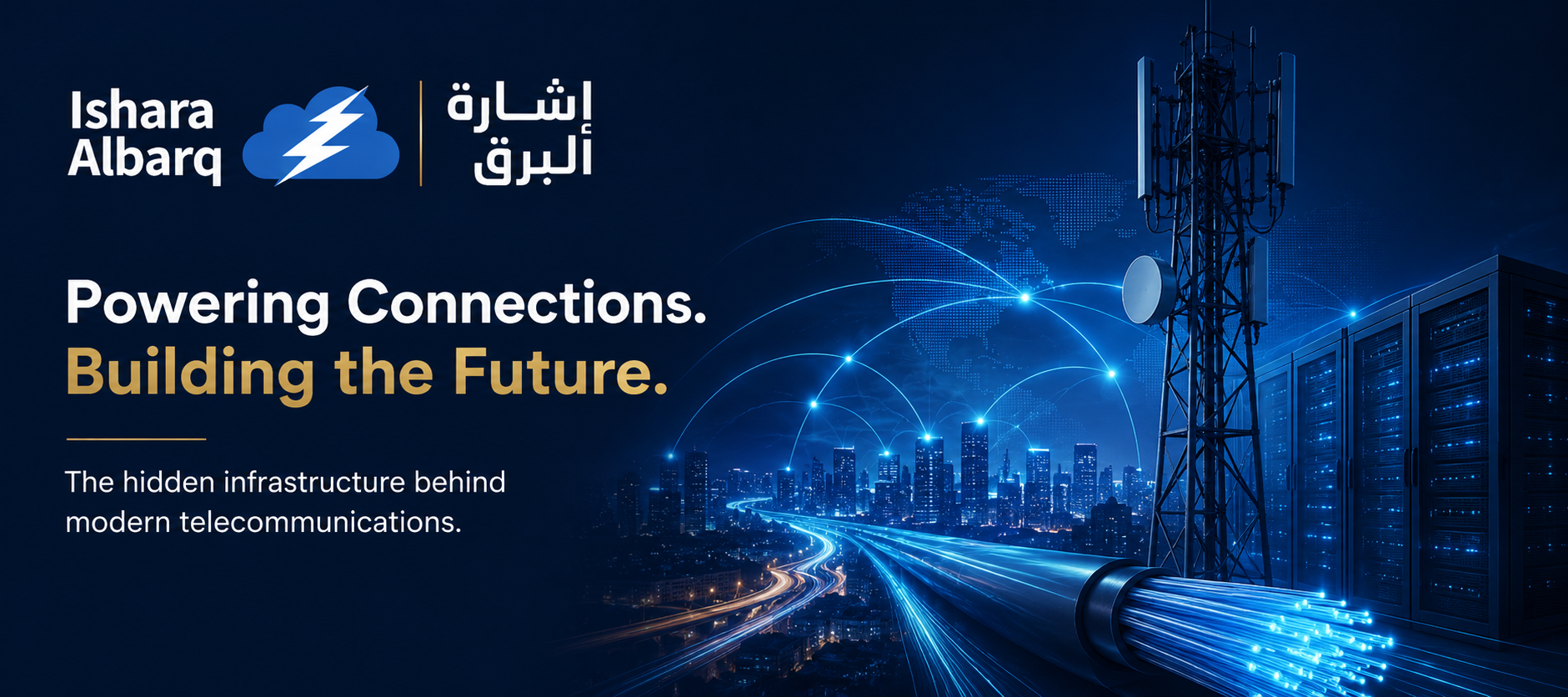
From fiber-optic cables buried beneath roads to data centers, network towers, power systems, routing equipment, and subsea cables crossing oceans, modern telecommunications depends on a complex layer of physical and digital infrastructure.
This hidden infrastructure is what allows information to move quickly, reliably, and securely around the world.
What Is Telecommunications Infrastructure?
Telecommunications infrastructure refers to the physical equipment, networks, facilities, and supporting systems that enable voice, video, and data communication.
It includes much more than cell towers.
A modern telecommunications network can involve:
-
Fiber-optic cables
-
Submarine communication cables
-
Cellular towers and radio equipment
-
Data centers
-
Network switches and routers
-
Core network infrastructure
-
Internet exchange points
-
Satellite communication systems
-
Power and backup systems
-
Cooling and environmental controls
-
Network monitoring and management platforms
These components work together as a connected ecosystem.
If one part becomes unavailable, the impact can sometimes extend far beyond a single location. This is why telecommunications infrastructure is increasingly viewed as critical infrastructure for modern economies.
Fiber Optics: The Backbone of Global Connectivity
One of the most important technologies behind modern telecommunications is fiber-optic communication.
Instead of transmitting information through electrical signals over copper, fiber-optic cables transmit data using pulses of light through extremely thin strands of glass or plastic.
This technology offers several major advantages, including high bandwidth, low signal loss, and the ability to carry enormous amounts of data over long distances.
Fiber networks support many of the services people depend on every day, including:
-
Broadband internet
-
Cloud computing
-
Video streaming
-
Mobile backhaul
-
Enterprise connectivity
-
Financial transactions
-
Government communications
-
International data transfers
The growth of cloud services, artificial intelligence, remote work, high-definition video, and connected devices is increasing the demand for high-capacity fiber networks.
Why Fiber Infrastructure Matters
A fast internet connection is only as reliable as the network supporting it.
That means investment in fiber infrastructure is not simply about increasing internet speeds. It is also about improving network capacity, reducing congestion, supporting future technologies, and creating greater resilience.
For telecommunications operators, fiber has become a strategic asset rather than simply a transmission medium.
The Critical Role of Submarine Cables
A surprising amount of international internet traffic travels through submarine communication cables laid across the world's oceans.
These cables connect continents and provide the high-capacity pathways required for global digital communication.
When someone in one country accesses a website, communicates with an international business, uses a cloud application hosted overseas, or transfers data between regions, the information may travel through one or more submarine cable systems.
These cables are engineered to operate under demanding underwater conditions and can span thousands of kilometers.
Their importance also highlights a fundamental reality of telecommunications:
The internet may feel wireless, but much of its global infrastructure is physical.
Submarine cables therefore play an important role in international connectivity, cloud infrastructure, financial networks, and digital commerce.
Mobile Networks Are More Than Cell Towers
The familiar mobile tower is only one visible part of a cellular network.
Behind each tower is a network of equipment and connections responsible for moving traffic from mobile devices into the wider telecommunications network.
A simplified mobile communication path might look like this:
Smartphone → Radio Network → Transport Network → Core Network → Internet or Service
The radio access network connects devices to nearby cellular sites. The transport network carries traffic between those sites and other network locations. The core network performs critical functions such as authentication, mobility management, traffic routing, and connection to external networks and services.
This means that improving mobile connectivity is not simply a matter of installing more towers.
Operators also need sufficient backhaul capacity, spectrum, power, fiber connectivity, processing capacity, and intelligent network management.
Data Centers: Where Digital Services Come Together
Modern telecommunications and cloud computing are increasingly interconnected.
Data centers provide the computing, storage, networking, and processing resources required to operate many of today's digital services.
Inside a data center, thousands of servers and networking devices can work together to support applications used by millions of people.
However, data centers require much more than computing hardware.
They also depend on:
-
Reliable electrical power
-
Backup generators and battery systems
-
Cooling infrastructure
-
Fire protection
-
Physical security
-
Network connectivity
-
Environmental monitoring
-
Redundant systems
A telecommunications network and a data center may be geographically separate, but they are closely connected.
The network provides the pathway for data to reach applications, while the data center provides the computing resources that process and store that data.
Power Is an Essential Part of Connectivity
One of the most overlooked elements of telecommunications infrastructure is power.
Network equipment cannot operate without a stable energy supply.
Telecommunications facilities therefore commonly use multiple layers of power protection and backup, depending on their importance and design.
These may include:
-
Utility power
-
Uninterruptible power supplies
-
Batteries
-
Backup generators
-
Power distribution systems
-
Energy monitoring
For network operators, power resilience can be just as important as network capacity.
A fiber cable may remain physically intact during a disruption, but if the equipment that operates the network loses power, connectivity can still be interrupted.
This is why infrastructure planning increasingly considers telecommunications, energy, and physical infrastructure as interconnected systems.
Network Resilience: Designing for Failure
No telecommunications network can assume that everything will work perfectly all the time.
Cables can be damaged. Equipment can fail. Construction projects can accidentally cut fiber. Power interruptions can occur. Extreme weather can affect infrastructure.
For this reason, network resilience is a central part of telecommunications engineering.
Resilient networks may use:
-
Diverse fiber routes
-
Redundant network equipment
-
Multiple data centers
-
Backup power
-
Alternative international connections
-
Automated traffic rerouting
-
Continuous network monitoring
The goal is not simply to prevent every failure.
The goal is to ensure that when a failure occurs, the network can continue operating or recover quickly.
Why Network Monitoring Matters
Modern telecommunications networks generate enormous amounts of operational data.
Network teams continuously monitor infrastructure to identify problems, unusual traffic patterns, equipment failures, capacity constraints, and other issues.
Network monitoring can provide visibility into:
-
Network availability
-
Bandwidth utilization
-
Latency
-
Packet loss
-
Equipment performance
-
Power conditions
-
Environmental conditions
-
Service interruptions
This information helps operators detect problems before they become major outages and supports faster troubleshooting when incidents occur.
As networks become more complex, automation and intelligent analytics are also becoming increasingly important.
The Infrastructure Challenge of 5G and Beyond
5G is often discussed in terms of faster mobile speeds and lower latency. But the technology also creates significant infrastructure requirements.
Supporting advanced mobile networks can require investment across multiple layers, including radio equipment, fiber backhaul, transport networks, core infrastructure, computing resources, and power systems.
The growth of applications such as industrial automation, connected vehicles, smart cities, augmented reality, and massive Internet of Things deployments can further increase infrastructure demands.
Future telecommunications networks will therefore need to be:
Faster. More distributed. More resilient. More automated.
This evolution is also driving greater interest in edge computing, where processing resources are placed closer to users and connected devices.
Physical Infrastructure Still Matters in a Digital World
The telecommunications industry is often described as digital, but its foundation remains remarkably physical.
Every digital service depends on physical assets somewhere in the network.
There are cables underground and under the sea. There are antennas on towers and rooftops. There are servers inside data centers. There are batteries and generators supporting critical facilities. There are technicians maintaining equipment and engineers designing routes.
The digital economy depends on this physical infrastructure operating continuously.
That is why telecommunications infrastructure deserves the same attention given to other essential infrastructure systems.
Building the Networks of Tomorrow
The next generation of telecommunications will not be defined by a single technology.
Instead, it will depend on the integration of multiple systems:
Fiber + Wireless + Cloud + Data Centers + Edge Computing + Automation + Intelligent Network Management
The organizations that can effectively design, operate, maintain, and scale these interconnected systems will play an important role in the future of global connectivity.
For businesses, governments, infrastructure providers, and technology companies, understanding telecommunications infrastructure is therefore becoming increasingly important.
Connectivity is no longer simply a communications service.
It is an essential foundation for digital business, public services, financial systems, industrial operations, and everyday life.
Final Thoughts
The next time you make a video call, stream a movie, send a message, or access a cloud application, remember that the experience depends on an enormous infrastructure network working behind the scenes.
The most visible part of telecommunications may be the device in our hands, but the real foundation lies beneath our feet, across cities, inside data centers, on communication towers, and beneath the world's oceans.
The future of connectivity will depend not only on faster technologies, but on stronger, smarter, and more resilient infrastructure.
Understanding that infrastructure is the first step toward understanding where the telecommunications industry is heading next.
Key Takeaways
-
Fiber-optic networks remain fundamental to high-capacity telecommunications.
-
Submarine cables are essential to global internet connectivity.
-
Mobile networks depend on much more than cellular towers.
-
Data centers and telecommunications networks increasingly operate as an interconnected ecosystem.
-
Reliable power and backup systems are critical to network availability.
-
Network redundancy and route diversity improve resilience.
-
5G and future technologies are increasing infrastructure requirements.
-
Automation, edge computing, and intelligent network management will play a growing role in future networks.