Dubai Is Attracting More Than Capital: Why Human Capital Could Shape Its Next Decade
Dubai has spent decades building a reputation as a global destination for business, investment, tourism and real estate.
But a new global ranking highlights another factor that may be just as important for the city's future: people.
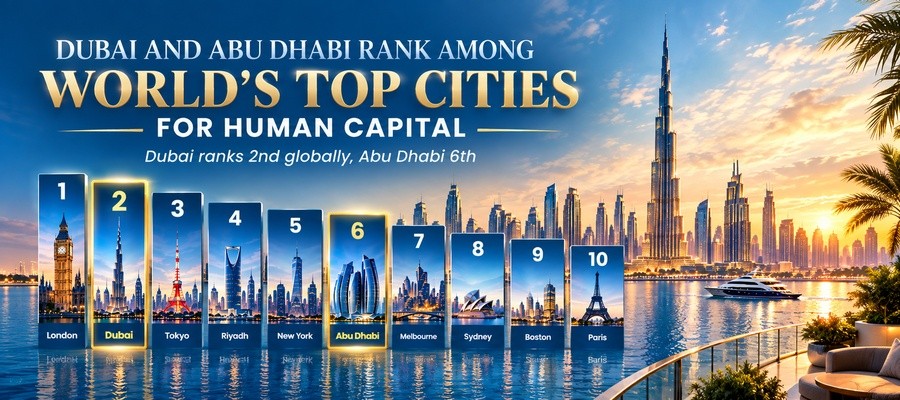
According to the Oxford Economics Global Cities Index 2026, Dubai ranks second globally for Human Capital, while Abu Dhabi ranks sixth. Oxford Economics measures Human Capital through factors related to talent, skills and the strength of the labour force.
For anyone looking at Dubai's long-term economic and real estate story, this is a significant data point.
Because cities do not grow on capital alone.
They grow when people, businesses, capital and infrastructure reinforce one another.
And Dubai appears to be building precisely that kind of ecosystem.
Dubai's Human Capital Ranking Is More Than a Number
The Oxford Economics Global Cities Index evaluates 1,000 major cities around the world across five broad categories:
-
Economics
-
Human Capital
-
Quality of Life
-
Environment
-
Governance
Each category is scored on a 0–100 scale and combined into an overall assessment. The Human Capital category specifically considers talent, skills and labour-force strength.
Dubai's 97.9 Human Capital score places it among the strongest cities globally in this category.
Abu Dhabi also performs strongly, with a Human Capital score of 89.2. Both cities are included by Oxford Economics among its 2026 Cities to Watch, reflecting their growing role in the global urban economy.
Dubai's overall position is also notable. Oxford Economics gives Dubai an overall score of 79.6, while its 2026 analysis says Dubai and Riyadh have entered the global top 50 for the first time.
That combination tells an interesting story.
Dubai is not simply trying to become a larger economy.
It is becoming a city that can attract and concentrate talent, businesses and international economic activity.
Why Does Human Capital Matter to Real Estate?
It is easy to look at real estate through the lens of prices, transactions and rental yields.
But behind every property market is a much simpler question:
Who is going to live, work and spend money there?
When professionals move to a city, they need homes.
When companies expand, they need offices.
When entrepreneurs relocate, they need commercial space and services.
When families move in, they create demand for schools, healthcare, retail, restaurants, transportation and leisure.
In other words, population and employment growth can become important foundations for real estate demand.
This is why human capital deserves more attention in conversations about Dubai property.
The relationship is not automatic, and a strong human-capital ranking does not guarantee that property prices will rise. Real estate is influenced by many other factors, including supply, affordability, interest rates, financing conditions, investor sentiment, regulation and individual location.
But a growing pool of skilled workers and businesses creates an important underlying economic demand base.
Dubai's Population Is Growing
The demographic story provides another important piece of the puzzle.
Dubai's population reached approximately 4.58 million by the end of 2025, according to data released by Dubai's Data and Statistics Establishment. That represented an increase of around 332,000 people, or 7.5%, compared with the end of 2024.
The daytime population is even larger.
Including temporary workers, visitors and tourists, the average number of people present in Dubai during daytime hours reached approximately 6.39 million in 2025.
These numbers matter because Dubai's economic footprint extends beyond its permanent residential population.
People arrive for work.
People arrive to establish companies.
People arrive for business and tourism.
And some eventually decide to stay.
That creates a continuously changing demand base for residential property, offices, hospitality, retail and infrastructure.
Capital Is Following the People — and the People Are Following Opportunity
Dubai's talent story is closely connected to its broader investment story.
The UAE attracted US$48.3 billion (AED177.3 billion) in foreign direct investment in 2025, according to UAE government data citing the latest UNCTAD World Investment Report.
The UAE ranked ninth globally among destinations for inbound FDI and second globally for greenfield projects, with 1,562 greenfield projects announced in 2025. Those projects were associated with more than 65,000 jobs across sectors including transportation, warehousing, business services, software and IT, automotive manufacturing, financial services and communications.
That is particularly relevant to the human-capital story.
Investment creates businesses.
Businesses create jobs.
Jobs attract professionals.
Professionals create household demand.
Households consume goods and services.
And that activity supports the wider urban economy.
This is one reason it can be useful to look at Dubai's real estate market as part of a much larger economic ecosystem rather than as an isolated asset class.
Dubai's Economy Is Becoming More Diverse
Another important factor is economic diversification.
Dubai's economy is no longer defined by one or two industries.
Financial services, trade, logistics, tourism, technology, construction, real estate, professional services and other sectors contribute to the city's economic activity.
Official data shows that Dubai's economy recorded AED355 billion in GDP during the first nine months of 2025, representing 4.7% growth compared with the same period of 2024.
More recent data shows Dubai's GDP reached approximately AED232 billion in Q1 2026, up 2.4% year-on-year. Real estate activities generated around AED26 billion in gross value added during the quarter, contributing 11.2% of Dubai's GDP, while construction grew 8.2%.
This matters because a diversified economy can create multiple channels of employment and demand.
A city that depends heavily on one industry can be vulnerable to a downturn in that sector.
A city with multiple economic engines has more opportunities to attract different types of workers and businesses.
The Real Estate Connection
For property investors and developers, this leads to an important way of thinking about Dubai.
Instead of asking only:
"How much is property worth today?"
it can also be useful to ask:
"What is happening to the economic base that supports future property demand?"
That means looking at indicators such as:
-
Population growth
-
Employment growth
-
Business formation
-
Foreign direct investment
-
Corporate expansion
-
Infrastructure development
-
International migration
-
Household formation
-
Rental demand
-
New housing supply
These indicators can provide a broader picture than property transactions alone.
For example, if a city is adding residents while attracting companies and skilled workers, the resulting demand can extend well beyond residential apartments.
It can influence office space, retail, hospitality, education, healthcare, logistics and mixed-use developments.
This is where the concept of human capital becomes particularly relevant to real estate.
Dubai's Global Position Is Changing
Oxford Economics' 2026 analysis describes a broader shift taking place across the Middle East.
The report notes that Dubai and Riyadh have entered the global top 50, while cities in the region have increasingly used infrastructure, investment and economic diversification to attract highly skilled workers and innovative companies.
Dubai's position is therefore part of a larger regional transformation.
The competition is no longer simply between individual buildings or property developments.
Cities are competing for:
Talent. Capital. Companies. Entrepreneurs. Innovation.
And the cities that can attract all five can potentially create stronger economic ecosystems.
Why "City to Watch" Matters
Oxford Economics has introduced a Cities to Watch section in its 2026 Global Cities Index to identify cities showing significant momentum and the potential to climb the rankings over time.
Dubai is included in this group, alongside cities such as Riyadh and Abu Dhabi.
Importantly, "City to Watch" should not be interpreted as a guarantee of future economic or property performance.
It is better understood as a signal that Oxford Economics sees meaningful structural momentum in the city's development.
That distinction matters for investors.
A city can have strong fundamentals while individual properties, neighbourhoods or projects perform very differently.
What Could This Mean for Dubai Property?
The human-capital story potentially strengthens the long-term case for monitoring Dubai's real estate market, but it should not be viewed in isolation.
A growing population can increase housing demand.
More companies can support office demand.
Higher employment can support consumption.
International residents can create demand across different price segments.
New businesses can increase demand for commercial and flexible workspace.
Infrastructure investment can open new development corridors.
And a growing international population can support demand for lifestyle-led communities.
However, supply matters just as much as demand.
If housing supply grows faster than underlying demand in a particular location or segment, prices and rents may behave differently from the broader city trend.
That is why investors should look beyond Dubai as one single market.
The micro-market matters.
Location, developer quality, property type, completion timeline, service charges, rental demand, infrastructure and future supply can all materially affect an individual investment.
The Bigger Story: People Create Economic Gravity
Perhaps the most interesting takeaway from the Oxford Economics data is not simply that Dubai ranks highly for Human Capital.
It is what that ranking represents.
A city becomes economically powerful when different forms of activity begin reinforcing one another.
Talent attracts companies.
Companies attract investment.
Investment creates jobs.
Jobs attract more people.
More people support businesses.
Businesses support infrastructure.
Infrastructure makes the city more attractive.
And the cycle can continue.
This is the idea of economic agglomeration — the tendency for businesses, workers, knowledge and capital to benefit from being concentrated in a connected urban ecosystem.
Dubai has spent years building that ecosystem.
The latest global city data suggests that its ability to attract people is now becoming one of the most visible parts of the story.
What Investors Should Watch Next
For anyone assessing Dubai's long-term growth story, the next decade may be less about asking where prices have already moved and more about understanding the fundamentals behind future demand.
Five areas deserve particular attention:
1. Population growth
Is Dubai continuing to attract residents at a sustainable pace?
2. Talent and employment
Are high-skilled professionals and international companies continuing to establish themselves in the city?
3. Business and FDI activity
Is international capital translating into new companies, jobs and productive economic activity?
4. Infrastructure and connectivity
Is new infrastructure expanding the areas where people want to live and businesses want to operate?
5. Housing supply
Is new residential supply keeping pace with population and household growth, and is it being delivered in the right locations and price segments?
These questions can provide a more complete framework for understanding Dubai's property market.
Final Thoughts
Dubai's real story may be bigger than real estate.
Real estate is one visible part of a much larger transformation involving people, businesses, capital, infrastructure and global connectivity.
The Oxford Economics Global Cities Index 2026 provides an interesting lens into that transformation.
Dubai's #2 global position for Human Capital, its inclusion among the report's Cities to Watch, strong population growth and continued investment activity all point to a city that is increasingly competing on its ability to attract people as well as money.
For property investors, that creates a more useful question than simply asking where prices are today:
Where are people, businesses and capital choosing to be over the next decade?
Because ultimately, behind every successful city are people.
And where people build careers, businesses build companies and families build their lives, demand for places to live, work and invest tends to follow.
Dubai's next chapter may therefore be less about attracting capital alone — and increasingly about attracting the people who create it, deploy it and grow it.
Sources
Oxford Economics, Global Cities Index 2026; UAE Federal Competitiveness and Statistics Centre; Dubai Data and Statistics Establishment; UAE Government/Ministry of Investment.
#Dubai #DubaiRealEstate #UAE #RealEstateInvestment #HumanCapital #GlobalCities #DubaiInvestment #AbuDhabi #PropertyInvestment #SeemaaNirmann