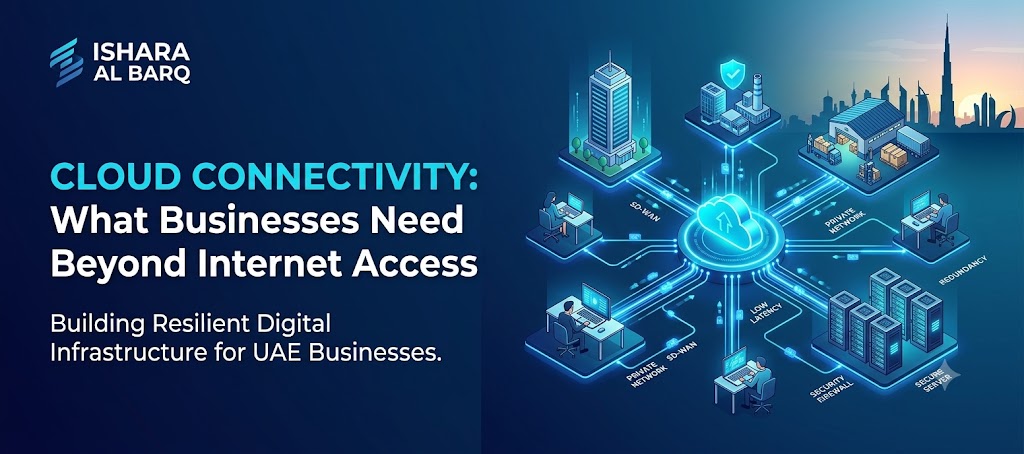
In today’s digital business environment, having an internet connection is no longer enough.
Businesses across the UAE are increasingly using cloud applications for communication, data storage, customer management, financial operations, collaboration, cybersecurity, and business intelligence. As more critical workloads move to the cloud, the quality of connectivity between employees, offices, data centers, applications, and cloud platforms becomes increasingly important.
This is where cloud connectivity comes into the picture.
Cloud connectivity is not simply about having faster internet. It is about creating a reliable, secure, and well-managed connection between a business and the cloud services it depends on every day.
What Is Cloud Connectivity?
Cloud connectivity refers to the network infrastructure that allows businesses, users, offices, applications, and devices to securely access cloud platforms and services.
A traditional internet connection provides general access to online services. Cloud connectivity takes a broader approach by focusing on how efficiently and securely business traffic reaches specific cloud environments.
Depending on business requirements, cloud connectivity can involve:
-
Dedicated cloud connections
-
Business-grade internet
-
Private network connections
-
SD-WAN
-
VPN connectivity
-
Cloud gateways
-
Network security solutions
-
Data center connectivity
-
Redundant network links
The right combination depends on the size, industry, applications, security requirements, and operational needs of the business.
Why Internet Access Alone May Not Be Enough
A standard internet connection can work well for basic activities such as browsing websites, sending emails, or accessing simple online applications.
However, businesses often rely on cloud systems for much more critical operations.
For example, a company may use cloud-based ERP software, CRM platforms, Microsoft 365, cloud storage, video conferencing, cybersecurity platforms, and business applications simultaneously.
If connectivity becomes slow or unstable, the impact can extend beyond inconvenience. Employees may lose productivity, applications may become difficult to access, and customer-facing operations can be affected.
This makes network reliability and performance an important part of digital infrastructure planning.
1. Reliability and Network Availability
Businesses need connectivity that remains available when employees and customers need it.
Network downtime can interrupt cloud applications, communication systems, remote working, and other important business processes.
For organizations with critical cloud workloads, network planning may include redundant links, backup connectivity, failover mechanisms, and appropriate network monitoring.
The objective is simple: reduce the impact of connectivity failures and maintain business continuity.
2. Security Beyond the Internet Connection
Cloud adoption also changes the way businesses think about cybersecurity.
When applications and data are accessed from different locations and devices, security cannot depend only on a traditional network perimeter.
Businesses may need multiple layers of protection, including:
-
Firewalls
-
Secure VPNs
-
Network segmentation
-
Identity and access controls
-
Encryption
-
Secure web gateways
-
Continuous monitoring
-
Endpoint security
A strong cloud connectivity strategy therefore needs to consider both network performance and security.
3. Low Latency for Business Applications
Speed is not always measured simply by download and upload bandwidth.
For many cloud applications, latency is equally important.
Latency refers to the time it takes for data to travel between two points. Higher latency can affect applications that require frequent communication between users and cloud platforms.
This can be particularly relevant for real-time collaboration, voice and video communication, financial applications, remote systems, and other interactive workloads.
Businesses should therefore evaluate connectivity based on the requirements of their applications rather than focusing only on bandwidth.
4. Dedicated and Private Connectivity
Some businesses require more controlled connectivity to cloud environments.
Depending on the cloud provider and business architecture, organizations may use dedicated or private connectivity options instead of relying entirely on the public internet.
These solutions can provide a more controlled path between business infrastructure and cloud environments.
For companies handling sensitive information or running mission-critical applications, this type of connectivity may become an important part of their overall infrastructure strategy.
5. Supporting Multiple Offices and Remote Teams
Modern businesses rarely operate from one location.
A company may have a headquarters in Dubai, branches in Abu Dhabi or Sharjah, warehouses, retail locations, remote employees, and external partners.
Cloud connectivity needs to support all these locations consistently.
Technologies such as SD-WAN can help organizations manage connectivity across multiple sites while providing centralized control, traffic management, and security capabilities.
This can make network management more practical as a business expands.
6. Scalability for Future Growth
Infrastructure should not only support today's requirements. It should also be capable of supporting tomorrow's business.
As organizations add employees, applications, branches, devices, and cloud workloads, network requirements can increase quickly.
A scalable connectivity strategy helps businesses avoid repeatedly redesigning their infrastructure whenever demand increases.
This is particularly important for growing companies operating in the UAE's rapidly developing digital economy.
7. Visibility and Network Monitoring
Another important difference between basic internet access and business-focused cloud connectivity is visibility.
Businesses need to understand what is happening across their networks.
Network monitoring can help organizations identify:
-
Connectivity problems
-
Unusual traffic
-
Performance degradation
-
Application bottlenecks
-
Availability issues
-
Security events
With better visibility, IT teams can identify problems earlier and make more informed infrastructure decisions.
Cloud Connectivity Is Part of a Larger Infrastructure
Cloud connectivity should not be treated as an isolated technology.
It is connected to several other areas of digital infrastructure, including fiber networks, structured cabling, routers, switches, firewalls, data centers, wireless networks, cybersecurity systems, and cloud platforms.
A well-designed infrastructure considers how these components work together.
For example, improving an internet connection may not solve an application performance problem if the issue is caused by internal network congestion, outdated equipment, poor routing, or insufficient security architecture.
This is why businesses benefit from looking at connectivity as part of the complete technology infrastructure rather than as a standalone internet service.
What UAE Businesses Should Consider
For businesses operating in the UAE, cloud connectivity decisions should be based on practical business requirements.
Before selecting a connectivity solution, organizations should consider:
Business applications: Which cloud applications are most important to daily operations?
Performance requirements: Do applications require low latency or high bandwidth?
Security: What type of data is being transmitted and what security controls are required?
Locations: How many offices, branches, warehouses, or remote users need access?
Reliability: What level of downtime can the business realistically tolerate?
Scalability: Can the solution support future growth?
Monitoring: How will network performance and security be monitored?
Integration: Can the connectivity solution work with the company's existing infrastructure?
Answering these questions can help businesses make infrastructure decisions based on actual operational needs rather than simply choosing the fastest available internet package.
The Future of Business Connectivity
As businesses continue adopting cloud computing, artificial intelligence, IoT, digital collaboration tools, and data-driven applications, connectivity will become increasingly important.
The future is not simply about connecting businesses to the internet. It is about creating secure, reliable, intelligent, and scalable digital networks that connect users, applications, infrastructure, and cloud environments.
For businesses, this means connectivity should be treated as a strategic infrastructure investment rather than just a monthly internet expense.
Final Thoughts
Cloud technology has changed the way businesses operate, but cloud adoption also creates new connectivity requirements.
A reliable internet connection remains important, but modern businesses may need much more: secure access, low latency, redundancy, monitoring, scalability, and integration with their wider IT infrastructure.
The organizations that understand these requirements can build stronger digital foundations and create infrastructure that is better prepared for future growth.
Cloud connectivity is no longer just about getting online. It is about building the network that keeps modern business connected.
This version is suitable for a Lowkot/Ishara-style technology newsletter, with a strong UAE-business focus and natural SEO terms such as cloud connectivity, digital infrastructure, cloud networking, network security, SD-WAN, business connectivity, and UAE digital transformation.