Technology & Digital Infrastructure
Businesses are becoming more connected than ever before.
From smart buildings and connected equipment to logistics systems, security solutions, retail technologies, and industrial operations, organizations are using connected devices to collect information and improve the way they work.
At the center of this transformation is the Internet of Things (IoT).
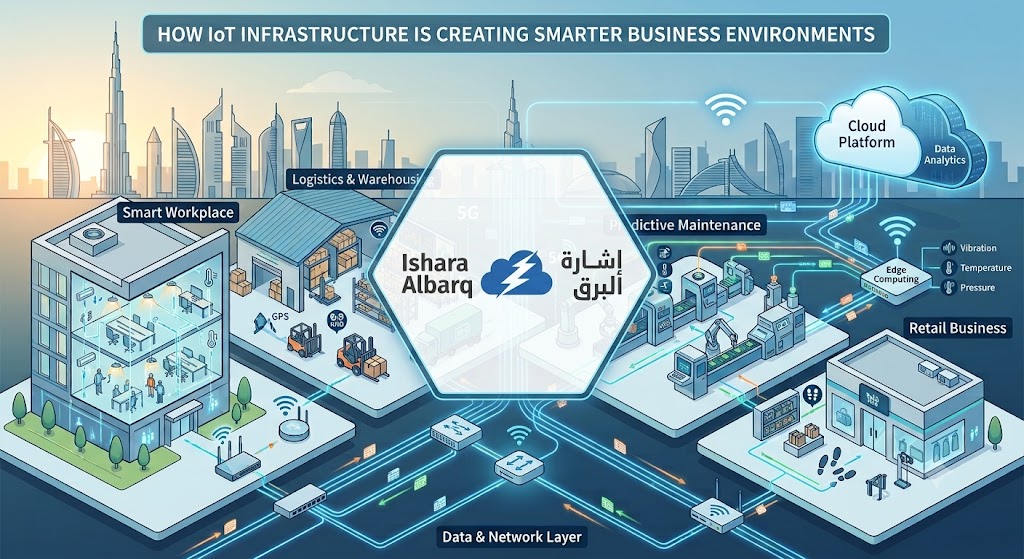
IoT connects physical devices to digital networks, allowing them to collect, exchange, and sometimes act on data. When supported by reliable network infrastructure, cloud platforms, edge computing, and data analytics, IoT can turn ordinary business environments into smarter and more responsive operations.
For businesses in the UAE, where digital transformation and smart technologies are becoming increasingly important, understanding IoT infrastructure can help organizations prepare for the next stage of connectivity.
What Is IoT Infrastructure?
IoT infrastructure is the combination of technologies required to connect, manage, monitor, and analyze data from connected devices.
A typical IoT environment can include:
-
Sensors and connected devices
-
Network switches and routers
-
Wireless networks
-
Fiber-optic connectivity
-
Gateways
-
Cloud platforms
-
Edge computing systems
-
Data storage
-
Monitoring platforms
-
Cybersecurity solutions
-
Data analytics tools
These components work together to create a flow of information between physical environments and digital systems.
For example, a temperature sensor in a warehouse can collect information continuously. That data can then be transmitted through a network to an IoT platform, where businesses can monitor conditions and respond when predefined limits are reached.
Why Businesses Are Investing in IoT
The value of IoT is not simply about connecting more devices.
The real opportunity comes from turning data into useful business information.
Connected devices can help organizations understand what is happening across their operations in real time.
Instead of relying entirely on manual inspections or periodic reports, businesses can receive continuous information from their equipment, facilities, vehicles, and other assets.
This can support better decision-making and more efficient operations.
Creating Smarter Workplaces
Modern offices are becoming increasingly connected.
IoT devices can monitor areas such as:
-
Lighting
-
Temperature
-
Energy consumption
-
Room occupancy
-
Equipment usage
-
Access systems
-
Air quality
For example, occupancy sensors can provide information about how different areas of an office are being used.
Businesses can use this information to improve space planning, energy management, and building operations.
The result is a workplace where technology can respond more intelligently to changing conditions.
IoT in Warehousing and Logistics
Logistics is another area where IoT can provide significant value.
Warehouses and distribution operations involve large numbers of products, vehicles, machines, and employees.
Connected sensors and tracking technologies can provide information about inventory movement, equipment status, environmental conditions, and asset locations.
For businesses operating in the UAE's highly connected trade and logistics environment, this type of visibility can support more informed operational decisions.
IoT can also help organizations identify delays or unusual conditions earlier, allowing teams to investigate problems before they become larger operational issues.
Supporting Predictive Maintenance
Equipment failure can be expensive.
Unexpected downtime can affect production schedules, deliveries, customer commitments, and operating costs.
IoT sensors can monitor equipment conditions such as temperature, vibration, pressure, or operating cycles.
When this information is analyzed over time, businesses may be able to identify patterns that indicate potential equipment problems.
This approach is often referred to as predictive maintenance.
Instead of waiting for equipment to fail completely, organizations can use available data to plan inspections or maintenance activities more effectively.
IoT and Energy Management
Energy efficiency is becoming an increasingly important consideration for businesses.
IoT infrastructure can provide detailed information about energy consumption across buildings, facilities, and equipment.
Smart meters and sensors can help organizations understand:
-
Where energy is being consumed
-
When consumption is highest
-
Which systems use the most energy
-
Whether equipment is operating efficiently
-
Where potential improvements may exist
This data can help businesses make more informed decisions about energy management.
IoT and Retail Businesses
Retail environments are also becoming more connected.
IoT technologies can support applications involving inventory monitoring, smart shelves, customer movement analysis, environmental monitoring, and equipment management.
For example, connected inventory systems can provide businesses with more timely information about stock levels.
This can help reduce the risk of products being unavailable when customers need them.
Combined with e-commerce and digital analytics, IoT can contribute to a more connected retail ecosystem.
The Role of Network Infrastructure
IoT cannot function effectively without reliable connectivity.
Thousands of connected devices may need to communicate with business systems simultaneously.
This makes the underlying network infrastructure extremely important.
Depending on the application, businesses may use:
Fiber-optic networks for high-capacity and reliable connectivity.
Wi-Fi networks for connected devices within offices, warehouses, and other facilities.
Cellular and 5G connectivity for mobile and distributed applications.
Gateways to connect IoT devices with wider networks and processing platforms.
Switches and routers to manage communication across the network.
A well-designed network provides the foundation on which IoT applications operate.
IoT, Cloud Computing, and Edge Computing
IoT infrastructure increasingly works alongside cloud and edge computing.
Cloud platforms can provide centralized storage, analytics, application management, and large-scale processing.
Edge computing can process certain information closer to where the data is generated.
This can be particularly useful when businesses need fast responses from connected systems.
For example:
IoT sensors → Network → Edge processing → Cloud platform → Business analytics
This combination can create a flexible infrastructure capable of supporting large-scale connected operations.
Security Cannot Be an Afterthought
More connected devices also mean more potential points that need to be protected.
An IoT environment can include devices located across offices, warehouses, factories, vehicles, buildings, and other locations.
Each connected device and network connection needs to be considered as part of the organization's overall cybersecurity strategy.
Businesses should consider measures such as:
-
Device authentication
-
Network segmentation
-
Access controls
-
Encryption
-
Software and firmware updates
-
Continuous monitoring
-
Secure device management
-
Regular security assessments
IoT security should be designed into the infrastructure from the beginning.
The Importance of Data
Connecting devices is only the beginning.
The real business value comes from understanding the information those devices produce.
Businesses need systems that can collect, organize, analyze, and present IoT data in a useful way.
For example, simply knowing that a machine is producing unusual vibration data may not be enough.
The organization needs a process that helps translate that information into an actionable decision.
This is why IoT, data analytics, artificial intelligence, and automation are increasingly being considered together.
IoT and Artificial Intelligence
AI can make IoT systems even more useful.
IoT devices generate large amounts of real-world data, while AI can help identify patterns and relationships within that information.
For example, AI-supported systems may analyze equipment data to identify unusual behavior or process information from multiple connected devices to support operational decisions.
The combination of:
IoT + AI + Cloud + Edge Computing + Connectivity
is creating new possibilities for intelligent business environments.
What UAE Businesses Should Consider
Before implementing IoT, businesses should first identify the specific problem they want to solve.
Important questions include:
-
What information do we need?
-
Where is that information generated?
-
How frequently does it need to be collected?
-
What network infrastructure is required?
-
Where should the data be processed?
-
How will devices be secured?
-
How will the system scale?
-
How will the collected data support business decisions?
Starting with a clear business objective can help prevent organizations from investing in connected technology simply because it is available.
Building an IoT-Ready Infrastructure
Organizations planning for IoT should think beyond individual devices.
A successful IoT environment requires an infrastructure capable of supporting connectivity, data processing, security, and future expansion.
Businesses may need to evaluate:
Network Capacity
Can the existing network handle additional connected devices and increasing data volumes?
Infrastructure Reliability
Can the system continue operating when individual components experience problems?
Scalability
Can more devices, locations, and applications be added in the future?
Security
Are connected devices and communication channels adequately protected?
Data Management
Where will IoT data be stored, processed, and analyzed?
These considerations can help create an infrastructure that supports long-term growth rather than a short-term technology project.
The Future of Smarter Business Environments
IoT is gradually changing the relationship between physical infrastructure and digital technology.
Buildings, warehouses, vehicles, machines, and business systems can increasingly communicate with each other and provide real-time information.
As connectivity improves and technologies such as AI, cloud computing, 5G, and edge computing continue to develop, IoT applications are likely to become more integrated into everyday business operations.
For UAE organizations, this creates opportunities to build more connected, data-driven, and responsive environments.
Final Thoughts
IoT infrastructure is becoming an important part of modern digital transformation.
The technology is not simply about adding sensors or connecting devices. It is about creating an environment where data from the physical world can support better digital decisions.
With reliable connectivity, secure networks, cloud and edge infrastructure, and effective data management, businesses can use IoT to improve visibility, efficiency, monitoring, and operational decision-making.
As the UAE continues to develop its digital economy, businesses that understand how IoT fits into the wider technology infrastructure will be better prepared to explore the opportunities created by a more connected future.
The smarter business environment of tomorrow starts with the right infrastructure today.