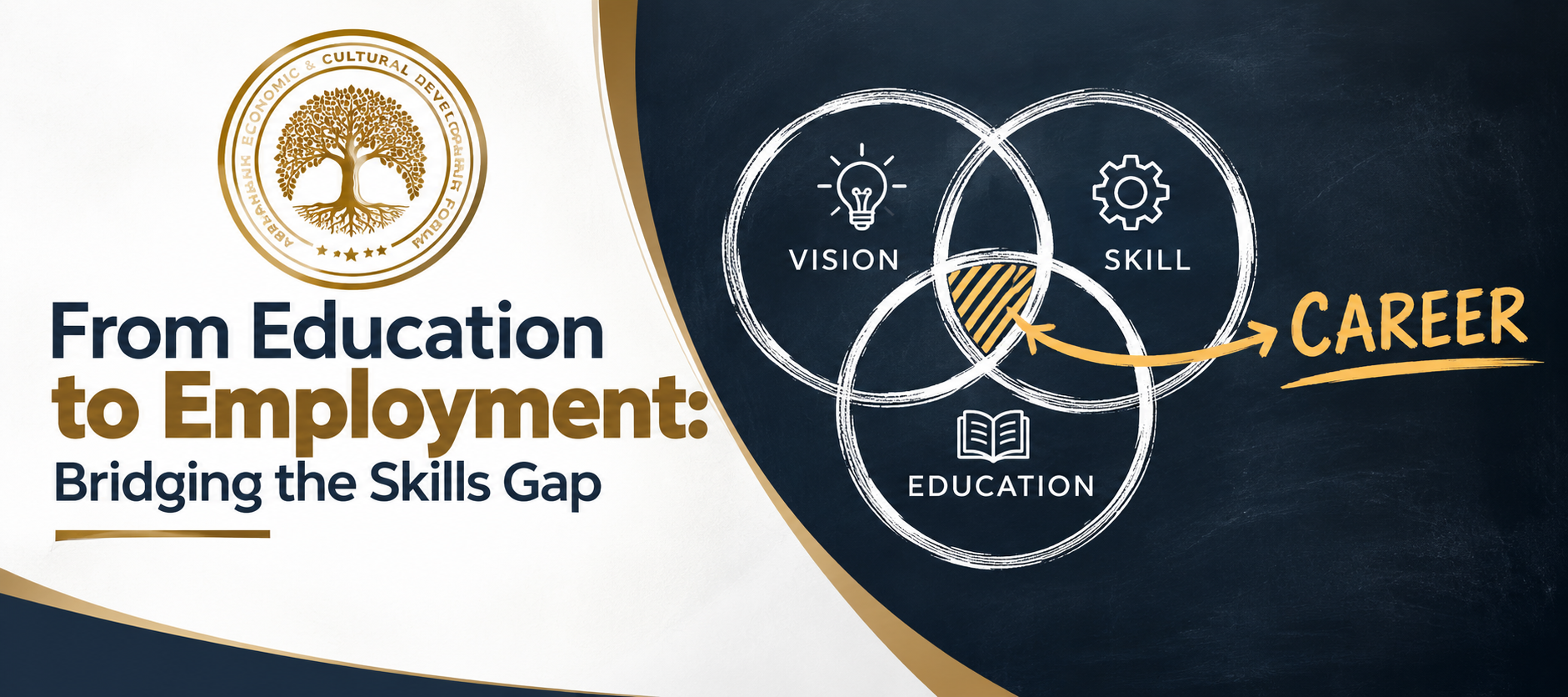
Education Meets Employment: Why Practical Skills Matter
A degree can open a door, but entering the world of work often requires much more than academic knowledge.
Students may spend years studying a subject and still discover that professional environments demand additional abilities: communication, teamwork, problem-solving, digital literacy, adaptability, practical experience, and the confidence to apply knowledge in real situations.
This difference between what people learn through education and what they need to use effectively in employment is often described as a skills gap.
Bridging that gap is not the responsibility of students alone. Educational institutions, employers, governments, communities, professional organizations, and individuals all have a role to play.
The goal should not be to make education serve only immediate employer needs. Instead, education should provide strong foundations while creating opportunities for learners to develop practical, transferable skills that remain useful as careers and industries change.
What Is the Skills Gap?
The skills gap refers broadly to a difference between the capabilities available in a workforce and the skills required for particular jobs or changing economic needs.
This gap can take different forms.
A graduate may have strong theoretical knowledge but limited workplace experience. An experienced employee may understand an industry well but need new digital skills. An entrepreneur may understand a market but need stronger financial or management capabilities.
The gap is therefore not simply about a lack of qualifications.
It can involve:
- Technical skills
- Digital skills
- Communication
- Critical thinking
- Problem-solving
- Teamwork
- Leadership
- Adaptability
- Professional behavior
- Industry-specific experience
Understanding these differences is the first step toward addressing them.
Why Education and Employment Need Stronger Connections
Education and employment serve different purposes, but they should not operate in isolation.
Education helps people develop knowledge, reasoning, research abilities, and intellectual foundations.
Employment requires people to apply those capabilities to practical situations involving customers, colleagues, deadlines, resources, technology, and organizational goals.
From Knowledge to Application
Consider a student studying business.
They may understand accounting concepts, marketing principles, and organizational theory.
In a workplace, however, they may also need to:
- Prepare a practical report
- Communicate with a client
- Work with colleagues
- Analyze an unfamiliar problem
- Use business software
- Present an idea
- Meet a deadline
- Respond to changing priorities
The knowledge remains valuable. But applying it requires additional skills and experience.
1. Education Should Include Practical Learning
Classroom learning provides an important foundation, but practical experience can help students understand how knowledge works outside the classroom.
Educational institutions can incorporate:
- Projects
- Case studies
- Research
- Internships
- Simulations
- Presentations
- Group assignments
- Community projects
- Entrepreneurship activities
Learning by Doing
A student who works on a real project may encounter challenges that are difficult to reproduce through a textbook.
They may have to negotiate responsibilities with teammates, revise an idea after receiving feedback, manage limited resources, or present their findings to an unfamiliar audience.
These experiences can develop practical judgment alongside academic knowledge.
2. Employers Can Help Prepare Future Talent
The responsibility for developing employable skills does not belong entirely to education providers.
Employers can contribute by creating opportunities for students and early-career professionals to understand workplace expectations.
Examples include:
- Internships
- Apprenticeships
- Graduate programs
- Mentorship
- Industry projects
- Workplace visits
- Guest lectures
- Skills workshops
- Job-shadowing opportunities
These connections can help learners understand how their education relates to actual professional environments.
3. Communication Skills Matter Across Industries
Technical knowledge is valuable, but most professionals also need to communicate.
A graduate may need to explain an idea to a manager, write an email to a customer, present research findings, collaborate with colleagues, or participate in a meeting.
Communication skills include:
- Clear writing
- Active listening
- Public speaking
- Presentation
- Professional correspondence
- Negotiation
- Feedback
- Cross-cultural communication
Communication Should Be Practiced
Students should not have to wait until their first job to develop these abilities.
Presentations, debates, group projects, research discussions, and community activities can provide useful practice.
4. Critical Thinking Helps People Adapt
The workplace rarely provides perfect information.
Employees and entrepreneurs often have to make decisions when information is incomplete or circumstances are changing.
Critical thinking helps people:
- Evaluate information
- Identify assumptions
- Compare alternatives
- Ask better questions
- Distinguish evidence from opinion
- Recognize uncertainty
- Consider consequences
These skills can be useful regardless of industry.
They also complement technical education by helping people determine how and when to apply what they know.
5. Digital Skills Are Becoming Part of Professional Life
Digital tools are now relevant across many areas of education and employment.
The specific technologies vary by industry, but many professionals encounter:
- Digital communication platforms
- Data and information systems
- Online collaboration tools
- Industry software
- Cybersecurity considerations
- Artificial intelligence
- Digital research
Digital literacy does not necessarily mean becoming a technology specialist.
It means understanding the tools relevant to your work and using them responsibly.
AI Requires Judgment Too
Artificial intelligence can assist with tasks such as research, drafting, analysis, and organization.
However, professionals still need to check important information, understand limitations, protect sensitive information, and apply human judgment.
Knowing how to use a tool is only part of digital competence. Knowing when and how to use it responsibly is equally important.
6. Soft Skills Are Professional Skills
The phrase "soft skills" can sometimes make important capabilities sound secondary.
In practice, skills such as communication, teamwork, reliability, problem-solving, adaptability, and leadership can influence how effectively people work.
For example, a technically skilled employee may still struggle if they cannot collaborate with colleagues or communicate problems clearly.
Important Transferable Skills
Some capabilities are useful across many careers:
- Communication
- Collaboration
- Time management
- Problem-solving
- Critical thinking
- Adaptability
- Leadership
- Professional writing
- Cultural awareness
- Self-management
These skills can complement specialized technical knowledge.
7. Internships Can Connect Learning With Experience
For many students, the transition from education to employment is difficult because they have limited professional experience.
Internships and similar opportunities can help bridge this gap.
A useful internship should provide more than a line on a résumé.
It can give a student the opportunity to:
- Observe professional practices
- Work with experienced colleagues
- Understand workplace expectations
- Apply academic knowledge
- Receive feedback
- Build professional relationships
- Discover areas for further learning
Employers can also gain insight into emerging talent and contribute to professional development.
8. Mentorship Can Make the Transition Easier
Young people often have questions that are difficult to answer through formal education alone.
A mentor can provide practical insight into:
- Career paths
- Workplace expectations
- Professional communication
- Industry practices
- Common early-career challenges
- Further learning opportunities
Mentorship does not need to be complicated.
A student or young professional may benefit simply from having someone experienced who is willing to listen, answer questions, and provide constructive feedback.
9. Career Education Should Begin Before Graduation
Career preparation is more useful when it begins before a student completes their education.
Students can benefit from learning about:
- Different career paths
- Industry expectations
- CV and résumé writing
- Interviews
- Professional networking
- Workplace communication
- Internships
- Entrepreneurship
- Further education
Career Awareness Is Not Career Pressure
The purpose is not to force young people to choose a career too early.
Instead, career education can help them understand the range of possibilities and make more informed decisions as their interests develop.
10. Entrepreneurship Can Develop Employability Skills
Not every student will become an entrepreneur.
However, entrepreneurship education can help develop skills that are useful in many professional settings.
Creating even a small project can involve:
- Identifying a problem
- Understanding users or customers
- Developing an idea
- Planning
- Budgeting
- Communication
- Marketing
- Negotiation
- Managing uncertainty
These experiences can help students understand how ideas move from concept to implementation.
11. Research Skills Have Practical Value
Research is not limited to universities.
Professionals frequently need to investigate questions before making decisions.
A person may need to research:
- Customer needs
- Market conditions
- Industry developments
- Competitors
- Regulations
- New technologies
- Potential partners
Learning how to identify reliable information, compare sources, interpret evidence, and communicate findings can therefore support both academic and professional development.
12. Education Should Support Lifelong Learning
The transition from education to employment should not be viewed as the end of learning.
Careers change.
Industries develop new technologies. Organizations adopt new processes. Professional expectations evolve.
This means people may need to continue learning throughout their working lives.
Lifelong learning can include:
- Professional courses
- Certifications
- Workshops
- Mentorship
- Online learning
- Research
- Industry events
- Peer learning
- Practical projects
The goal is not to collect qualifications endlessly.
It is to remain capable of learning and adapting when circumstances change.
13. Women Need Equal Access to Skills and Opportunities
Bridging the skills gap also means considering whether different groups have equal access to education, training, mentorship, professional networks, and career opportunities.
For women and young women in particular, access to practical training can support participation in areas such as:
- Entrepreneurship
- Technology
- Research
- Management
- Leadership
- Finance
- Professional development
Skills development is most useful when learning is accompanied by meaningful opportunities to apply those skills.
14. Young People Need More Than Qualifications
Qualifications can demonstrate knowledge and commitment, but employment involves applying that knowledge.
Young people can strengthen their preparation by building a portfolio of experiences.
This might include:
- Academic projects
- Research
- Volunteer work
- Internships
- Freelance projects
- Entrepreneurship
- Community initiatives
- Student leadership
- Digital projects
Show What You Can Do
Instead of focusing only on what they have studied, young people can also demonstrate what they have created, solved, organized, researched, communicated, or contributed to.
This provides employers with a more practical picture of their capabilities.
15. Employers Should Communicate Skills Requirements Clearly
Another part of the skills gap comes from unclear expectations.
Job descriptions sometimes combine numerous requirements without distinguishing between essential skills and skills that can be learned after hiring.
Clear communication can help candidates understand:
- What knowledge is essential
- What skills are preferred
- What experience is required
- What can be developed through training
Employers can also identify where existing employees need additional development.
16. Training Should Continue Inside the Workplace
Hiring people with the right foundation is only one part of workforce development.
Organizations can also invest in existing employees through:
- Training programs
- Mentorship
- Internal learning
- Cross-functional projects
- Leadership development
- Professional certifications
- Skills assessments
Workplace learning can help employees adapt as responsibilities and organizational needs change.
AECD Forum Perspective
The transition from education to employment closely connects with the broader interests of the Abrahamic Economic & Cultural Development (AECD) Forum.
Education provides the foundation for personal and professional development, while skill development helps people apply knowledge in practical environments. Together, they can contribute to stronger pathways for young people, professionals, entrepreneurs, and communities.
The issue also connects naturally with youth development, women's participation, leadership, professional training, research, entrepreneurship, economic development, international cooperation, and sustainable development.
For young people, the education-to-employment journey can be strengthened through opportunities to gain practical experience, connect with mentors, participate in research, develop entrepreneurial skills, and engage with professionals.
For businesses, collaboration with educators can help create clearer pathways between learning and employment.
For communities and policymakers, supporting skills development can be part of broader efforts to improve participation in economic and professional life.
AECD Forum can contribute to this conversation by creating space for dialogue and knowledge-sharing among educators, professionals, entrepreneurs, researchers, young people, communities, and other stakeholders.
The central idea is simple:
Education should not end with a certificate. It should give people the foundation to keep learning, contribute productively, and adapt throughout their professional lives.
Practical Action Points
1. Identify the Skills Your Career Requires
Choose a career or professional area that interests you and identify the technical and transferable skills commonly used in that field.
2. Gain Practical Experience
Look for internships, volunteering, research projects, freelance assignments, student initiatives, or community activities where you can apply your knowledge.
3. Build a Skills Portfolio
Keep examples of projects, presentations, research, designs, reports, campaigns, or other work that demonstrate what you can do.
4. Find a Mentor
Connect with an experienced professional who can provide practical guidance and feedback about your chosen field.
5. Strengthen One Transferable Skill
Choose one area—communication, critical thinking, teamwork, leadership, or time management—and deliberately practice it.
6. Keep Learning After Graduation
Identify areas where your industry is changing and develop a habit of continuing education through courses, workshops, research, or practical learning.
7. Build Connections Between Education and Industry
Students, educators, and employers can participate in career events, industry projects, guest lectures, internships, and mentorship programs to strengthen these connections.
Bridging the gap between education and employment is not about choosing practical skills over academic learning.
It is about connecting the two.
Knowledge provides a foundation. Practical experience teaches application. Communication helps people collaborate. Critical thinking supports decisions. Digital literacy helps people work with changing technologies. Mentorship provides guidance. Lifelong learning helps people remain adaptable.
Young people should have opportunities to gain these experiences before and during their transition into employment. Employers can contribute by offering meaningful entry-level opportunities and continuing to develop their workforce. Educational institutions can strengthen connections with industry and communities. Policymakers and professional organizations can help create broader pathways for learning and employment.
The future of work will continue to change, but one principle is likely to remain important:
People need opportunities not only to learn, but to apply, develop, and continually renew what they know.
Bridging education and employment is therefore not a single program or one-time solution. It is an ongoing partnership between education, industry, communities, and individual.
Educators, employers, communities, professional organizations, and policymakers all have a role to play.
The goal is simple: create stronger pathways from learning → skills → experience → meaningful work.
#EducationToEmployment #SkillsGap #SkillDevelopment #CareerReadiness #YouthDevelopment #FutureOfWork #EmployabilitySkills #Education #ProfessionalDevelopment #Entrepreneurship #AECDForum