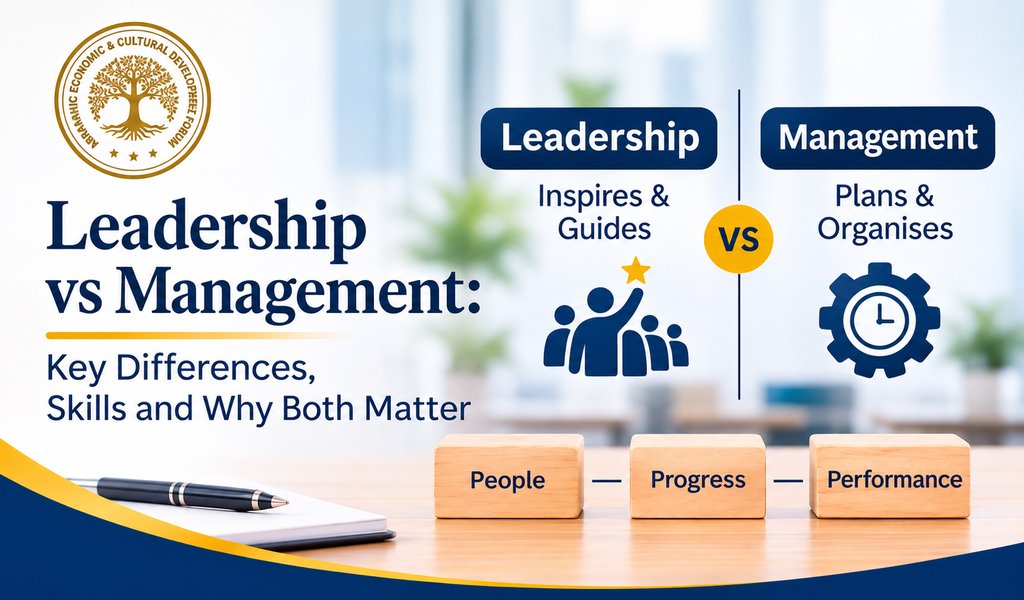
Leadership and management are not the same, but successful organisations need both.
Leadership and management are often used interchangeably in the workplace. Both involve working with people, making decisions and achieving objectives. However, they serve different purposes. Understanding the difference between leadership and management helps individuals become more effective professionals, build stronger teams and contribute to long-term organisational success.
Management focuses on planning, organising and ensuring that work is completed efficiently. Leadership focuses on creating direction, inspiring people and helping them move towards a shared goal. While management provides structure, leadership gives people a sense of purpose.
Organisations need both. A team may have clear processes and well-defined responsibilities, but without leadership, employees can struggle to understand the bigger picture. Similarly, a strong vision may not produce meaningful results without effective management to turn ideas into action.
For professionals, entrepreneurs, educators and future leaders, developing both skill sets is an important part of career growth.
1. What Is Leadership?
Leadership is the ability to guide, influence and encourage people towards a common objective. A leader helps individuals understand why their work matters and how their contributions support a larger purpose.
Leadership is not limited to people with senior job titles. A junior employee who takes initiative, supports colleagues or proposes a useful solution can demonstrate leadership.
Key characteristics of effective leadership
-
Vision: Understanding the direction a team or organisation should take.
-
Communication: Explaining ideas clearly and listening to different perspectives.
-
Inspiration: Encouraging people to contribute and perform at their best.
-
Decision-making: Making thoughtful choices, particularly when situations are uncertain.
-
Empathy: Understanding the challenges, experiences and concerns of others.
-
Accountability: Taking responsibility for decisions and their outcomes.
For example, when a project faces unexpected difficulties, a leader helps the team understand the challenge, considers possible solutions and maintains confidence in the shared objective.
2. What Is Management?
Management is the process of planning, organising, coordinating and monitoring resources to achieve defined goals. Managers help ensure that responsibilities are clear, deadlines are realistic and work is completed according to agreed requirements.
Management is particularly important in organisations where several people, departments or activities must work together.
Key characteristics of effective management
-
Planning: Setting objectives, priorities and timelines.
-
Organisation: Assigning responsibilities and arranging resources.
-
Coordination: Ensuring that people and departments work together.
-
Monitoring: Reviewing progress and identifying problems.
-
Problem-solving: Addressing operational challenges.
-
Efficiency: Making effective use of time, budgets and available resources.
For instance, a project manager may divide a large assignment into smaller tasks, assign each task to a team member, establish deadlines and monitor progress to ensure the project stays on track.
3. Leadership vs Management: Understanding the Key Differences
Although leadership and management are closely connected, their primary focuses differ.
These differences are useful for understanding the two roles, but they are not strict boundaries. Effective leaders also need organisational skills, while good managers must communicate, motivate and support their teams.
4. Why Organisations Need Both Leadership and Management?
A successful organisation needs more than good ideas or efficient processes. It needs people who can establish direction and others who can turn that direction into practical results.
Leadership creates direction
Leaders help employees understand organisational priorities and the reasons behind important decisions. A clear direction can help teams remain focused, especially during periods of uncertainty.
Management turns plans into action
Managers translate objectives into tasks, timelines and responsibilities. They help ensure that available resources are used appropriately and that progress can be reviewed.
Together, they support sustainable progress
Consider an organisation introducing a new digital service. Leadership explains why the change is important, communicates the intended benefits and encourages employees to participate. Management coordinates the training, schedules implementation, allocates resources and monitors the process.
Without leadership, employees may not understand or support the change. Without management, the organisation may struggle to implement it effectively.
5. Can One Person Be Both a Leader and a Manager?
Yes. In many professional roles, individuals are expected to demonstrate both leadership and management skills.
A department head, for example, may manage budgets, allocate work and review performance while also mentoring employees, resolving disagreements and communicating a long-term vision.
The balance depends on the situation.
-
When deadlines are approaching, management skills help organise priorities and resources.
-
When employees are uncertain about a new direction, leadership skills help explain the purpose and build confidence.
-
When a team is experiencing conflict, leadership supports constructive communication while management helps establish a fair process for resolving the issue.
-
When an organisation is planning for growth, leadership identifies opportunities while management develops the steps needed to pursue them.
The ability to recognise which approach a situation requires is an important professional skill.
6. How to Develop Leadership Skills?
Leadership can be developed through practice, reflection and experience. People do not need to wait for a promotion or formal authority to begin building these abilities.
Practise active listening
Give colleagues the opportunity to express their views. Listen to understand their concerns rather than simply preparing a response.
Take initiative
Look for practical ways to improve a process, support a colleague or solve a problem. Follow through on commitments.
Build emotional intelligence
Learn to recognise your emotions and understand how your behaviour affects others. Respond thoughtfully, particularly during difficult conversations.
Communicate with clarity
Explain expectations, share relevant information and invite feedback. Good communication reduces misunderstandings and helps people work towards shared objectives.
Support other people's development
Share knowledge, offer constructive feedback and recognise the contributions of colleagues. Leadership is not only about personal achievement; it also involves helping others grow.
7. How to Develop Management Skills?
Management skills help professionals organise work, use resources effectively and maintain consistent progress.
Improve planning and prioritisation
Break larger objectives into manageable tasks. Identify which activities are urgent, which are important and which can be scheduled for later.
Learn to delegate
Delegation involves assigning responsibilities according to people's abilities, available time and development needs. It also requires providing clear expectations and appropriate support.
Monitor progress
Use suitable methods to review deadlines, responsibilities and results. Regular progress checks can help identify problems before they become more difficult to address.
Strengthen problem-solving abilities
Understand the cause of a problem before choosing a solution. Consider available options, possible consequences and the resources required.
Use feedback constructively
Ask team members what is working and where improvements are needed. Feedback can help managers adjust plans and improve working practices.
8. The Role of Leadership and Management in Career Development
Leadership and management skills are valuable at different stages of a professional journey.
Students can develop leadership by participating in group projects, taking responsibility and learning to collaborate. Early-career professionals can strengthen management abilities by organising assignments, meeting deadlines and coordinating tasks.
Entrepreneurs need leadership to communicate their business vision and management to oversee operations, finances and customer responsibilities. Experienced professionals may need both skills to guide teams, manage organisational change and support future leaders.
Developing these abilities can also improve professional confidence. Individuals who communicate clearly, take responsibility and organise their work are better prepared to contribute in different professional environments.
9. Common Misunderstandings About Leadership and Management
Several misconceptions can prevent people from developing these skills effectively.
Misunderstanding 1: Leadership only belongs to senior executives.
Leadership can be demonstrated at every level through initiative, responsibility and positive influence.
Misunderstanding 2: Managers only focus on tasks.
Effective managers also support people, communicate expectations and help employees perform well.
Misunderstanding 3: A good leader does not need management skills.
Vision needs planning, coordination and follow-through to become meaningful results.
Misunderstanding 4: A good manager does not need leadership skills.
People are more likely to understand and contribute to organisational goals when managers communicate purpose and build trust.
Misunderstanding 5: These abilities are fixed personality traits.
Leadership and management can both improve through learning, experience, feedback and deliberate practice.
AECD Forum Perspective
Leadership and management are important elements of professional development, education and sustainable economic progress. They help individuals contribute more effectively to workplaces, businesses and communities.
The Abrahamic Economic & Cultural Development (AECD) Forum recognises the importance of education, skill development, leadership, training and international cooperation in building capable individuals and stronger communities.
Understanding the relationship between leadership and management supports these wider goals. Leadership encourages people to think beyond immediate responsibilities, communicate a shared purpose and consider the needs of others. Management helps turn those intentions into organised activities and practical outcomes.
For young people and emerging professionals, learning both skill sets can provide a stronger foundation for future responsibilities. For entrepreneurs and business leaders, combining vision with effective organisation can support responsible decision-making and long-term development.
A culture of continuous learning, collaboration and accountability can help individuals and organisations contribute to meaningful progress.
Practical Action Points
Here are seven ways to begin developing leadership and management skills:
-
Take responsibility: Volunteer to coordinate a project, lead a discussion or manage a specific task.
-
Practise clear communication: Explain your ideas, listen carefully and confirm that responsibilities are understood.
-
Improve your planning: Set realistic goals, divide work into smaller tasks and review progress regularly.
-
Ask for feedback: Seek honest suggestions from colleagues, mentors, teachers or supervisors.
-
Learn to delegate: When working with others, distribute tasks fairly and provide the support people need.
-
Develop problem-solving skills: Look beyond immediate difficulties and consider practical, long-term solutions.
-
Keep learning: Participate in training, professional development activities and collaborative projects that strengthen both skill sets.
Leadership and management are different, but neither works as effectively in isolation. Leadership gives people direction, purpose and encouragement, while management provides the structure and coordination needed to achieve results.
In today's professional environment, individuals benefit from understanding both. Whether someone is beginning a career, managing a team, running a business or contributing to a community initiative, these abilities support better decisions and stronger collaboration.
The most effective professionals do not simply choose between leading and managing. They learn when to inspire, when to organise and how to bring people together around meaningful goals.
Developing both skills is an ongoing process—and one that can begin with the responsibilities we take on today.
#Leadership #Management #LeadershipSkills #ManagementSkills #ProfessionalDevelopment #CareerGrowth #WorkplaceSkills #TeamLeadership #BusinessLeadership #SkillDevelopment #FutureLeaders #OrganisationalDevelopment