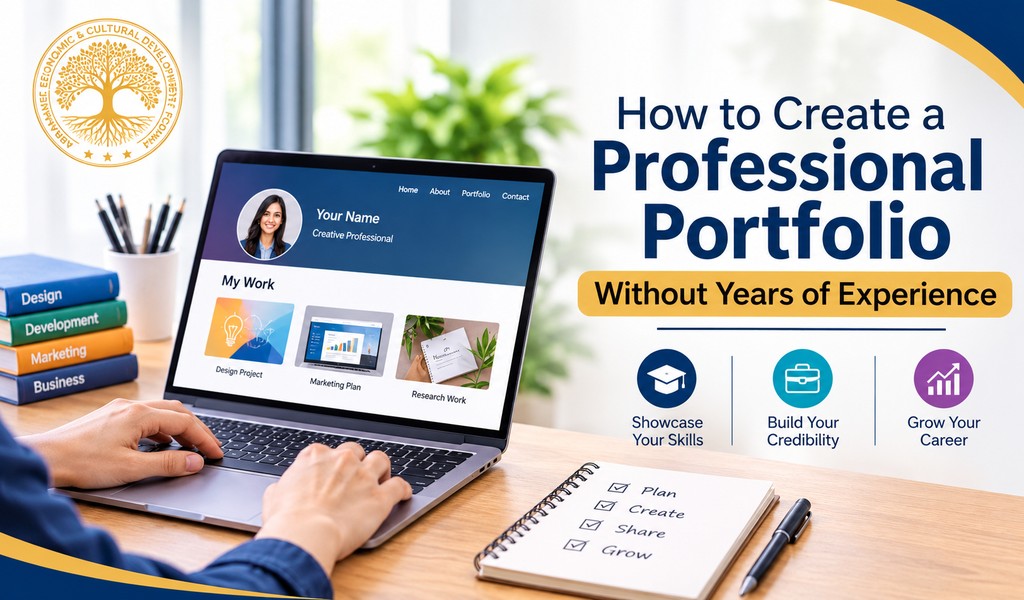
Build Your Portfolio Before You Build Years of Experience!
A professional portfolio is not just a collection of achievements from a long career. It is a way to demonstrate what you can do, how you approach challenges, and what value you can bring to an organisation or client.
For students, fresh graduates, career changers, freelancers, and early-career professionals, building a portfolio can feel difficult. They may believe they need years of employment, major projects, or impressive job titles before they have anything worth presenting.
That is not necessarily true. A strong portfolio can begin with academic assignments, personal projects, volunteer work, internships, practical exercises, and other examples that demonstrate relevant skills. What matters most is presenting this work honestly, clearly, and professionally.
1. Understand What a Professional Portfolio Should Demonstrate
A professional portfolio provides evidence of your abilities. Unlike a traditional CV, which mainly lists qualifications, responsibilities, and experience, a portfolio shows examples of what you have actually created, completed, or contributed to.
Depending on your career field, it might include:
-
Writing samples, articles, or research projects
-
Graphic designs, presentations, or creative work
-
Website designs, coding projects, or technical demonstrations
-
Marketing plans, campaign concepts, or content calendars
-
Academic projects and case studies
-
Volunteer contributions and community initiatives
-
Certificates and records of relevant training
The purpose is not to include everything you have ever done. It is to select work that supports the professional direction you want to pursue.
For example, someone applying for a digital marketing role could include a sample social media campaign, a content calendar, a keyword research exercise, and a short explanation of the audience and objectives behind the work.
2. Start With Projects, Not Job Titles
One of the biggest misconceptions about professional portfolios is that every example must come from paid employment.
In reality, useful evidence can come from different learning and practical experiences.
Academic and personal projects
A university assignment can become a portfolio example when it demonstrates research, problem-solving, communication, or technical ability. A personal project can also show initiative and the willingness to practise independently.
For instance, an aspiring web developer might create a simple website for a fictional business. A student interested in business management could prepare a market research report using publicly available information.
Clearly identify these as academic or self-initiated projects rather than presenting them as paid client work.
Volunteer work and internships
Volunteering can provide opportunities to work with real people, understand practical requirements, and develop professional habits.
Helping a community organisation prepare an event, supporting a small business with basic social media content, or assisting with a research activity may provide useful portfolio material.
Where possible, explain your specific contribution and obtain permission before sharing work created for an organisation.
Practice projects and simulations
If you have not yet had an opportunity to work with a client, create a realistic practice project.
A person interested in graphic design could develop a sample brand identity. Someone preparing for a data analysis role could analyse an openly available dataset and explain the findings.
Make it clear that the project is a demonstration or simulation. Honesty makes your portfolio more credible.
3. Choose a Clear Professional Direction
A portfolio becomes less effective when it tries to represent too many unrelated interests.
Before selecting your work, identify the type of opportunity you want to pursue.
Ask yourself:
-
Which industry or profession interests me?
-
What skills do employers or clients expect in this field?
-
What kind of work would I like to do?
-
Which of my existing projects demonstrate relevant abilities?
You do not need to commit to one career path forever. However, giving your portfolio a clear focus helps readers understand your strengths.
For example, a person interested in communication and marketing might organise their portfolio around content writing, audience research, campaign planning, and presentation skills.
4. Demonstrate Skills Through Real Examples
Simply writing that you are creative, organised, analytical, or a good communicator does not provide much evidence.
A portfolio should show how these skills appear in your work.
Explain the problem, your approach, and the result
For each major project, include a short description covering:
The objective: What were you trying to achieve?
Your contribution: What tasks or responsibilities did you handle?
Your approach: What steps, tools, or methods did you use?
The outcome: What did you produce, learn, or improve?
For example:
Project: Social Media Content Plan
-
Objective: Develop a sample content plan for a small retail business.
-
Contribution: Researched the target audience and prepared a monthly content calendar.
-
Approach: Organised content around product information, customer questions, and seasonal themes.
-
Outcome: Created a structured plan that demonstrates content planning and audience awareness.
If a project has no measurable business result, do not invent one. Explain the completed work and what it demonstrates.
5. Make Your Portfolio Easy to Navigate
A portfolio should help someone understand your abilities without having to search through large amounts of information.
You can create it as a PDF, a personal website, a digital presentation, or a professional profile with links to selected work.
Essential sections to include
1. Introduction
Write a short professional introduction explaining your interests, background, and career direction.
2. Skills
List relevant technical and transferable skills. Include only those you can reasonably demonstrate.
3. Selected projects
Present your strongest examples with a short explanation of your role and approach.
4. Education and training
Mention relevant qualifications, courses, workshops, and certifications. Keep information accurate and current.
5. Contact information
Include a professional email address and appropriate links, such as LinkedIn or a personal website.
Keep the layout consistent, use readable fonts, and avoid unnecessary decoration. The quality of the work should remain the main focus.
6. Use Free and Accessible Tools to Present Your Work
Building a professional portfolio does not always require an expensive website or specialist software.
Depending on your field, useful starting points include:
-
Canva: For visual portfolios, presentations, and design samples.
-
Google Drive: For organising and sharing documents and project files.
-
GitHub: For showcasing code, software projects, and technical documentation.
-
Behance: For presenting selected creative and design work.
-
LinkedIn: For sharing professional achievements and directing people to your portfolio.
Choose tools that suit your work and make access straightforward. Check sharing permissions before sending links to employers or clients.
7. Focus on Quality Rather Than Quantity
A portfolio does not become impressive simply because it contains many projects.
A small collection of carefully selected examples is often easier to understand and evaluate than a large collection of unrelated work.
Start with three to five strong projects if that is what you have available. Each example should serve a purpose and demonstrate a relevant skill.
Review your portfolio regularly. Remove outdated material, correct errors, and replace weaker examples as your abilities develop.
8. Include Learning and Professional Development
Employers and clients may also want to understand how you approach learning and improvement.
You can demonstrate this through:
-
Relevant online courses and certifications
-
Workshop participation
-
Independent research
-
Practical assignments
-
New tools or techniques you have learned
-
Feedback you received and how you applied it
Do not rely on certificates alone. Whenever possible, connect learning to a practical example.
For instance, completing a course in data analysis becomes more meaningful when accompanied by a small project showing how you used the concepts.
9. Build Credibility Through Honesty and Professionalism
A portfolio should represent your abilities accurately. Avoid claiming responsibility for work completed by a team or presenting practice projects as commercial assignments.
If a project involved collaboration, explain your individual contribution. If you used publicly available information, credit the source where appropriate. Obtain permission before displaying confidential, private, or client-owned material.
You should also check spelling, grammar, formatting, file links, and image quality before sharing your portfolio.
Professional credibility grows when the work is presented clearly and the information can be trusted.
10. Keep Improving Your Portfolio as Your Career Develops
Your first portfolio is a starting point, not a finished record of your professional life.
As you gain experience, add stronger projects, practical outcomes, new qualifications, and examples of increasing responsibility.
Ask mentors, teachers, colleagues, or professionals in your chosen field to review your work. Their feedback can help you identify gaps and improve how you present your abilities.
A portfolio should develop alongside your career goals.
AECD Forum Perspective
Professional development is not limited to formal education or years spent in a particular job. It also involves applying knowledge, developing practical skills, building confidence, and demonstrating the ability to contribute.
This connects naturally with the broader interests of the Abrahamic Economic & Cultural Development (AECD) Forum in education, skill development, youth empowerment, women's empowerment, training, entrepreneurship, and professional development.
For students and young professionals, portfolio building can help connect classroom learning with workplace expectations. For career changers and women returning to professional life, it can provide a structured way to demonstrate relevant abilities gained through different experiences.
Educational institutions, training providers, employers, and community organisations can also support this process by creating opportunities for practical assignments, mentorship, internships, collaborative projects, and skills-based learning.
A stronger connection between learning and practical evidence can help individuals communicate their capabilities more effectively and prepare for a wider range of professional opportunities.
Practical Action Points
-
Choose a career direction: Identify the type of role, industry, or client you want to approach.
-
List your existing work: Review academic assignments, personal projects, volunteer activities, and training exercises.
-
Select relevant examples: Choose three to five projects that demonstrate useful skills.
-
Explain your contribution: Describe what you did, how you approached the task, and what you produced.
-
Create a simple portfolio: Use a PDF, website, or suitable digital platform to organise your work.
-
Ask for feedback: Request a review from a teacher, mentor, colleague, or professional in your field.
-
Update it regularly: Add new work and remove examples that no longer represent your current abilities.
Building a strong professional portfolio does not require an impressive job title or many years of experience. It requires a clear understanding of your skills, a willingness to practise, and the ability to present your work meaningfully.
Every academic assignment, personal project, volunteer contribution, or practical exercise can become an opportunity to demonstrate what you are capable of doing. The important step is to select relevant examples, explain them honestly, and continue improving.
For students, graduates, career changers, and aspiring professionals, a portfolio can serve as a practical bridge between learning and employment. Start with what you have, build on what you learn, and let the quality of your work communicate your potential.
#ProfessionalPortfolio #CareerDevelopment #ProfessionalGrowth #SkillDevelopment #CareerPlanning #FreshGraduates #Students #YouthDevelopment #EmployabilitySkills #PersonalBranding #LifelongLearning #ProfessionalDevelopment