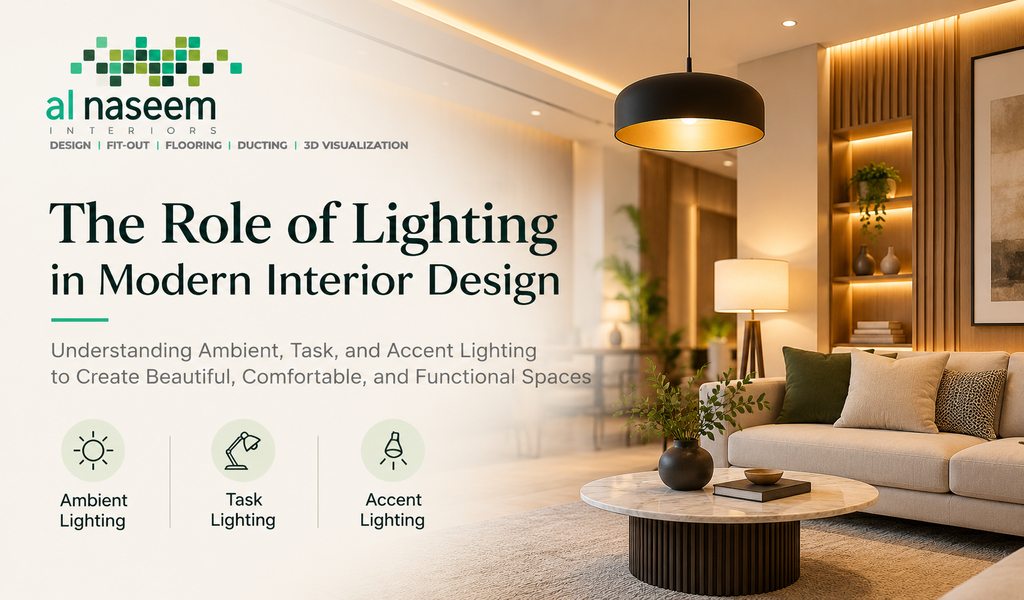
Good Lighting Makes Good Design Better
Lighting is one of the most important elements of interior design, yet it is often considered only after furniture, flooring, wall finishes, and decorative elements have been selected. In reality, lighting plays a much bigger role than simply making a room brighter. It influences how a space looks, how people feel, how comfortably they perform everyday activities, and how different design features are experienced.
A beautifully designed room can lose much of its appeal if the lighting is too harsh, poorly positioned, or insufficient. Similarly, a simple interior can feel sophisticated and welcoming when the lighting is thoughtfully planned.
Modern interior design focuses on creating spaces that balance appearance with functionality. This is where a well-designed lighting scheme becomes essential.
Whether it is a luxury villa, apartment, office, restaurant, or retail space, understanding the three main types of lighting—ambient, task, and accent lighting—can help create interiors that are both practical and visually appealing.
1. Why Is Lighting Important in Interior Design?
Lighting affects almost every aspect of an interior environment. It influences visibility, highlights architectural details, supports different activities, and helps establish the atmosphere of a room.
A well-planned lighting design can:
-
Make rooms feel brighter and more welcoming.
-
Improve visibility for everyday activities.
-
Highlight furniture, artwork, and architectural features.
-
Create different moods for different occasions.
-
Support comfortable working and reading environments.
-
Enhance the appearance of colours and materials.
-
Help define different functional areas within an open space.
Lighting should therefore be considered during the early stages of interior planning rather than treated as a finishing detail.
2. Understanding the Three Main Types of Interior Lighting
A successful lighting scheme generally combines three essential layers: ambient lighting, task lighting, and accent lighting.
Each serves a different purpose, but they work best when planned together.
3. Ambient Lighting: The Foundation of a Well-Lit Space
Ambient lighting, also known as general lighting, provides the primary illumination for a room.
Its purpose is to create an overall level of brightness that allows people to move around and use the space comfortably.
Without sufficient ambient lighting, a room may feel dark, unevenly illuminated, or difficult to navigate.
Common Types of Ambient Lighting
-
Recessed ceiling lights
-
Ceiling-mounted fixtures
-
Chandeliers
-
Pendant lights
-
Cove lighting
-
Indirect ceiling lighting
Where Is Ambient Lighting Used?
Living rooms: Provides general illumination while creating a comfortable atmosphere for everyday activities.
Bedrooms: Supports overall visibility without necessarily making the room excessively bright.
Kitchens: Provides general illumination across work areas and circulation spaces.
Offices: Helps maintain suitable visibility throughout the workplace.
Commercial spaces: Creates a consistent lighting environment for customers, employees, and visitors.
Design Considerations
Ambient lighting should be planned according to room dimensions, ceiling height, natural daylight, surface finishes, and the activities performed in the space.
The number and positioning of light fixtures should be based on the required illumination rather than simply installing as many lights as possible.
4. Task Lighting: Lighting Designed for Specific Activities
While ambient lighting illuminates the overall room, task lighting provides focused illumination for particular activities.
It is especially useful in areas where people need clear visibility and precision.
Common Types of Task Lighting
-
Desk lamps
-
Under-cabinet kitchen lights
-
Reading lamps
-
Adjustable wall lights
-
Vanity mirror lights
-
Focused workstation lighting
Where Is Task Lighting Most Useful?
Kitchen: Under-cabinet lighting can illuminate countertops and preparation areas, making everyday cooking tasks easier.
Home office: Desk lamps and suitable workstation lighting can improve visibility when reading, writing, or working with documents.
Bedroom: Bedside reading lights provide focused illumination without requiring the entire room to be brightly lit.
Bathroom: Properly positioned mirror lighting helps provide more even illumination for grooming activities.
Retail spaces: Focused lighting can help employees and customers see products and displays clearly.
Design Considerations
Task lighting should be positioned carefully to minimise shadows, reflections, and glare.
For example, a desk lamp should provide sufficient illumination without creating distracting reflections on a computer screen. In kitchens, under-cabinet lighting should be positioned to illuminate the working surface rather than the user's back.
Choosing adjustable fixtures can also make task lighting more flexible.
5. Accent Lighting: Highlighting the Beauty of an Interior
Accent lighting is used to draw attention to specific objects, surfaces, or architectural features.
It adds depth and visual interest by creating contrast between illuminated and less illuminated areas.
Unlike ambient lighting, which serves the entire room, accent lighting has a more selective purpose.
Common Types of Accent Lighting
-
Picture lights
-
Track lighting
-
Wall washers
-
Display cabinet lighting
-
LED strip lighting
-
Recessed spotlights
-
Cove and feature lighting
Where Is Accent Lighting Used?
Feature walls: Highlights decorative finishes, textured surfaces, or architectural details.
Artwork: Directs attention towards paintings, photographs, and decorative pieces.
Display cabinets: Illuminates selected objects, collections, and decorative accessories.
Living rooms: Adds visual depth around shelving, TV units, and selected design features.
Reception areas: Highlights branding, signage, and architectural elements.
Design Considerations
Accent lighting should complement the overall lighting scheme rather than overpower it.
The direction, intensity, and beam angle should be selected according to the feature being illuminated. For valuable artwork or light-sensitive materials, suitable lighting and exposure levels should also be considered.
6. How to Combine Ambient, Task, and Accent Lighting?
One of the most effective approaches to modern interior lighting is layering.
Instead of depending on one central ceiling light, designers combine different lighting sources to create a balanced environment.
For example, consider a modern living room:
-
Ambient lighting: Recessed ceiling lights provide general illumination.
-
Task lighting: A floor lamp near the sofa supports reading.
-
Accent lighting: LED strips highlight a feature wall or display shelving.
Together, these layers provide flexibility for different activities and occasions.
During the day, natural daylight may provide much of the required illumination. In the evening, ambient lighting can be reduced while accent and task lighting create a more relaxed environment.
The objective is to make lighting adaptable rather than treating every room as if it has only one lighting requirement.
7. The Importance of Natural Light
Artificial lighting is only one part of a successful lighting design. Natural daylight should also be considered from the beginning of an interior project.
Windows, skylights, glass doors, and open layouts can help bring daylight into interior spaces.
Natural light can make rooms feel more connected to their surroundings and may reduce the need for artificial lighting during daylight hours.
However, daylight needs to be managed carefully.
Direct sunlight can create glare, excessive brightness, and unwanted heat gain. Appropriate window treatments, shading, glazing, and furniture positioning can help manage these conditions.
For residential and commercial interiors in Dubai and the UAE, controlling solar heat and glare is particularly important because of the region's strong sunlight.
A good lighting plan considers both the benefits and limitations of natural daylight.
8. Choosing the Right Colour Temperature
Colour temperature affects how artificial lighting appears to the eye. It is measured in Kelvin (K).
Different colour temperatures create different visual effects.
Warm White (Approximately 2700K–3000K)
Warm white lighting produces a softer, warmer appearance.
It is commonly used in:
-
Bedrooms
-
Living rooms
-
Hotel-style interiors
-
Relaxation areas
-
Selected dining spaces
Neutral White (Approximately 3500K–4000K)
Neutral white offers a more balanced appearance between warm and cool tones.
It may be suitable for:
-
Kitchens
-
Bathrooms
-
Offices
-
Work areas
-
General residential spaces
Cool White (Approximately 5000K–6500K)
Cooler lighting produces a more neutral-to-blue appearance.
It may be considered for selected task-oriented or technical environments, depending on the application and visual requirements.
However, higher colour temperature does not automatically mean better visibility or productivity.
The appropriate choice depends on the room's function, surrounding materials, user preferences, and the required lighting quality.
9. Lighting Design for Different Interior Spaces
Every room has different lighting requirements. A successful design should respond to how each area is used.
Living Room Lighting
Living rooms often serve several purposes, including relaxation, entertainment, reading, and social gatherings.
A combination of ambient ceiling lighting, floor lamps, wall lights, and accent lighting can provide flexibility.
Dimmable lighting can be particularly useful when different activities require different brightness levels.
Bedroom Lighting
Bedrooms should have lighting that supports both practical activities and relaxation.
A balanced arrangement may include general ceiling lighting, bedside reading lights, and subtle accent lighting around selected architectural details.
The positioning of switches is also important for everyday convenience.
Kitchen Lighting
Kitchens require careful lighting because different areas support different activities.
A practical lighting arrangement may include general ceiling illumination, focused lighting over worktops, and selected decorative lighting over dining counters or islands.
Lighting should avoid casting unnecessary shadows across preparation surfaces.
Bathroom Lighting
Bathroom lighting needs to support grooming and everyday activities while being suitable for wet and humid conditions.
Mirror lighting should provide reasonably even illumination, while ceiling fixtures must have appropriate electrical and moisture-protection ratings for their installation zones.
Office Lighting
Office lighting should provide comfortable visibility for computer work, reading, meetings, and collaborative activities.
Glare control, uniformity, daylight management, and appropriate fixture positioning are important considerations.
10. Modern Lighting Trends in Interior Design
Lighting technology and design continue to evolve, giving homeowners and businesses more ways to personalise their spaces.
Some popular approaches include:
LED Lighting: Energy-efficient LED technology is widely used in ceiling lights, strip lighting, downlights, and decorative fixtures.
Smart Lighting Systems: Smart controls can allow users to adjust brightness, colour temperature, and lighting schedules where compatible systems are installed.
Minimalist Lighting: Simple fixtures with clean lines complement contemporary and understated interiors.
Indirect Lighting: Concealed lighting can create soft illumination while reducing the visual presence of the light source.
Statement Pendant Lights: Carefully selected decorative fixtures can become focal points above dining tables, kitchen islands, or reception areas.
Integrated Architectural Lighting: Lighting can be incorporated into ceiling details, wall panels, shelving, and joinery to create a cohesive design.
The most effective trends are those that support the function and character of the space rather than being adopted purely for appearance.
11. Common Lighting Mistakes to Avoid
Even an expensive lighting installation may not deliver the desired result if the planning is inadequate.
Some common mistakes include:
-
Depending entirely on one central ceiling light.
-
Installing too many recessed spotlights.
-
Choosing colour temperatures that conflict across adjoining areas.
-
Ignoring glare on television and computer screens.
-
Positioning lights without considering furniture arrangements.
-
Using decorative lighting without sufficient general illumination.
-
Forgetting task lighting in kitchens, workspaces, and reading areas.
-
Selecting unsuitable fixtures for bathrooms or outdoor locations.
-
Failing to plan switches, dimmers, and electrical connections in advance.
A coordinated lighting plan can help avoid these issues and ensure that every fixture has a clear purpose.
12. Why Professional Lighting Planning Matters?
Lighting design involves more than selecting attractive fixtures from a catalogue.
It requires understanding the room's dimensions, ceiling structure, electrical requirements, furniture arrangement, natural light, and intended activities.
A professional lighting plan may include:
-
Assessing the layout and function of each room.
-
Understanding natural daylight conditions.
-
Identifying ambient, task, and accent lighting requirements.
-
Selecting suitable fixtures and colour temperatures.
-
Planning fixture positions and lighting levels.
-
Coordinating ceiling designs and electrical layouts.
-
Integrating dimmers and smart controls where required.
-
Reviewing the installation and final lighting effect.
For larger residential and commercial projects, coordination between interior designers, electrical consultants, ceiling contractors, and fit-out teams is particularly important.
It helps ensure that lighting fixtures, false ceilings, electrical systems, and architectural details work together.
Lighting is not simply the final touch added to an interior. It is an essential design element that influences how a space looks, feels, and functions.
Ambient lighting provides overall illumination, task lighting supports specific activities, and accent lighting highlights important design features. When these three layers are carefully combined with natural daylight, suitable colour temperatures, and appropriate controls, they can create interiors that are comfortable, practical, and visually balanced.
Whether you are designing a modern apartment, luxury villa, office, or commercial property, thoughtful lighting planning can make a meaningful difference to the finished environment.
At Al Naseem Interiors, lighting should be considered as part of the complete interior design and fit-out process. By coordinating lighting with false ceilings, furniture layouts, materials, and architectural details, it becomes possible to create spaces where every lighting element serves a purpose.
Great interior design is not only about what you see. It is also about how the space is illuminated and experienced.