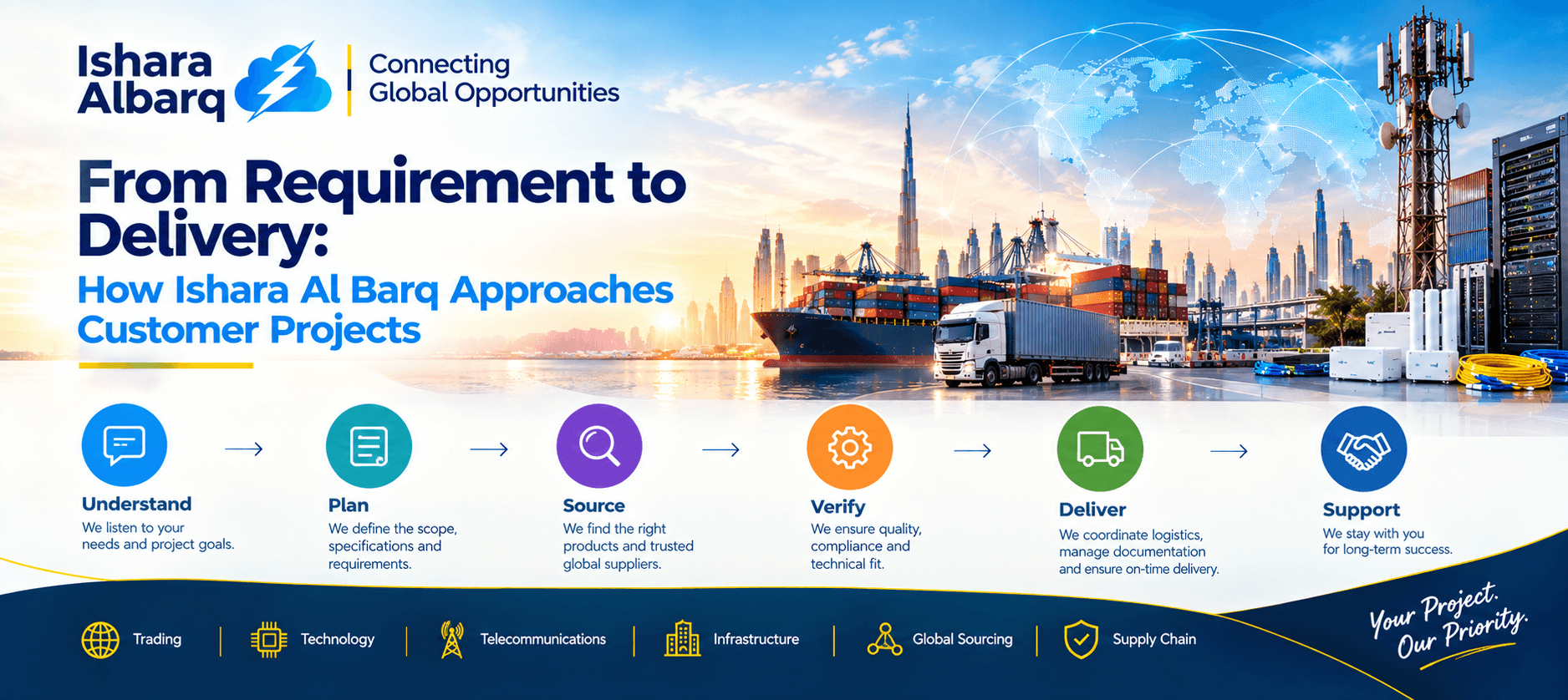
Understanding Needs. Sourcing Solutions. Delivering Results. ⭐
From Understanding the Need to Delivering the Right Solution
Show Methodology | Customer-Centric Approach | Trading, Technology & Infrastructure
A successful customer project does not begin when a product is shipped.
It begins much earlier—with understanding what the customer actually needs.
In technology, telecommunications, infrastructure, and international procurement, customers often have requirements that go beyond a simple product specification. They may need specific equipment, a particular quantity, a defined delivery timeline, technical compatibility, quality assurance, international sourcing, and reliable coordination from supplier to final destination.
This is why having a clear and structured project methodology matters.
At Ishara Al Barq, the approach is built around connecting the customer's requirement with the right products, suppliers, technical considerations, commercial expectations, and delivery process.
The objective is simple:
Understand the requirement → Find the right solution → Coordinate the supply chain → Deliver with confidence.
1. Understanding the Customer Requirement
Every project starts with listening.
Before recommending a product or approaching suppliers, it is important to understand the customer's actual requirement.
This can include:
-
Product type
-
Technical specifications
-
Quantity
-
Application
-
Project location
-
Required delivery date
-
Quality expectations
-
Budget considerations
-
Documentation requirements
-
Installation or project requirements
For technical and infrastructure projects, even a small detail can influence the final product selection.
That is why the first stage is not about selling.
It is about understanding.
2. Converting Requirements Into a Clear Scope
Once the requirement is understood, the next step is to organize it into a clear project scope.
A well-defined scope helps answer:
What exactly is required?
How much is required?
What technical standards need to be followed?
When is it required?
Where does it need to be delivered?
What quality and documentation requirements apply?
This creates a common understanding between the customer, procurement team, suppliers, and other stakeholders.
Clear scope reduces the risk of misunderstandings later in the project.
3. Identifying the Right Product or Solution
The cheapest available product is not necessarily the right product.
For technical projects, product selection should consider:
-
Compatibility
-
Performance
-
Capacity
-
Reliability
-
Application
-
Availability
-
Lead time
-
Quality
-
Long-term requirements
For example, a telecommunications project may require equipment that works with an existing network environment.
Simply finding a product that matches the name of the requested item may not be enough.
The solution needs to fit the application.
4. Connecting With the Right Suppliers
Once the requirement is clearly defined, supplier sourcing begins.
International supplier networks can provide access to manufacturers and suppliers across different markets.
However, supplier selection should involve more than comparing quotations.
Important factors can include:
-
Manufacturing capability
-
Product quality
-
Experience
-
Production capacity
-
Lead time
-
Communication
-
Technical capability
-
Commercial terms
-
Previous performance
The objective is to identify suppliers that can realistically meet the project's requirements.
A strong supplier network is valuable because it creates options—not because it simply contains many names.
5. Technical Verification
Technical products require technical understanding.
Before moving forward, important specifications can be reviewed to ensure that the proposed product aligns with the customer's requirement.
Depending on the project, this may involve reviewing:
-
Technical datasheets
-
Product models
-
Specifications
-
Compatibility
-
Interfaces
-
Capacity
-
Standards
-
Accessories
-
Testing requirements
This step helps reduce the risk of receiving a product that looks correct commercially but does not work for the intended application.
6. Commercial Evaluation
After technical requirements are understood, commercial factors can be evaluated.
A project quotation may involve more than the product price.
Businesses should consider:
Product Cost + Quality + Lead Time + Logistics + Documentation + Delivery
This broader view provides a better understanding of the overall sourcing requirement.
A lower purchase price may not always represent better value if it comes with poor quality, unreliable delivery, or excessive lead times.
The goal is value—not simply the lowest number.
7. Quality Assurance
Quality is an important part of the customer journey.
Depending on the product and project, quality assurance may involve:
-
Supplier verification
-
Specification checks
-
Sample review
-
Production monitoring
-
Pre-shipment inspection
-
Testing
-
Documentation review
The earlier potential quality issues are identified, the easier they can generally be managed.
This is especially important for infrastructure and telecommunications equipment where product performance can influence the wider project.
8. Coordinating Production
Once the order is confirmed, supplier coordination becomes critical.
Production should be monitored against the agreed schedule.
Key milestones may include:
Order Confirmation → Production Start → Production Progress → Completion → Quality Check → Packing
Regular communication provides visibility into whether the project remains on schedule.
If a supplier encounters an unexpected issue, early communication gives the customer more time to consider alternatives.
9. Managing International Logistics
For internationally sourced products, delivery is a journey—not a single event.
The process can involve:
Supplier → Factory → Inspection → Packing → Freight → Customs → UAE → Warehouse → Project Site
Each stage needs coordination.
A delay at one stage can affect the next.
This is why logistics should be considered from the beginning rather than after production has already finished.
10. Documentation and Compliance
International procurement also requires attention to documentation.
Depending on the product and transaction, documentation may include:
-
Commercial invoice
-
Packing list
-
Certificate of origin
-
Product documentation
-
Inspection reports
-
Technical documents
-
Other applicable certificates
Accurate documentation helps support smoother movement of goods and provides customers with the information they need for their projects.
The physical product and its documentation should move together as part of one coordinated process.
11. Keeping the Customer Updated
Communication is one of the most important parts of project management.
Customers should have visibility into important milestones.
For example:
Requirement Confirmed
The project scope is understood.
Supplier Selected
The sourcing route is established.
Order Confirmed
Commercial and technical requirements are aligned.
Production Started
Manufacturing is underway.
Quality Completed
Products have passed the required checks.
Shipment Dispatched
The order is moving toward its destination.
Delivery Completed
The products have reached the required location.
This level of visibility creates confidence and makes project planning easier.
12. Managing Changes
Customer requirements can change.
Quantities may increase.
Specifications may be updated.
Delivery schedules may move.
A product may become temporarily unavailable.
A strong project methodology needs to accommodate change without losing control of the overall process.
The key is to evaluate:
What changed?
Why did it change?
What is the impact?
What alternatives are available?
Does the project timeline need to be updated?
This creates a more structured approach to changing requirements.
13. Solving Problems Before They Become Bigger
No international supply chain is completely free from unexpected challenges.
A supplier may face production issues.
A shipment may experience delays.
A product may become unavailable.
Documentation may require correction.
The important factor is how quickly the issue is identified and managed.
A proactive approach follows:
Identify → Assess → Communicate → Resolve → Monitor
This can help prevent smaller problems from becoming major project disruptions.
14. Coordinating Multiple Stakeholders
Customer projects often involve several parties.
These may include:
-
Customer teams
-
Procurement professionals
-
Engineers
-
Suppliers
-
Manufacturers
-
Quality inspectors
-
Freight providers
-
Logistics teams
-
Warehouse teams
-
Project managers
Each stakeholder has a different role.
The project becomes more efficient when everyone has access to the right information at the right time.
This is where coordination creates real value.
15. Delivery Is More Than Reaching the Destination
A successful project should not be measured only by whether a shipment arrived.
The bigger questions are:
Did the right product arrive?
Did it meet the agreed requirements?
Was the quantity correct?
Was the delivery aligned with the project schedule?
Was the documentation complete?
Was the customer kept informed?
This is the difference between simply moving products and managing a customer project.
Ishara Al Barq's Integrated Approach
Ishara Al Barq's model connects multiple capabilities across the customer journey.
1. Customer Requirement
Understanding the business and technical need.
↓
2. Product & Solution Identification
Finding suitable products based on the application.
↓
3. Global Supplier Sourcing
Connecting with relevant international suppliers.
↓
4. Technical & Commercial Evaluation
Balancing specifications, quality, cost, and lead time.
↓
5. Quality & Production Coordination
Monitoring manufacturing and quality requirements.
↓
6. International Logistics
Coordinating the movement of products.
↓
7. UAE Delivery
Managing the journey toward the customer or project site.
↓
8. Long-Term Relationship
Supporting future requirements and sourcing opportunities.
This integrated methodology reflects Ishara Al Barq's broader positioning across trading, technology, telecommunications, infrastructure, global sourcing, and supply-chain management.
Why This Methodology Matters to Customers
Customers often do not want to manage ten different conversations for one project.
They want clarity.
They want to know:
-
What is being sourced?
-
Who is supplying it?
-
Does it meet the requirement?
-
When will it be ready?
-
When will it ship?
-
When will it arrive?
-
What happens if something changes?
A structured project methodology helps bring these questions together.
The result is a more connected customer experience from requirement to delivery.
Global Sourcing With Local Understanding
International sourcing provides access to manufacturers and suppliers around the world.
But sourcing internationally also requires an understanding of the destination market.
For UAE businesses, this can mean considering:
-
Delivery requirements
-
Import processes
-
Documentation
-
Project timelines
-
Local customer expectations
-
Infrastructure requirements
Combining global supplier access with an understanding of UAE business requirements can make the sourcing process more effective.
Building Trust Through Process
Trust is not created by a single successful transaction.
It is built through consistent execution.
Customers gain confidence when a partner:
-
Understands their requirements
-
Provides accurate information
-
Works with reliable suppliers
-
Communicates clearly
-
Monitors progress
-
Addresses problems early
-
Delivers according to expectations
A strong methodology provides the foundation for that consistency.
Beyond a Transaction
A traditional trading transaction can look like:
Order → Supplier → Shipment → Delivery
But a customer-focused project approach is broader:
Requirement → Analysis → Sourcing → Verification → Procurement → Quality → Logistics → Delivery → Relationship
The difference is significant.
The first model focuses on moving a product.
The second focuses on delivering a solution that supports the customer's objective.
The Role of Technology in Project Management
Technology can also improve visibility throughout the customer journey.
Digital tools can help track:
-
Orders
-
Supplier progress
-
Inventory
-
Production
-
Shipments
-
Documentation
-
Delivery milestones
As businesses manage increasingly complex international supply chains, digital visibility can become an important part of efficient project management.
The future of procurement is not simply about buying faster.
It is about seeing the entire process more clearly.
A Methodology Built Around the Customer
Every customer project is different.
Some projects may require a single product.
Others may involve multiple suppliers, technical specifications, international shipping, and strict delivery timelines.
The methodology should therefore remain structured while still being flexible enough to accommodate different requirements.
The core principle remains the same:
Understand first. Source intelligently. Coordinate carefully. Communicate clearly. Deliver reliably.
Final Thoughts
A customer project does not end when a supplier accepts an order.
It moves through multiple stages before the required product reaches its final destination.
Every stage creates an opportunity to add value—or create risk.
At Ishara Al Barq, the focus is on connecting these stages through an integrated approach to customer requirements, global sourcing, technology, telecommunications, infrastructure, supplier coordination, and logistics.
From the first conversation to final delivery, the objective is to make the journey more structured, transparent, and reliable.
Because successful project delivery is not simply about getting a product from one place to another.
It is about understanding what the customer needs—and making sure every step works toward delivering it.
Ishara Al Barq
From Requirement to Delivery — Connecting Global Suppliers, Technology & Infrastructure.
Key Takeaways
-
Every successful project starts with clearly understanding the customer requirement.
-
Technical and commercial requirements should be evaluated together.
-
Supplier selection should consider quality, capability, reliability, and lead time—not just price.
-
Quality assurance should be integrated into the sourcing process.
-
International logistics requires coordination across multiple stages.
-
Clear communication gives customers better project visibility.
-
Early identification of problems can help reduce project disruption.
-
A structured methodology can improve consistency across different customer projects.
-
Global supplier access becomes more valuable when combined with local market understanding.
-
Customer relationships are strengthened through transparency, reliability, and consistent execution.
-
Ishara Al Barq's approach connects trading, technology, telecommunications, infrastructure, global sourcing, and supply-chain coordination into one customer-focused journey.