Procurement & Sourcing
Choosing the right supplier is one of the most important decisions in procurement. A supplier may influence the quality of your products, delivery schedules, operating costs, customer satisfaction, and ultimately the reputation of your business.
This becomes even more important when working with overseas suppliers.
A professional website, attractive quotation, or persuasive sales presentation does not necessarily provide enough information to understand a supplier's real capabilities. Businesses need to look deeper before committing significant funds, sharing sensitive specifications, or entering a long-term commercial relationship.
This is where supplier due diligence becomes valuable.
Supplier due diligence is the process of gathering and checking relevant information about a supplier before and during a business relationship. It helps companies understand who they are dealing with, what the supplier can actually deliver, and where potential commercial or operational risks may exist.
For UAE businesses involved in international procurement and sourcing, a structured due-diligence process can provide an important layer of protection for business investments.
What Is Supplier Due Diligence?
Supplier due diligence is a structured review of a supplier's identity, capabilities, financial and operational information, compliance, reputation, quality systems, and business practices.
The depth of due diligence should depend on factors such as:
-
Supplier importance
-
Order value
-
Product category
-
Country and jurisdiction
-
Supply-chain dependency
-
Regulatory requirements
-
Business criticality
-
Level of customization
-
Potential consequences of supplier failure
A small routine purchase may require basic checks, while a strategic supplier responsible for critical technology or large recurring orders may require much deeper assessment.
Why Supplier Due Diligence Matters
A supplier relationship can create several types of risk.
Financial Risk
A supplier may fail to deliver after receiving payment, experience financial difficulties, or introduce unexpected costs.
Quality Risk
Products may not meet agreed specifications, resulting in returns, replacements, project delays, or customer complaints.
Operational Risk
Production capacity, staffing, equipment, or logistics problems can affect delivery schedules.
Compliance Risk
Products or suppliers may not meet applicable legal, regulatory, certification, or documentation requirements.
Reputation Risk
A supplier's business practices can potentially affect the reputation of companies that work with them.
Supply-Chain Risk
Overdependence on one supplier or one production location can create vulnerability when disruptions occur.
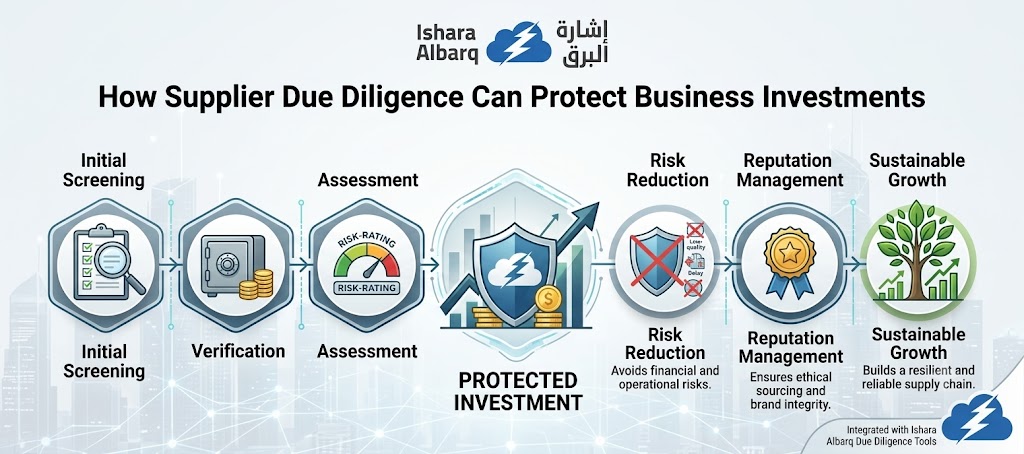
Due diligence does not eliminate these risks, but it can help businesses identify and manage them before making major commitments.
1. Verify the Supplier's Legal Identity
The first step is confirming that the supplier is a real and properly established business.
Collect information such as:
-
Legal company name
-
Registration number
-
Registered address
-
Operating address
-
Website
-
Official contact details
-
Years in business
-
Ownership information where relevant
Where available, verify registration details through appropriate official or commercial sources in the supplier's jurisdiction.
Do not rely solely on information provided in a sales email or online marketplace profile.
2. Understand Who Actually Manufactures the Product
A company presenting itself as a supplier may be a manufacturer, trading company, distributor, or sourcing intermediary.
This distinction can matter significantly.
Ask:
-
Is the product manufactured internally?
-
Where is the factory located?
-
Are third-party manufacturers involved?
-
Who controls production?
-
Who performs quality inspections?
-
Can the manufacturing facility be inspected?
A trading company may still be an appropriate supplier, but the buyer should understand the supply chain behind the transaction.
3. Check the Supplier's Experience
Experience can provide useful context when evaluating a supplier.
Consider:
-
How long the company has operated
-
Export experience
-
Industries served
-
Product categories
-
Markets supplied
-
Experience with similar projects
-
Experience with customers in the destination market
Relevant experience is particularly useful when products require technical knowledge, customization, or complex logistics.
4. Evaluate Financial Stability
For important supplier relationships, businesses may need to understand whether the supplier has the financial capacity to continue operating and fulfilling orders.
Depending on the transaction and available information, due diligence may include reviewing:
-
Company financial information
-
Credit information
-
Payment history
-
Trade references
-
Banking information where appropriate
-
Publicly available corporate information
The objective is not necessarily to obtain every financial detail. It is to understand whether there are obvious indicators that could affect the supplier's ability to perform its obligations.
For significant transactions, professional financial or legal due diligence may be appropriate.
5. Assess Production Capacity
A supplier may appear capable during negotiations but struggle to meet actual demand.
Ask about:
-
Production capacity
-
Number of production lines
-
Equipment
-
Workforce
-
Current utilization
-
Normal lead times
-
Peak-season capacity
-
Raw-material availability
-
Ability to scale production
If your business expects demand to increase, ask whether the supplier can support that growth.
6. Review Quality-Control Systems
Product samples are useful, but one good sample does not necessarily prove consistent production quality.
Ask how the supplier manages quality throughout the production process.
A mature quality process may include:
Incoming inspection → In-process inspection → Final inspection → Documentation → Shipment
Businesses can also define measurable acceptance criteria and, where appropriate, arrange independent inspections.
The goal is to verify not only what the supplier can produce once, but how consistently it can produce according to the agreed requirements.
7. Verify Certifications and Compliance
Certifications can be important depending on the product and market.
A due-diligence process may review:
-
Applicable product certifications
-
Testing reports
-
Quality-management certifications
-
Environmental documentation
-
Safety requirements
-
Technical standards
-
UAE import or regulatory requirements where applicable
Businesses should verify whether documents are authentic, current, relevant to the specific product, and applicable to the intended market.
Simply seeing a certification logo on a website is not enough.
8. Investigate References
Relevant customer references can provide useful information about a supplier's real-world performance.
Where commercially appropriate, ask for references from customers with similar requirements.
Questions may include:
-
Was delivery consistent?
-
Was product quality reliable?
-
How did the supplier handle problems?
-
Was communication effective?
-
Were specifications followed?
-
Did the supplier respond appropriately to complaints?
References should be independently verified where practical.
9. Examine the Supplier's Communication
Communication is often one of the earliest indicators of how a supplier relationship may operate.
During the evaluation process, observe:
-
Response times
-
Technical understanding
-
Accuracy of information
-
Willingness to provide documentation
-
Transparency about limitations
-
Handling of difficult questions
-
Ability to communicate changes
A supplier does not need to respond instantly to every message, but important requests should receive clear and professional responses within reasonable timeframes.
10. Check the Supplier's Physical Operations
For strategically important suppliers, businesses may consider a factory visit or independent audit.
An on-site assessment can provide information about:
-
Production facilities
-
Machinery
-
Storage areas
-
Raw materials
-
Quality-control processes
-
Production organization
-
Workforce
-
Safety practices
-
Actual manufacturing capabilities
When a physical visit is not practical, an independent third-party audit can provide another method of verification.
11. Review Cybersecurity and Data Protection
Technology procurement can involve more than physical products.
Suppliers may receive:
-
Technical drawings
-
Product designs
-
Customer information
-
Business documents
-
Software access
-
Network information
-
Commercial data
Where sensitive information is involved, supplier due diligence should consider how that information is stored, accessed, protected, and shared.
Businesses should also define appropriate confidentiality and data-protection requirements.
12. Evaluate Supply-Chain Dependencies
A supplier may itself depend on other companies.
For example:
Your Business → Supplier → Subcontractor → Raw-Material Provider
The more critical the product, the more important it may be to understand significant dependencies.
Ask:
-
Which components are sourced externally?
-
Are critical materials dependent on one provider?
-
Are products manufactured at one location?
-
Are important processes subcontracted?
-
What alternatives exist if a key supplier fails?
Understanding these dependencies can help businesses assess supply-chain resilience.
13. Review Logistics Capability
A supplier's responsibility does not necessarily end when production is complete.
International procurement may involve:
-
Export documentation
-
Packaging
-
Freight
-
Shipping schedules
-
Customs documentation
-
Insurance
-
Delivery coordination
Ask whether the supplier has experience with international shipments and whether the required documentation can be provided accurately and on time.
For UAE businesses, the procurement team should also understand the relevant import and customs requirements for the particular product.
14. Look for Warning Signs
Due diligence should also identify situations that require additional investigation.
Potential warning signs may include:
-
Unverifiable company information
-
Major inconsistencies in documentation
-
Unusually aggressive payment demands
-
Pressure to make immediate payments
-
Repeated changes in bank details
-
Unclear manufacturing locations
-
Refusal to provide basic documentation
-
Significant differences between samples and specifications
-
Unexplained delays in answering important questions
-
Claims that cannot be independently verified
A warning sign does not automatically prove misconduct. It means the business may need additional verification before proceeding.
15. Use Contracts to Protect the Relationship
Due diligence provides information, but contractual arrangements define the commercial relationship.
Depending on the transaction, agreements should clearly address:
-
Product specifications
-
Quantity
-
Pricing
-
Delivery terms
-
Inspection requirements
-
Quality standards
-
Payment terms
-
Warranty
-
Replacement procedures
-
Confidentiality
-
Intellectual property
-
Compliance obligations
-
Dispute resolution
-
Termination provisions
For significant international transactions, businesses should obtain appropriate legal advice regarding the contract and applicable jurisdictions.
16. Protect Intellectual Property
Technology procurement may involve proprietary designs, engineering drawings, product specifications, software, or other intellectual property.
Before sharing sensitive information, consider:
-
Confidentiality agreements
-
Access controls
-
Ownership provisions
-
Restrictions on unauthorized use
-
Restrictions on subcontracting
-
Secure document sharing
The level of protection should reflect the sensitivity and commercial value of the information.
17. Start With a Controlled Transaction
Even after completing due diligence, businesses can learn a great deal from actual performance.
Where appropriate, begin with a controlled order before moving into a larger long-term commitment.
Evaluate:
-
Product quality
-
Delivery accuracy
-
Packaging
-
Documentation
-
Communication
-
Issue resolution
-
Consistency
A supplier's performance during the first transaction can provide useful evidence for future procurement decisions.
18. Continue Monitoring Suppliers
Supplier due diligence should not necessarily be a one-time exercise.
Business circumstances can change.
A supplier may:
-
Expand rapidly
-
Change ownership
-
Move production
-
Change subcontractors
-
Lose certifications
-
Experience financial difficulties
-
Change key personnel
-
Become dependent on a new source
For critical suppliers, businesses can establish periodic reviews based on risk and importance.
A Practical Supplier Due-Diligence Checklist
| Area | What to Check |
|---|---|
| Legal Identity | Registration, address and company information |
| Ownership | Relevant ownership or corporate information |
| Manufacturing | Factory location and production model |
| Capacity | Production volume and scalability |
| Quality | QC procedures and inspection processes |
| Certifications | Applicable and verifiable documentation |
| Financial | Relevant financial and credit information |
| References | Experience and customer feedback |
| Logistics | Export and delivery capabilities |
| Compliance | Applicable laws, standards and requirements |
| Cybersecurity | Protection of sensitive business information |
| Supply Chain | Critical dependencies and subcontractors |
| Contract | Commercial, quality and legal terms |
| Performance | Results from samples and trial orders |
How Due Diligence Protects Business Investments
Supplier due diligence can help protect investments in several ways.
Before Payment
It can help verify who you are dealing with and whether the supplier appears capable of fulfilling the order.
Before Production
It can help confirm specifications, quality requirements, capacity, and documentation.
Before Shipment
Inspection and documentation checks can help verify whether the order meets agreed requirements.
During the Relationship
Ongoing monitoring can help identify changes that could affect supply, quality, compliance, or commercial performance.
This creates a more structured procurement process:
Verify → Assess → Document → Contract → Monitor
Supplier Due Diligence Is Not About Eliminating Every Risk
No due-diligence process can guarantee that a supplier relationship will never encounter problems.
Markets change. Companies experience unexpected events. Logistics can be disrupted. Demand can shift.
The purpose of due diligence is to help businesses make decisions using better information and appropriate risk controls.
The depth of the process should therefore match the potential impact of the supplier relationship.
A routine purchase and a strategic, high-value supplier should not necessarily receive the same level of investigation.
Final Thoughts
Supplier due diligence is an important part of responsible procurement because every supplier relationship represents a business decision and, in many cases, a financial commitment.
By verifying company information, evaluating manufacturing capabilities, checking quality systems, reviewing compliance, assessing financial and supply-chain risks, and documenting commercial expectations, businesses can build a clearer understanding of their suppliers before making significant commitments.
For UAE businesses working with international suppliers, this structured approach can support stronger procurement processes and more resilient supply chains.
The key question is not simply:
"Can this supplier offer us a good price?"
It is:
"Have we gathered enough reliable information to understand who we are doing business with and what risks we are taking?"
That is the foundation of effective supplier due diligence.