Category: Telecommunications & Networking
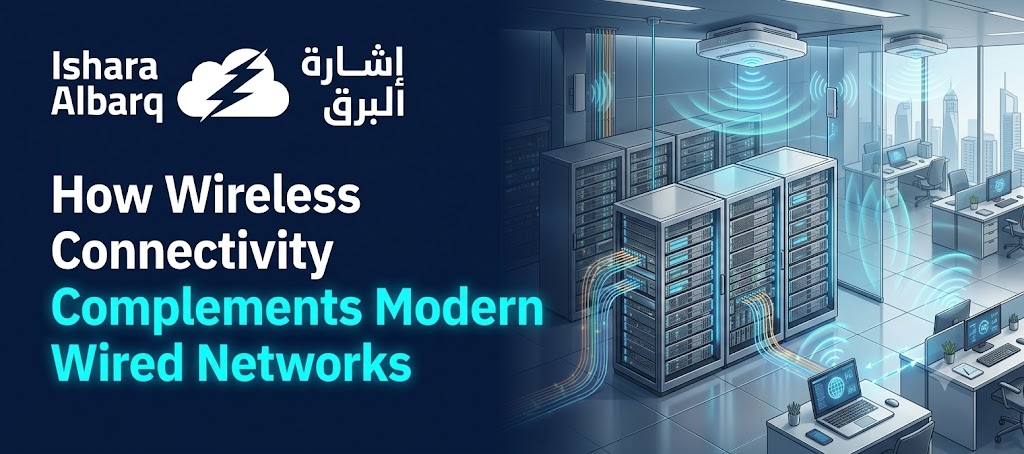
Modern businesses need connectivity that is reliable, flexible, and capable of supporting an increasing number of users and devices. While wireless technology provides the convenience of mobility, wired infrastructure continues to provide an important foundation for high-performance business networks.
The two technologies are not necessarily competing solutions.
In many modern business environments, wired and wireless networks work together, with each serving different connectivity requirements.
The Role of Wired Networks
Wired networks use physical connections such as copper Ethernet and fiber optic cabling to connect devices and network infrastructure.
They are commonly used for:
-
Network switches
-
Servers
-
Workstations
-
Access points
-
IP cameras
-
Network storage
-
Data centers
-
Building-to-building connections
Wired connectivity can provide predictable performance and is particularly useful for infrastructure that requires stable, high-capacity connections.
Fiber is often used for network backbones and longer-distance connections, while copper Ethernet is widely used for shorter connections to end devices.
Why Wireless Connectivity Matters
Wireless networks allow compatible devices to connect without requiring a physical network cable at the point of use.
This provides businesses with greater flexibility for employees and devices that need to move around a workplace.
Wireless connectivity can support:
-
Laptops and smartphones
-
Tablets
-
Wireless printers
-
IoT devices
-
Meeting-room equipment
-
Guest networks
-
Wireless access points
-
Mobile business applications
For modern workplaces, wireless access can make it easier for employees to work from different areas of a facility without requiring a physical network connection at every location.
Wired and Wireless Networks Work Together
A common misconception is that businesses must choose between wired and wireless infrastructure.
In reality, a wireless network itself depends heavily on wired infrastructure.
A typical setup may look like:
Internet / Core Network → Fiber Backbone → Network Switch → Ethernet Cable → Wireless Access Point → Wireless Devices
The wireless access point provides the wireless connection to users, but the access point still needs a reliable connection back to the network.
This means the quality of the wired infrastructure can directly influence the performance and capacity of the wireless network.
1. Wired Networks Provide the Foundation
Wireless access points need network connectivity and power.
In many business environments, Ethernet cabling connects access points to network switches. Technologies such as Power over Ethernet (PoE) can allow a compatible Ethernet connection to carry both data and electrical power.
This can simplify the deployment of wireless access points across offices, commercial buildings, and other facilities.
2. Wireless Adds Mobility
Wired connections are highly useful for fixed devices, but employees increasingly use mobile devices throughout the workplace.
Wireless connectivity allows users to move between areas while remaining connected to business applications and communication services.
This can be particularly useful in:
-
Offices
-
Hotels
-
Warehouses
-
Educational facilities
-
Healthcare environments
-
Retail locations
-
Large commercial buildings
The wireless design should reflect the physical environment and the number and type of devices being supported.
3. Network Capacity Must Include Wireless Demand
Adding wireless access does not automatically guarantee good performance.
A wireless network needs sufficient capacity for the number of connected devices and the applications they use.
Businesses should consider:
-
Number of users
-
Number of devices
-
User density
-
Application requirements
-
Access-point capacity
-
Wired uplink capacity
-
Internet bandwidth
-
Interference
-
Physical building layout
For example, an office with a large number of users participating in video meetings may have very different requirements from a small office primarily using email and web applications.
4. Wireless Design Requires More Than Coverage
A wireless network should not be designed only around whether a signal reaches a particular area.
Good wireless planning also considers capacity and user density.
A location may have strong wireless signal strength but still experience poor performance if too many devices are competing for available wireless resources.
Professional wireless planning can therefore involve site surveys, access-point placement, channel planning, capacity assessment, and performance testing.
5. Fiber and Wireless Can Extend Connectivity
Large facilities may use fiber to connect different network rooms, floors, or buildings.
Wireless access points can then provide local connectivity to users and mobile devices.
This combination allows businesses to use fiber where high-capacity backbone connectivity is required while using wireless where mobility is important.
The result is a network architecture where different technologies support different parts of the connectivity chain.
6. Wired Connections Remain Important for High-Demand Devices
Not every device should necessarily rely on wireless.
Devices that require predictable, high-capacity connectivity may benefit from a wired connection.
Examples can include:
-
Servers
-
Desktop workstations
-
Network storage
-
High-resolution surveillance systems
-
Network infrastructure
-
Certain specialized equipment
Using wired connectivity for fixed, high-demand devices can also reduce unnecessary load on the wireless network.
7. Wireless Networks Need Proper Security
Wireless connectivity introduces additional security considerations because devices communicate through radio signals rather than physical network cables.
Businesses should implement appropriate wireless security controls, authentication methods, access policies, and network segmentation according to their requirements.
Guest users, employees, IoT devices, and other categories of devices may also require different levels of network access.
Wireless security should therefore be considered as part of the overall network architecture rather than as a separate feature.
8. IoT Is Increasing the Importance of Wireless
The growth of connected devices is changing how businesses use wireless networks.
Depending on the environment, organizations may connect:
-
Sensors
-
Smart building systems
-
Inventory devices
-
Security equipment
-
Environmental monitoring systems
-
Asset-tracking devices
-
Connected appliances
These devices can create additional network traffic and management requirements.
Businesses should therefore consider IoT growth when planning both wireless capacity and the underlying wired infrastructure.
9. Wireless Depends on Good Network Planning
A strong wireless network begins with a strong overall network design.
Businesses should evaluate the complete connectivity path:
Device → Wireless Access Point → Wired Uplink → Network Switch → Core Network → Internet or Business Application
A weakness at any point can affect the overall user experience.
For this reason, wireless planning should be integrated with structured cabling, switching, internet connectivity, network security, and capacity planning.
10. Future Growth Should Be Considered
Network requirements can change quickly.
More employees, additional devices, cloud applications, video conferencing, IoT systems, and digital services can increase demand on both wired and wireless infrastructure.
Businesses should therefore consider future requirements when installing access points, switches, cabling, and network backbones.
Scalable infrastructure can make future expansion easier and reduce the need for major redesigns.
Creating a Balanced Network Strategy
The goal is not to make everything wireless or everything wired.
A practical business network often uses both technologies according to the needs of each device and application.
Wired connectivity can provide a stable foundation for infrastructure and fixed high-demand devices.
Wireless connectivity can provide flexibility and mobility for users and devices that benefit from cable-free access.
Together, they can create a more adaptable business network.
Final Thoughts
Wireless connectivity has become an essential part of modern business networking, but it does not eliminate the importance of wired infrastructure.
The strongest approach is often a combination of both.
Fiber and copper cabling can provide the backbone and network connections, while wireless access points extend connectivity to mobile users and connected devices.
By planning wired and wireless infrastructure together, businesses can create networks that provide reliable connectivity, support mobility, manage growing device numbers, and remain scalable as technology requirements evolve.
For organizations investing in telecommunications infrastructure, the question is not simply wired or wireless — it is about understanding how both technologies can work together to support long-term business connectivity.