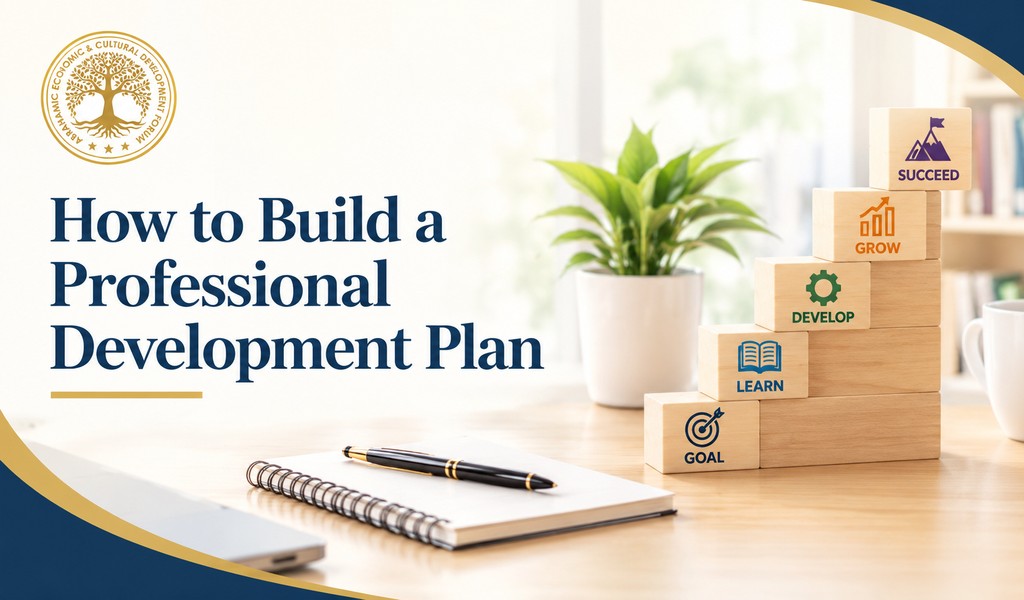
Plan Your Growth. Build Your Future.
Career growth rarely happens by accident. Whether you are starting your first job, preparing for a leadership role, changing careers, or running a business, continuous learning and clear goals can help you move forward with greater confidence.
A professional development plan provides a practical way to identify your strengths, recognize areas for improvement, and decide which skills and experiences you need to achieve your career goals. Instead of relying only on opportunities as they arise, you can take an active role in shaping your professional future.
In today's changing work environment, technical knowledge alone may not be enough. Communication, leadership, critical thinking, adaptability, digital skills, and the ability to learn continuously can also contribute to professional success.
The good news is that building a professional development plan does not require complicated tools or a large budget. It begins with understanding where you are today, deciding where you want to go, and taking consistent steps toward that destination.
What Is a Professional Development Plan?
A professional development plan is a structured roadmap that outlines your career goals, the skills you need to develop, and the actions you will take to improve your professional abilities.
It connects your ambitions with practical steps, helping you turn broad intentions into achievable goals.
For example, someone who wants to become a team leader might identify communication, delegation, conflict resolution, and project management as areas for development. Their plan could include completing a leadership course, managing a small project, and seeking feedback from an experienced manager.
A useful professional development plan generally includes:
-
Career goals: What you want to achieve.
-
Current skills: Your existing strengths and experience.
-
Development needs: The knowledge and abilities you want to improve.
-
Action steps: The activities that will help you progress.
-
A timeline: When you intend to complete each activity.
-
Progress measures: How you will assess improvement.
The purpose is not to create a perfect document. It is to establish a realistic plan that helps you make meaningful progress.
Why Is Professional Development Important?
1. It gives your career direction
Without clear goals, it is easy to spend time on activities that do not support your long-term ambitions. A development plan helps you decide which opportunities deserve your attention.
For instance, a marketing professional interested in management may benefit more from learning team leadership and strategic planning than from repeatedly taking courses in skills they already use confidently.
2. It helps you identify skill gaps
Understanding what you already do well—and what you still need to learn—makes professional growth more focused.
A person preparing for a career change may discover that their existing communication and problem-solving skills are valuable, while industry-specific knowledge requires further development.
3. It encourages continuous learning
Industries, technologies, and workplace expectations change over time. Regular learning helps professionals review their knowledge and remain open to new methods and responsibilities.
Learning does not always require a formal qualification. Practical assignments, mentoring, workshops, reading, and collaboration with experienced colleagues can also support development.
4. It builds confidence through progress
Large ambitions can feel overwhelming when they are not divided into manageable steps. A professional development plan makes progress easier to recognize.
Completing a course, leading a meeting, presenting an idea, or receiving positive feedback can provide evidence that your skills are developing.
5. It supports long-term career flexibility
Your interests and priorities may change as you gain experience. A development plan helps you build transferable skills that can be useful across different roles, industries, and professional settings.
How to Build a Professional Development Plan Step by Step?
Step 1: Assess Your Current Skills and Experience
Begin by taking an honest look at your professional abilities, achievements, interests, and challenges.
Consider both technical skills and interpersonal strengths. Technical skills might include financial analysis, digital marketing, research, or project management. Interpersonal skills might include communication, teamwork, emotional intelligence, and leadership.
Ask yourself:
-
Which tasks do I perform well?
-
What achievements am I most proud of?
-
Which responsibilities do I find challenging?
-
What feedback have I received from colleagues or supervisors?
-
Which skills would help me perform better in my current role?
-
What do I enjoy learning or doing?
You can also ask a trusted colleague or mentor for feedback. An outside perspective may reveal strengths or development needs that you have overlooked.
Practical example: A project coordinator may be excellent at organizing schedules but struggle to communicate delays to stakeholders. Recognizing this gap creates a clear opportunity to improve professional communication.
Step 2: Define Your Career Goals
Once you understand your current position, decide what you want to achieve.
Your goals might involve promotion, greater responsibility, a career change, entrepreneurship, improved performance, or preparation for a specialized role.
Try to be specific. Instead of saying, "I want to improve my leadership," define what improvement would look like.
For example:
"I want to develop my leadership skills so I can confidently manage a small project team within the next six months."
This goal provides a direction and a timeframe. It also helps you identify the experiences and learning activities you need.
Consider setting both short-term and long-term goals. Short-term goals may focus on learning a skill over the next few months, while long-term goals may involve moving into a new role or building a business.
Step 3: Identify the Skills You Need to Develop
Compare your current abilities with the skills required to reach your goals.
You can review job descriptions, professional standards, industry publications, or feedback from people working in your desired role.
Focus on the skills that are most relevant to your next step rather than attempting to learn everything at once.
Depending on your career direction, development priorities may include:
-
Communication and presentation
-
Leadership and decision-making
-
Digital literacy and technology
-
Critical thinking and problem-solving
-
Time management and organization
-
Negotiation and conflict resolution
-
Industry-specific technical knowledge
-
Financial literacy and business planning
For example, an aspiring entrepreneur may need to strengthen budgeting, customer research, sales, and business communication. A professional preparing for a senior position may prioritize strategic thinking, delegation, and team management.
Step 4: Choose Practical Learning Activities
After identifying your development needs, select activities that will help you build the required skills.
Different skills require different approaches. Reading about leadership can introduce useful ideas, but leading a project gives you an opportunity to apply them.
Consider combining several learning methods:
Formal learning: Courses, certifications, workshops, and professional training.
Practical experience: Assignments, presentations, projects, volunteering, and new workplace responsibilities.
Learning from others: Mentoring, coaching, peer discussions, and observing experienced professionals.
Independent learning: Books, research, professional articles, and relevant online learning resources.
Feedback and reflection: Reviewing your performance, identifying mistakes, and adjusting your approach.
Whenever possible, connect learning with real tasks. If you are developing presentation skills, volunteer to present a project update. If you want to improve analytical thinking, take responsibility for reviewing a process and recommending improvements.
Step 5: Create a Realistic Timeline
A development plan becomes more useful when it includes deadlines.
Divide larger goals into smaller activities and assign a target date to each one. Make sure the timeline fits your work responsibilities, personal commitments, and available resources.
For example, a three-month development goal could look like this:
-
Month 1: Complete a course on professional communication.
-
Month 2: Deliver two presentations and request feedback.
-
Month 3: Review progress, identify remaining challenges, and practise the skills that need further improvement.
A realistic schedule is more valuable than an ambitious plan that becomes difficult to maintain.
Step 6: Measure Your Progress
Completing a learning activity does not always mean that you have mastered a skill. Progress should also be measured through application and results.
Choose indicators that relate to your goal.
For example:
-
For communication, assess whether presentations are clearer and questions are handled more confidently.
-
For time management, review whether important tasks are completed more consistently.
-
For leadership, seek feedback on delegation, decision-making, and team coordination.
-
For technical skills, complete a relevant project or demonstrate proficiency in a specific task.
Keep a simple record of completed activities, feedback received, challenges encountered, and lessons learned.
This record can also help you prepare for performance reviews, job interviews, and conversations about future responsibilities.
Step 7: Review and Update Your Plan
Professional development is an ongoing process. Your goals may change as you gain experience, discover new interests, or encounter different opportunities.
Review your plan regularly, perhaps once a month, and conduct a more detailed assessment every three to six months.
Ask yourself:
-
What progress have I made?
-
Which activities have been most useful?
-
What obstacles have slowed me down?
-
Do my goals still reflect my priorities?
-
What should I change or learn next?
Adjusting your plan is not a sign of failure. It is a way to keep your development relevant to your circumstances and ambitions.
Common Mistakes to Avoid
Even a well-intentioned professional development plan can lose momentum if it is not practical.
Setting too many goals
Trying to improve several unrelated skills at once can divide your attention. Begin with two or three priorities and expand your plan as you make progress.
Choosing goals without a clear purpose
Taking courses simply because they are available may not support your career direction. Before committing to a learning activity, consider how it will help you perform better or prepare for a future opportunity.
Focusing only on qualifications
Certificates can demonstrate learning, but employers and clients may also value practical experience, sound judgment, communication, and the ability to apply knowledge.
Ignoring feedback
Feedback can highlight areas that are difficult to recognize independently. Treat constructive feedback as information you can use, rather than as a personal judgment.
Making an unrealistic schedule
A plan that requires more time or money than you can reasonably provide may be difficult to sustain. Choose learning activities that fit your circumstances and build consistency gradually.
Failing to review progress
A development plan should change when your needs change. Regular reviews help you identify what is working and where a different approach may be necessary.
AECD Forum Perspective
Professional development is closely connected with education, skill development, leadership, entrepreneurship, and economic participation. When people have opportunities to build relevant skills, they can make more informed career decisions and contribute their abilities more effectively to workplaces and communities.
The Abrahamic Economic & Cultural Development (AECD) Forum's broader areas of interest include education, training, professional development, youth and women's empowerment, entrepreneurship, and international cooperation. A practical approach to professional development supports these priorities by encouraging people to identify their potential, pursue learning opportunities, and apply their knowledge constructively.
For young people, a development plan can help connect education with workplace expectations. For women returning to employment or seeking leadership opportunities, it can provide a structured way to identify transferable skills and plan further learning. For entrepreneurs, it can highlight areas such as financial management, negotiation, and business strategy that deserve attention.
Organizations, educational institutions, and community initiatives can also contribute by making mentoring, training, career guidance, and practical learning more accessible.
Professional growth is not solely an individual responsibility. Employers and institutions have a role in creating fair opportunities for people to learn, practise new skills, and progress in their careers.
Practical Action Points: Start Building Your Plan Today
Use these actions to turn your professional ambitions into a workable plan.
-
Write down one career goal. Choose an outcome that matters to your current role or future direction.
-
List your strengths and development needs. Identify what you can already do well and what you need to improve.
-
Select two priority skills. Focus on abilities that will make the greatest difference to your goal.
-
Choose one learning activity for each skill. Consider a course, mentoring session, practical assignment, or independent study.
-
Set deadlines. Give each activity a realistic completion date.
-
Find a source of feedback. Ask a trusted colleague, supervisor, or mentor to help you assess your progress.
-
Schedule a monthly review. Record what you have learned, what you have applied, and what you will do next.
Building a professional development plan is a practical way to take greater responsibility for your career. It helps you understand your current abilities, set meaningful goals, choose relevant learning opportunities, and measure your progress over time.
The most effective plan is not necessarily the longest or most detailed. It reflects your priorities, fits your circumstances, and encourages you to take consistent action.
Whether you are a student preparing for your first job, a professional seeking new responsibilities, a leader developing a team, or an entrepreneur building a business, continued learning can help you prepare for future opportunities.
You do not need to have every step figured out today. Start with one clear goal, identify the next skill you need, and take the first practical step toward developing it.
Your career direction becomes clearer when a plan supports your ambitions—and your plan is supported by action.
#ProfessionalDevelopment #CareerGrowth #CareerPlanning #SkillDevelopment #ContinuousLearning #ProfessionalGrowth #LeadershipDevelopment #WorkplaceSkills #LifelongLearning #CareerSuccess #YouthDevelopment #Entrepreneurship #PersonalDevelopment