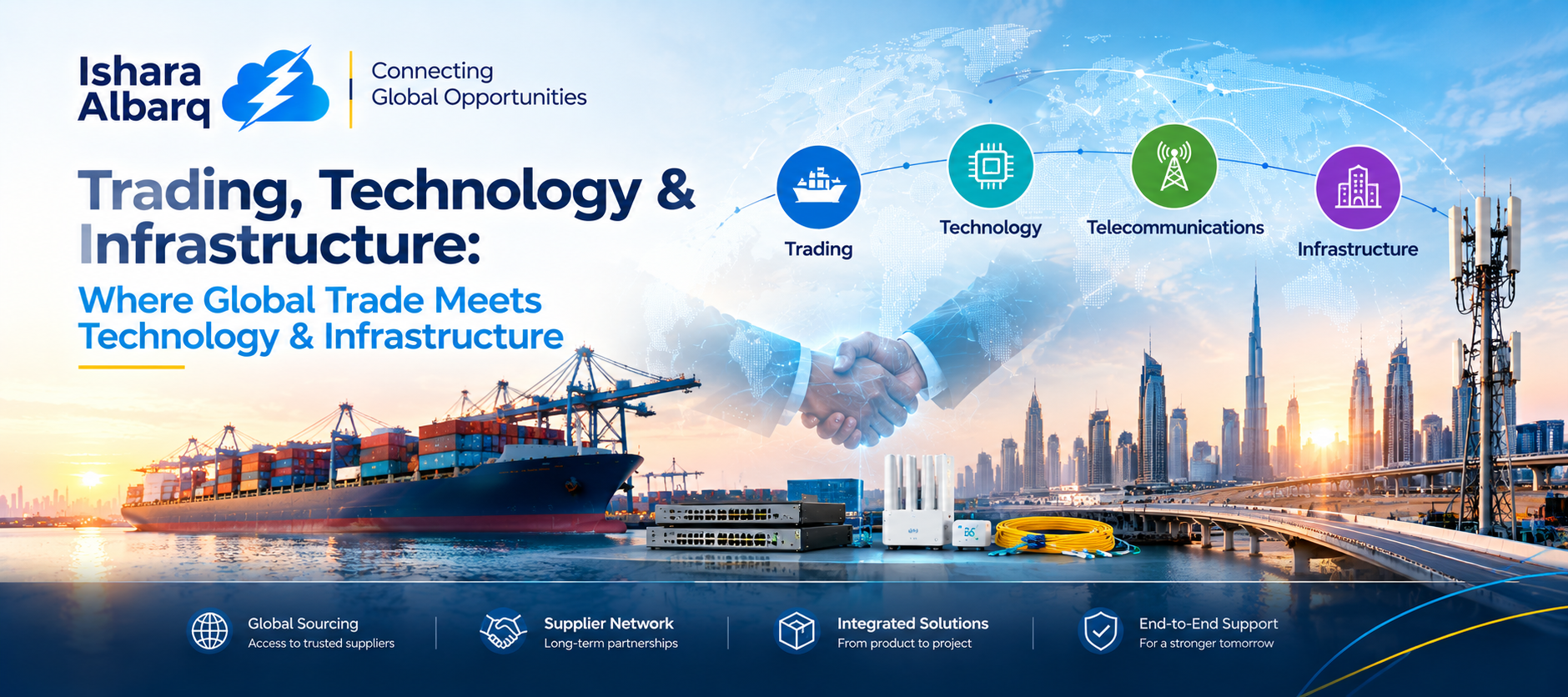
Where Global Trade Meets Technology & Infrastructure
Positioning Ishara Al Barq | Industry Insight & Brand Positioning
Modern business is becoming increasingly interconnected.
A technology company may depend on international suppliers. An infrastructure project may require specialized telecommunications equipment. A trading business may connect manufacturers with businesses in another market. And a digital network may ultimately depend on physical infrastructure that most people never see.
These activities may appear to belong to different industries, but in practice, they are closely connected.
This is where Ishara Al Barq’s unique model comes into focus: bringing together trading, technology, telecommunications, infrastructure, international sourcing, and supplier networks to help businesses connect opportunities across markets.
Where Trading Meets Technology and Infrastructure
Traditionally, industries have often operated within separate boundaries.
Trading focused on buying and selling.
Technology focused on systems and innovation.
Infrastructure focused on physical development.
Telecommunications focused on connectivity.
Today, these boundaries are becoming less distinct.
A modern infrastructure project may require:
International Suppliers + Trading Expertise + Technical Knowledge + Logistics + Telecommunications + Infrastructure
The ability to connect these elements can create significant value for businesses.
Trading Is More Than Buying and Selling
International trading is sometimes viewed simply as the movement of products from one country to another.
In reality, successful trading requires understanding the complete commercial journey.
This can involve:
-
Identifying reliable suppliers
-
Understanding market requirements
-
Evaluating products
-
Negotiating commercial terms
-
Coordinating procurement
-
Managing documentation
-
Arranging logistics
-
Understanding delivery requirements
-
Supporting customers
For businesses operating across international markets, the real challenge is often not finding a product.
It is finding the right product, from the right source, with the right commercial and technical conditions.
Technology Adds Another Layer
Technology has transformed almost every part of modern commerce.
Businesses increasingly depend on:
-
Telecommunications networks
-
Data connectivity
-
Cloud infrastructure
-
Networking equipment
-
Digital platforms
-
Automation
-
Smart infrastructure
-
Data-driven operations
But technology does not exist in isolation.
Behind a digital service is often a physical network of equipment, cables, power systems, facilities, transportation, and infrastructure.
This creates a natural connection between technology and physical supply chains.
Infrastructure Is the Foundation
Infrastructure provides the physical environment that allows businesses and technology to operate.
Consider telecommunications.
A customer may simply see a fast internet connection.
Behind that connection can be:
Fiber → Ducts → Manholes → Cabinets → Optical Equipment → Network Systems → Data Infrastructure
Every component has a role.
A delay in sourcing one critical component can affect an entire project.
This is why infrastructure projects require more than technical planning.
They also require procurement, supplier coordination, logistics, and commercial expertise.
The Hidden Connection Between Industries
The relationship can be illustrated simply:
Trading
Connects markets and suppliers
↓
Technology
Provides systems and solutions
↓
Infrastructure
Provides the physical foundation
↓
Telecommunications
Creates connectivity
↓
Businesses
Use these capabilities to operate, expand, and compete
The industries are different.
But the value is created when they work together.
Why This Integrated Model Matters
Businesses increasingly want fewer disconnected processes.
Instead of managing separate relationships for:
-
Supplier sourcing
-
Product procurement
-
Technical requirements
-
Logistics
-
Infrastructure equipment
-
Telecommunications solutions
they increasingly benefit from partners who understand how these areas interact.
This is particularly relevant for companies involved in infrastructure development, telecommunications, technology deployment, and international procurement.
An integrated approach can improve:
-
Communication
-
Supplier coordination
-
Product selection
-
Procurement efficiency
-
Project visibility
-
Supply-chain planning
-
Market access
From Supplier to Solution
One of the most important differences between traditional trading and a more integrated model is the way the product is viewed.
A traditional approach may ask:
“What product does the customer want to buy?”
A more solution-oriented approach asks:
“What does the customer actually need to achieve?”
That difference matters.
A business may not simply need a networking product.
It may need:
Product + Technical Compatibility + Supplier + Logistics + Delivery + Project Coordination
The product is only one part of the solution.
International Supplier Networks Create Opportunity
Global manufacturing has created access to suppliers across many markets.
Businesses in the UAE can source products and technologies from manufacturing and trading hubs around the world.
However, international sourcing also creates challenges.
Businesses need to evaluate:
-
Supplier reliability
-
Product quality
-
Manufacturing capability
-
Lead times
-
Commercial terms
-
Export documentation
-
Transportation
-
Compliance
-
After-sales support
A strong supplier network is therefore not simply a large list of manufacturers.
It is a network of qualified and relevant relationships.
The UAE as a Commercial Connector
The UAE occupies an important position in international trade and regional business.
Its geographic location connects markets across:
Asia + Middle East + Africa + Europe
This creates opportunities for businesses involved in sourcing, distribution, infrastructure, technology, and international trade.
For companies operating from the UAE, the ability to connect international suppliers with regional requirements can become an important competitive advantage.
This is where an integrated trading and infrastructure model can create meaningful value.
Where Ishara Al Barq Fits
Ishara Al Barq's positioning is built around the intersection of these sectors.
Rather than viewing trading, technology, and infrastructure as separate activities, the model connects them.
Trading
Connecting businesses with international suppliers and commercial opportunities.
Technology
Understanding the equipment, systems, and technical requirements behind modern connectivity.
Infrastructure
Supporting the products and supply chains that enable physical projects.
Telecommunications
Connecting equipment, networks, and infrastructure requirements.
Global Sourcing
Helping businesses access relevant international supplier markets.
Supply Chain
Coordinating the movement of products from supplier to destination.
The result is a broader ecosystem rather than a single-service approach.
Technical Knowledge Makes Trading More Valuable
Commercial knowledge is important.
But when products are technical, understanding what is being sourced becomes equally important.
For example, telecommunications equipment may have specific requirements relating to:
-
Capacity
-
Compatibility
-
Interfaces
-
Standards
-
Network architecture
-
Environmental conditions
-
Installation
-
Testing
A purely commercial approach may focus primarily on price.
A technically informed approach considers whether the product is actually appropriate for the intended application.
The right product is not necessarily the cheapest product. It is the product that meets the business and technical requirement.
Infrastructure Projects Need Commercial Coordination
Infrastructure projects often involve multiple stakeholders.
These can include:
-
Project owners
-
Contractors
-
Engineers
-
Procurement teams
-
Manufacturers
-
Suppliers
-
Logistics providers
-
Installation teams
Each stakeholder has different responsibilities.
If communication breaks down between them, delays can occur.
An organization that understands both the commercial and technical sides can help connect these requirements more effectively.
From Global Source to Local Requirement
One of the biggest opportunities in international trading is connecting global manufacturing capability with local market demand.
The process can look like:
Market Requirement
↓
Product & Technical Assessment
↓
International Supplier Identification
↓
Commercial Negotiation
↓
Quality & Specification Verification
↓
International Logistics
↓
UAE Import & Delivery
↓
Project or Customer Application
This is where trading becomes more than a transaction.
It becomes a complete supply-chain journey.
Why Supplier Relationships Matter
Strong supplier relationships can create advantages beyond pricing.
Trusted relationships can support:
-
Better communication
-
Faster responses
-
Improved production planning
-
More reliable lead times
-
Product customization
-
Technical discussions
-
Problem resolution
-
Long-term sourcing strategies
For technical and infrastructure businesses, these relationships can become strategically important.
A reliable supplier can contribute to the success of multiple projects over time.
The Importance of Supply Chain Visibility
When products move internationally, businesses need visibility.
They should know:
Where is the product?
Has production started?
Has quality been checked?
When will it ship?
When will it arrive?
Is documentation complete?
When can it reach the project site?
Supply chain visibility helps businesses make better decisions and identify potential problems earlier.
Managing Risk Across Multiple Industries
The intersection of trading, technology, and infrastructure also means managing different types of risk.
These can include:
Commercial Risk
Pricing, payment terms, and supplier stability.
Technical Risk
Product compatibility and performance.
Supply Chain Risk
Production and transportation delays.
Quality Risk
Products not meeting specifications.
Project Risk
Equipment arriving after the required installation date.
Market Risk
Changes in demand or international market conditions.
An integrated approach helps businesses look at these risks together instead of treating them as completely separate problems.
Technology and Data Are Changing Trading
Digital tools are also changing how international trading and supply chains operate.
Businesses can increasingly use technology to improve:
-
Supplier management
-
Procurement
-
Inventory visibility
-
Shipment tracking
-
Demand forecasting
-
Market intelligence
-
Documentation
-
Communication
This creates an opportunity to make international sourcing more transparent and data-driven.
The future of trading will not only be about moving products.
It will be about moving information, products, and decisions together.
Building a More Connected Business Model
The future of business is increasingly ecosystem-driven.
A telecommunications project may require a supplier.
The supplier may require international logistics.
The project may require technical expertise.
The customer may require infrastructure support.
The infrastructure may depend on specialized technology.
Each part influences the other.
This creates an important business opportunity:
Organizations that can connect multiple parts of the ecosystem can create value that individual services cannot provide alone.
What Makes an Integrated Partner Valuable?
A strong integrated partner should understand both the individual components and the connections between them.
That means understanding:
-
What the customer needs
-
What the supplier can provide
-
What technical specifications are required
-
How the product should move
-
Where risks may appear
-
How the solution fits the project
-
What happens after delivery
This broader perspective can improve decision-making throughout the supply chain.
The Future: Connected Markets, Connected Infrastructure
As international trade and technology continue to evolve, the separation between industries will become less important.
Trading will increasingly depend on technology.
Technology will continue to depend on infrastructure.
Infrastructure will depend on global supply chains.
And supply chains will increasingly depend on digital visibility and international collaboration.
The result is a connected ecosystem.
Final Thoughts
Trading, technology, and infrastructure may appear to be separate industries.
But look closer, and their connection becomes clear.
Trading brings products and suppliers together.
Technology creates smarter and more connected solutions.
Infrastructure provides the physical foundation.
Telecommunications connects people, businesses, and systems.
Supply chains make the entire journey possible.
This intersection is where Ishara Al Barq aims to create its unique position.
By bringing together international sourcing, supplier networks, trading expertise, telecommunications, technology, infrastructure, and supply-chain coordination, Ishara Al Barq can approach business opportunities from a broader perspective.
The objective is not simply to move products from one market to another.
It is to connect the right suppliers, technologies, infrastructure, and commercial opportunities to create long-term value.
Ishara Al Barq
Connecting Trading, Technology, Infrastructure & Global Opportunities.
Key Takeaways
-
Trading, technology, telecommunications, and infrastructure are increasingly interconnected.
-
Modern trading requires more than finding products at competitive prices.
-
Technical knowledge can improve product sourcing and supplier selection.
-
Infrastructure projects depend heavily on reliable international supply chains.
-
Strong supplier networks create value through reliability, quality, and long-term relationships.
-
The UAE's position as a global commercial hub creates opportunities for international sourcing and regional distribution.
-
Supply-chain visibility can improve project planning and risk management.
-
An integrated commercial and technical approach can help businesses make better sourcing decisions.
-
Technology and data are making international procurement and trading more transparent.
-
The future belongs to connected business ecosystems rather than isolated services.