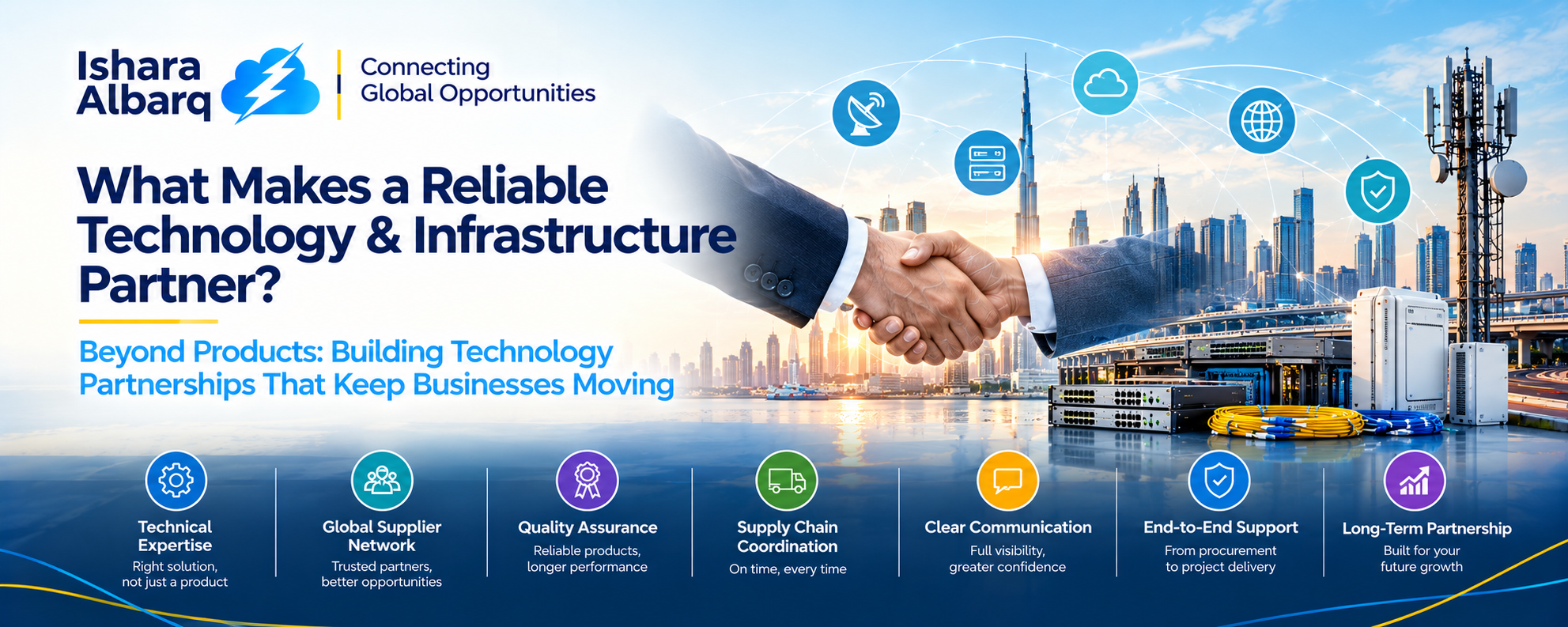
Beyond Products: Building Technology Partnerships That Keep Businesses Moving
Brand Positioning | Technology & Infrastructure Expertise
In today's connected business environment, technology and infrastructure are no longer supporting functions—they are essential to how organizations operate, communicate, grow, and compete.
Whether it is a telecommunications network, enterprise connectivity project, data infrastructure, or a large-scale technology deployment, success depends on more than simply purchasing equipment.
Businesses need a partner who understands the product, the technology, the supplier, the project requirements, and the journey from sourcing to implementation.
This raises an important question:
What actually makes a technology and infrastructure partner reliable?
The answer goes far beyond competitive pricing.
1. Understanding the Business Requirement
A reliable partner starts by understanding what the customer is trying to achieve.
Instead of immediately recommending a product, the right partner considers:
-
What is the application?
-
What technical specifications are required?
-
What is the project timeline?
-
What quantity is needed?
-
Where will the equipment be deployed?
-
What level of reliability is expected?
-
What are the long-term requirements?
This approach helps ensure that the solution is aligned with the actual business objective.
Good technology partnerships begin with questions—not just quotations.
2. Strong Technical Knowledge
Technology and infrastructure products can be highly specialized.
Networking equipment, optical systems, telecommunications components, power infrastructure, and connectivity solutions can have specific technical requirements.
A reliable partner should understand important factors such as:
-
Compatibility
-
Performance
-
Capacity
-
Standards
-
Interfaces
-
Installation requirements
-
Environmental conditions
-
Scalability
-
Testing and maintenance
Technical understanding allows businesses to make better purchasing decisions and avoid selecting products based solely on price.
3. Access to Reliable Suppliers
A strong technology partner needs a dependable supplier network behind it.
International sourcing can open access to manufacturers and suppliers across multiple markets, but supplier selection requires careful evaluation.
Important considerations include:
-
Manufacturing capability
-
Product quality
-
Delivery performance
-
Technical expertise
-
Certifications
-
Production capacity
-
Communication
-
Warranty and support
A large supplier database is not necessarily valuable.
A qualified supplier network is.
4. Quality Should Never Be an Afterthought
A product that arrives on time but fails to meet the required specifications can create serious problems.
Quality management should therefore be considered throughout the sourcing process.
Depending on the product, this can include:
Specification Review → Sample Approval → Production → Inspection → Testing → Final Delivery
This approach helps identify potential problems before they reach the customer or project site.
For infrastructure and telecommunications projects, quality can directly influence reliability, installation schedules, and long-term performance.
5. Reliable Supply Chain Coordination
Technology products often travel across borders before reaching their final destination.
The journey may involve:
International Supplier → Manufacturing → Quality Control → Packaging → Shipping → Customs → Warehouse → Project Site
Every stage matters.
A reliable partner should understand how these stages connect and maintain visibility throughout the process.
This becomes particularly important when equipment is required according to a fixed project schedule.
6. Clear Communication
One of the simplest indicators of a reliable partner is communication.
Customers should not have to repeatedly ask:
“Where is my order?”
A strong partner provides timely information about:
-
Production status
-
Expected completion
-
Quality checks
-
Shipment schedules
-
Documentation
-
Delivery timelines
-
Potential delays
When problems occur, they should be communicated early rather than hidden until the last moment.
Transparency builds confidence.
7. Understanding International Procurement
For businesses sourcing technology and infrastructure products internationally, procurement involves more than negotiating a price.
It can include:
-
Supplier identification
-
Product verification
-
Commercial negotiations
-
Documentation
-
Quality control
-
International logistics
-
Customs coordination
-
Delivery planning
A partner with international procurement expertise can help businesses navigate these different stages more effectively.
8. The Ability to Manage Complex Requirements
Not every project is straightforward.
A customer may need multiple products from different suppliers, delivered at different stages of a project.
For example:
Network Equipment + Fiber Components + Cabinets + Power Systems + Accessories
Coordinating these requirements requires planning.
A reliable partner should be able to understand the relationship between different products and help organize sourcing around the customer's project requirements.
9. Scalability Matters
A technology solution may work perfectly for a small deployment but become difficult to manage as the business grows.
Reliable partners think beyond the immediate requirement.
They consider:
-
Future expansion
-
Additional capacity
-
Product availability
-
Technology upgrades
-
Replacement requirements
-
Long-term supplier relationships
This creates a more sustainable technology strategy.
The best solution is not only suitable for today—it should also support tomorrow.
10. Speed Without Sacrificing Accuracy
Businesses want fast responses.
But speed should not come at the expense of accuracy.
A reliable partner should aim to provide timely information while still verifying:
-
Product specifications
-
Availability
-
Pricing
-
Lead times
-
Supplier capability
-
Delivery requirements
A quick but inaccurate answer can create more problems than a carefully verified one.
11. Problem-Solving Capability
Every complex project can encounter unexpected challenges.
A shipment may be delayed.
A supplier may change a production schedule.
A product may become unavailable.
A technical requirement may change.
The value of a reliable partner becomes especially visible when something goes wrong.
Instead of simply reporting the problem, a strong partner asks:
What happened?
What is the impact?
What alternatives are available?
What can be done now?
This turns supplier management into genuine problem solving.
12. Commercial Understanding
Technical knowledge is important, but commercial understanding matters too.
Businesses need solutions that make sense financially.
A reliable partner considers factors such as:
-
Purchase cost
-
Logistics cost
-
Lead time
-
Inventory requirements
-
Product lifespan
-
Maintenance
-
Replacement costs
-
Total cost of ownership
The cheapest product is not always the most economical solution.
Real value comes from balancing price, quality, performance, reliability, and long-term requirements.
13. Transparency Builds Long-Term Relationships
Long-term business relationships are built on trust.
Trust develops when a partner is transparent about:
-
Product availability
-
Lead times
-
Pricing
-
Supplier limitations
-
Technical specifications
-
Potential risks
-
Delivery expectations
No supply chain is completely free from uncertainty.
The important thing is how openly that uncertainty is managed.
Technology & Infrastructure Are Connected
Modern infrastructure demonstrates why an integrated approach is important.
Take telecommunications as an example.
A reliable network may depend on:
Fiber Optics → Ducts → Cabinets → Optical Equipment → Network Devices → Power → Monitoring → Connectivity
These components are connected.
A problem with one element can affect the larger system.
Therefore, businesses benefit from partners who understand not only individual products but also how those products fit into the wider infrastructure ecosystem.
Why Supplier Relationships Matter
Technology and infrastructure projects can depend on specialized products with specific delivery requirements.
Strong supplier relationships can support:
-
Better communication
-
More predictable lead times
-
Improved product access
-
Faster problem resolution
-
Technical discussions
-
Better planning
-
Long-term sourcing
This is why supplier relationships should be treated as a strategic asset rather than simply a purchasing channel.
Global Sourcing, Local Understanding
International sourcing gives businesses access to global manufacturing capabilities.
But global sourcing becomes more valuable when combined with knowledge of the local market.
For UAE businesses, this can mean understanding:
-
Local business requirements
-
Import processes
-
Delivery expectations
-
Infrastructure projects
-
Telecommunications requirements
-
Regional market conditions
The combination of global supplier access + local market understanding can create a stronger sourcing model.
Technology Partnerships Should Create Visibility
A customer should be able to understand what is happening with their project.
Good visibility can include:
Supplier Selected
↓
Order Confirmed
↓
Production Started
↓
Quality Checked
↓
Shipment Prepared
↓
Goods in Transit
↓
Customs & Delivery
↓
Project Site
This type of visibility helps customers plan resources and respond to changes more effectively.
Risk Management Is Part of Reliability
Reliability does not mean that problems never occur.
It means that the business is prepared to manage them.
Potential risks can include:
-
Supplier delays
-
Product shortages
-
Quality issues
-
Transportation disruptions
-
Documentation problems
-
Changing project requirements
-
Single-supplier dependency
A reliable technology and infrastructure partner should identify important risks and, where practical, help develop alternatives.
What Businesses Should Look for in a Partner
Before choosing a technology or infrastructure partner, businesses should ask:
Does the partner understand our industry?
Technical products require technical understanding.
Can they access reliable suppliers?
Supplier quality directly affects project quality.
Can they manage international sourcing?
Global procurement requires coordination across multiple stages.
Do they communicate clearly?
Visibility reduces uncertainty.
Can they handle problems?
Unexpected challenges are part of complex projects.
Do they understand the bigger picture?
Products should fit the project—not simply fill an order.
Can they support long-term growth?
A good partner should be capable of supporting future requirements.
The Ishara Al Barq Approach
This is where Ishara Al Barq's positioning becomes distinctive.
The objective is not to operate as just another product supplier.
The focus is on connecting multiple parts of the business ecosystem:
Trading + Global Sourcing + Technology + Telecommunications + Infrastructure + Supply Chain
This integrated perspective allows Ishara Al Barq to look beyond the individual transaction.
The focus is on understanding:
What does the customer need?
Which technology or product is appropriate?
Which supplier can provide it reliably?
How should it be sourced?
How will it reach the UAE?
How does it fit the project?
This creates a more connected approach to technology and infrastructure sourcing.
From Product Supplier to Strategic Partner
There is an important difference between supplying a product and becoming a partner.
A product supplier may focus on:
Product → Price → Order → Delivery
A strategic partner looks at:
Requirement → Technology → Supplier → Procurement → Quality → Logistics → Delivery → Long-Term Support
The second approach creates a much broader relationship.
It is built around business outcomes rather than individual transactions.
The Future of Technology & Infrastructure Partnerships
Technology is evolving quickly.
Businesses are increasingly adopting:
-
Smarter networks
-
Digital infrastructure
-
Advanced telecommunications
-
Connected systems
-
Automation
-
Data-driven operations
-
Scalable infrastructure
As technology becomes more interconnected, businesses will need partners who can understand multiple parts of the ecosystem.
The future will not simply belong to companies that sell technology.
It will increasingly favor organizations that can connect technology with suppliers, infrastructure, markets, and business requirements.
Final Thoughts
A reliable technology and infrastructure partner is much more than a company that can provide equipment.
Reliability comes from a combination of:
Technical Knowledge + Supplier Access + Quality + Communication + Procurement Expertise + Supply Chain Coordination + Problem Solving + Long-Term Thinking
For businesses operating in telecommunications, infrastructure, technology, and international trade, these capabilities can make a significant difference.
At Ishara Al Barq, the goal is to bring these capabilities together through an integrated approach to trading, global sourcing, technology, telecommunications, infrastructure, and supply-chain coordination.
Because businesses do not simply need products.
They need the right products, from the right sources, delivered at the right time, with the right expertise behind them.
Ishara Al Barq
Connecting Global Suppliers, Technology & Infrastructure.
Key Takeaways
-
A reliable technology partner should understand both business and technical requirements.
-
Supplier quality and reliability are as important as pricing.
-
International procurement requires coordination beyond the purchase order.
-
Quality control should be part of the sourcing process.
-
Clear communication improves project visibility.
-
Supply chain coordination can reduce uncertainty and delivery risks.
-
Technical expertise helps businesses select appropriate products.
-
Long-term supplier relationships can improve sourcing reliability.
-
A good partner should be able to manage unexpected challenges.
-
Scalability and future requirements should be considered from the beginning.
-
The strongest technology partnerships focus on solutions and outcomes, not just products.
-
An integrated approach can connect trading, technology, infrastructure, telecommunications, and global sourcing.