Category: Telecommunications & Networking
In a telecommunications project, cables are more than just physical connections between devices. They form the foundation of communication, networking, security, and data infrastructure.
As networks become larger and more complex, the number of cables installed within server rooms, data centers, offices, and commercial buildings can quickly increase. Without proper cable management, even a technically well-designed network can become difficult to maintain, troubleshoot, and expand.
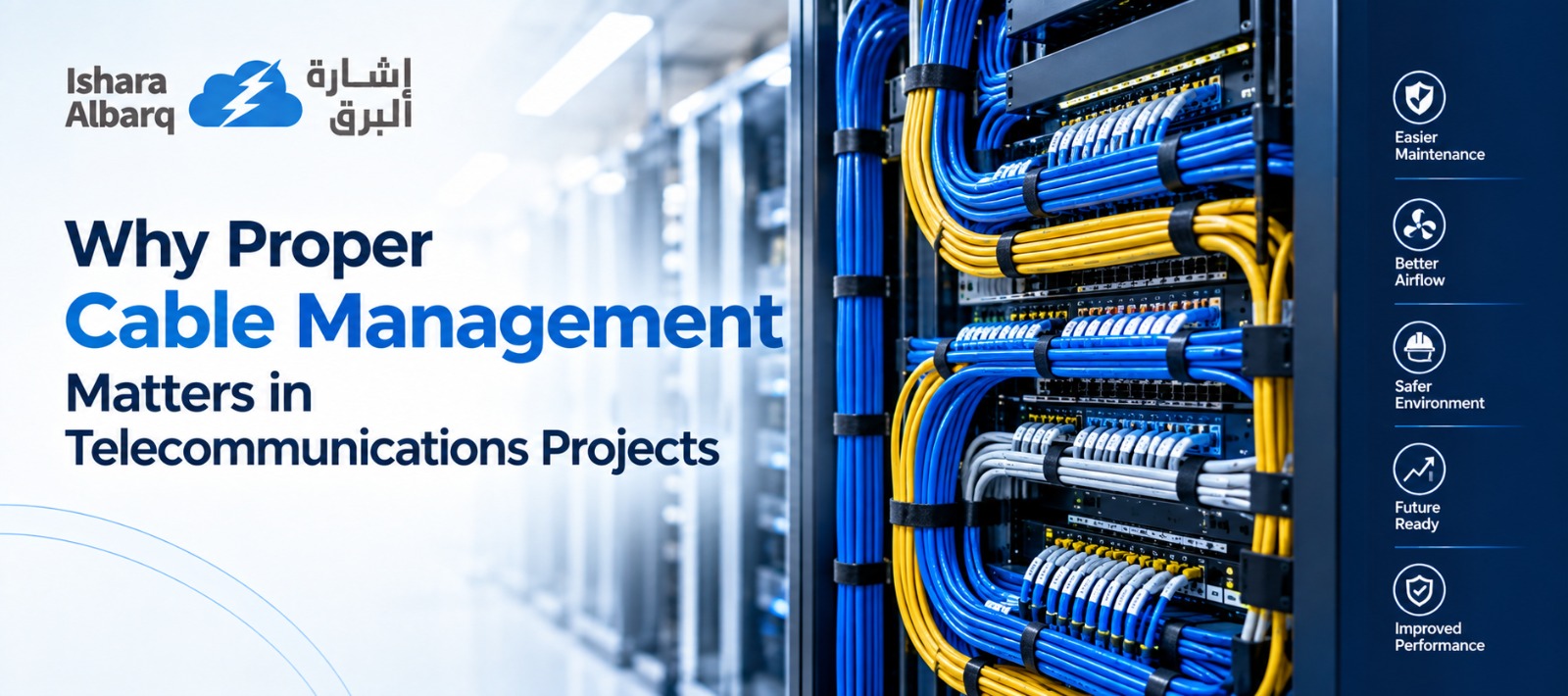
Proper cable management creates a cleaner, safer, more organized, and more serviceable telecommunications infrastructure.
What Is Cable Management?
Cable management refers to the planning, routing, organizing, securing, labeling, and maintaining of cables within a telecommunications or networking installation.
It can involve:
-
Cable trays and ladder racks
-
Cable conduits
-
Patch panels
-
Rack management systems
-
Cable ties and hook-and-loop fasteners
-
Cable labels
-
Fiber management systems
-
Horizontal and vertical cable managers
-
Proper separation of different cable types
Good cable management begins during the design stage and continues throughout installation and maintenance.
Why Cable Management Matters
A telecommunications project may contain hundreds or even thousands of individual connections. If those cables are installed without a structured approach, identifying a specific connection later can become unnecessarily difficult.
Proper organization helps technicians understand where cables originate, where they terminate, and how they connect to network equipment.
This can make installation, troubleshooting, maintenance, and future upgrades more efficient.
1. Easier Troubleshooting and Maintenance
One of the biggest advantages of organized cabling is easier troubleshooting.
Imagine a network rack filled with tangled and unlabeled cables. If one connection develops a problem, a technician may have to spend considerable time tracing cables to identify the correct connection.
With proper routing and labeling, the relevant cable can be identified much more quickly.
This can help reduce maintenance time and minimize disruption to business operations.
2. Better Airflow Around Network Equipment
Server rooms and telecommunications rooms often contain switches, routers, servers, patch panels, and other equipment that generate heat.
Poorly managed cables can obstruct airflow around equipment and make an already crowded rack more difficult to manage.
Proper cable routing helps maintain a more organized equipment environment and can support better airflow planning.
Cable management should therefore be considered alongside rack layout, equipment placement, ventilation, and cooling requirements.
3. Improved Safety
Cable clutter can create physical hazards.
Loose cables running across floors, walkways, or equipment areas can create trip hazards and may be more vulnerable to accidental damage.
Using appropriate trays, conduits, racks, and routing systems keeps cables in designated paths and reduces unnecessary exposure.
A well-organized telecommunications room is easier for technicians to access and work in safely.
4. Protecting Cable Performance
Cable installation practices can affect network performance.
Different cable types have specific installation requirements. For example, copper cables have limitations regarding bending, pulling force, and routing near sources of electromagnetic interference.
Fiber optic cables also require appropriate handling, including respecting recommended bend-radius requirements and protecting connectors and fibers from unnecessary stress.
Proper cable management helps maintain appropriate routing and reduces the risk of physical damage during installation or future maintenance.
5. Better Rack Organization
Network racks can quickly become difficult to manage when equipment and cabling are not planned together.
Patch panels, switches, fiber enclosures, power distribution, and cable managers should be positioned with accessibility and future maintenance in mind.
Vertical and horizontal cable management can help create clear pathways between patch panels and network equipment.
A well-organized rack also makes it easier to identify available ports and perform future changes.
6. Simplifying Future Upgrades
Telecommunications infrastructure is rarely static.
Businesses may add:
-
New employees
-
Additional network devices
-
Security cameras
-
Wireless access points
-
IP phones
-
IoT systems
-
Additional fiber connections
-
New network switches
If the existing cabling system is already disorganized, adding new connections can make the situation worse.
A properly managed infrastructure provides a more structured foundation for future expansion.
7. Accurate Labeling Improves Network Documentation
Cable labeling is a small step that can provide significant long-term value.
Labels can help identify:
-
Cable origin
-
Cable destination
-
Patch-panel port
-
Rack location
-
Network connection
-
Fiber link
-
Equipment connection
Labels should follow a consistent naming convention that matches the project's documentation.
When physical cabling and network documentation correspond with each other, technicians can understand the infrastructure more efficiently.
8. Separating Power and Data Cabling
In many telecommunications environments, power and data cabling need to be planned carefully.
Appropriate separation can help reduce potential electromagnetic interference and make infrastructure easier to maintain.
The exact requirements depend on the cable types, electrical systems, building design, applicable standards, and installation environment.
Professional planning is therefore important rather than simply placing every cable in the same pathway.
9. Supporting Fiber Optic Infrastructure
Fiber optic installations require particular attention to cable routing and handling.
Fiber cables can be sensitive to excessive bending, pulling, crushing, and poor termination practices.
Proper fiber management systems can help maintain appropriate bend radii, protect connections, and organize fiber distribution.
This becomes especially important in high-density telecommunications rooms and data center environments where large numbers of fiber connections may be present.
10. Professional Appearance Builds Confidence
Cable management is not only about technical performance.
A clean telecommunications room creates a more professional environment for technicians, contractors, facility teams, and customers who may inspect the infrastructure.
Organized racks and clearly labeled cables demonstrate that the infrastructure has been installed with planning and long-term maintenance in mind.
For businesses, this can also make infrastructure audits and technical inspections easier.
Cable Management Should Start During Project Planning
Cable management should not be treated as something to fix after installation.
It should be considered during the early design stages.
A telecommunications project should account for:
-
Cable quantities and types
-
Rack locations
-
Pathways and trays
-
Patch-panel requirements
-
Fiber distribution
-
Power and data separation
-
Labeling standards
-
Equipment locations
-
Future expansion
-
Testing and documentation
Planning these elements before installation can reduce unnecessary rework later.
Don't Ignore Future Capacity
A telecommunications project should consider more than the cables required today.
If a business expects future expansion, pathways and cable-management systems should provide reasonable room for additional connections where practical.
This does not mean installing unnecessary cabling. Instead, it means designing infrastructure that can accommodate foreseeable changes without creating major disruption.
The Importance of Testing and Documentation
Cable management and cable testing go hand in hand.
After installation, appropriate testing can verify that the cabling meets the required performance specifications.
Documentation should also record important information about the completed installation, including cable routes, termination points, rack layouts, patch-panel connections, and test results where applicable.
This information becomes valuable during future maintenance and upgrades.
Final Thoughts
Proper cable management may not be the most visible part of a telecommunications project, but it has a significant impact on the long-term usability of network infrastructure.
Organized cabling can make networks easier to maintain, troubleshoot, expand, document, and manage.
From structured pathways and rack organization to labeling, fiber protection, and appropriate cable separation, every detail contributes to a more reliable infrastructure environment.
For businesses investing in telecommunications and networking systems, cable management should be treated as an essential part of the project — not simply as a finishing touch.