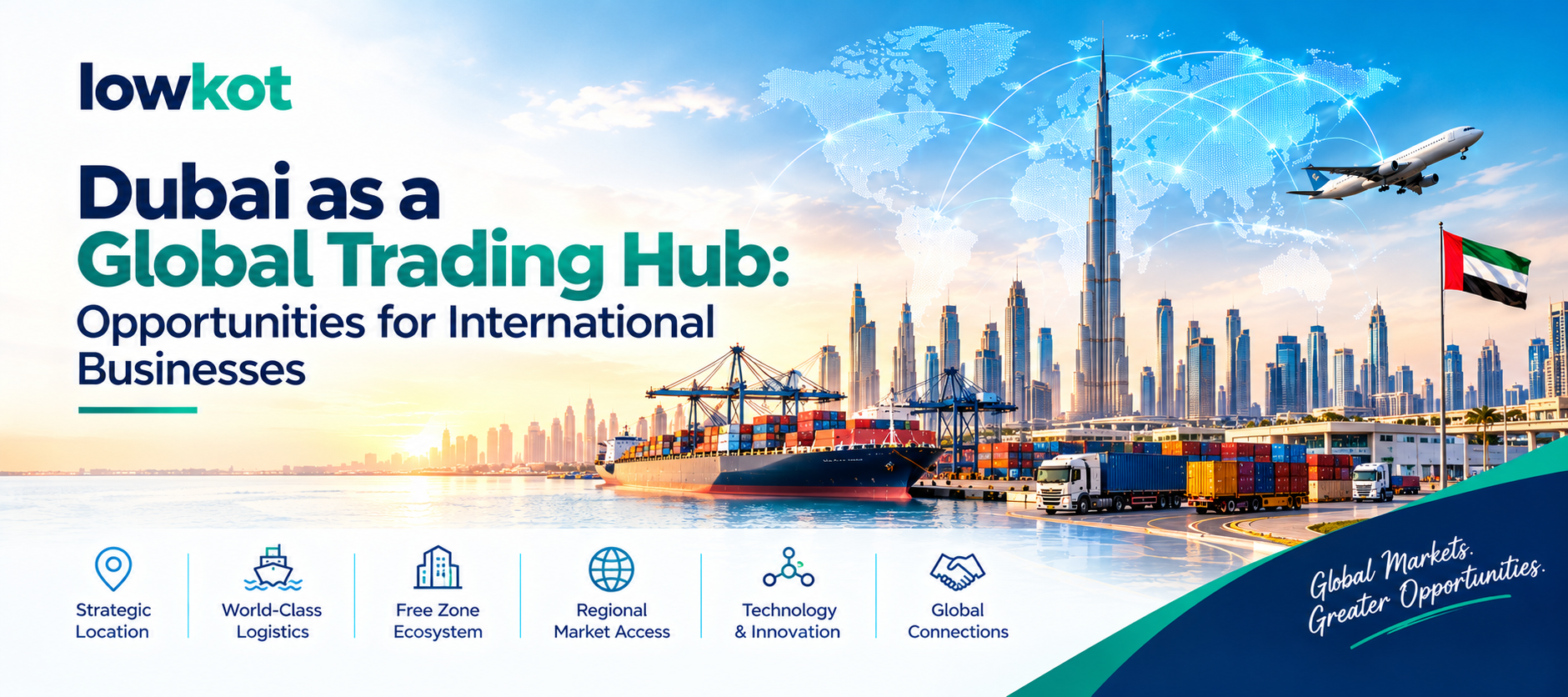
Dubai + Global Business: How Strategic Location, Logistics, Technology and Market Access Create New Opportunities
Dubai has evolved far beyond its traditional role as a regional trading centre. Today, it is an important meeting point for businesses looking to connect Asia, the Middle East, Africa, Europe and global markets.
For international companies, Dubai offers a combination that is difficult to overlook: strategic geographic positioning, advanced logistics infrastructure, international connectivity, established business ecosystems and access to a diverse regional market.
The UAE's non-oil foreign trade exceeded AED 1.7 trillion in the first half of 2025, with non-oil exports reaching AED 369.5 billion. This reflects the broader momentum behind the country's strategy of expanding international trade beyond oil. (Government of Dubai Media Office)
But what actually makes Dubai attractive to international businesses?
The answer is not one single advantage. It is the combination of location + infrastructure + trade networks + technology + market access.
Why Dubai Matters to Global Business
International businesses constantly look for ways to reach new markets while keeping supply chains efficient.
Dubai's position allows companies to operate from a commercially connected location between major markets.
For a company sourcing products from Asia and supplying customers in the Middle East or Africa, for example, Dubai can function as a strategic base for:
-
International sourcing
-
Import and export
-
Re-export
-
Regional distribution
-
Warehousing
-
Logistics
-
Procurement
-
Technology trading
-
Infrastructure supply
-
Business expansion
This makes Dubai particularly relevant for companies whose operations depend on moving products across borders.
1. A Strategic Geographic Location
Geography remains one of Dubai's biggest business advantages.
Dubai sits at an important crossroads between East and West, giving businesses access to markets across the Middle East, Africa, South Asia, Europe and beyond.
This is especially valuable for companies involved in international procurement.
A business may source telecommunications equipment from one country, infrastructure products from another, consolidate shipments in the UAE and distribute them to customers across the region.
Instead of managing every market independently, Dubai can provide a central point from which regional activities can be coordinated.
Dubai can act as a bridge between suppliers and markets.
2. World-Class Trade and Logistics Infrastructure
Global trade cannot function without physical infrastructure.
Ports, airports, roads, warehouses, customs systems and logistics networks all contribute to the movement of goods.
One of Dubai's most important trade assets is Jebel Ali Port.
According to DP World, Jebel Ali provides access to more than 80 weekly services connecting over 150 ports globally, with multimodal links across sea, land and other logistics networks. (DP World)
This connectivity is important for businesses that depend on predictable international movement of goods.
For international companies, infrastructure can influence:
-
Shipping options
-
Transit planning
-
Inventory management
-
Distribution
-
Regional market access
-
Supply chain flexibility
A strong logistics ecosystem therefore becomes a business advantage, not simply a transportation advantage.
3. Dubai's Free Zone Ecosystem
Free zones are another important part of Dubai's international business environment.
They have helped create specialised ecosystems where companies can establish operations connected to trading, manufacturing, logistics, technology and other sectors.
One of the best-known examples is Jebel Ali Free Zone (Jafza).
Its proximity to Jebel Ali Port creates an integrated environment where trading, logistics, warehousing and industrial activities can operate close to major transportation infrastructure.
This kind of ecosystem can be particularly useful for businesses involved in:
-
Import and export
-
Regional distribution
-
Manufacturing
-
Wholesale
-
Technology
-
Industrial products
-
Logistics
-
International procurement
In May 2026, DP World announced that Jafza had attracted AED 854 million in investment commitments during the first four months of 2026, covering sectors including manufacturing, logistics, healthcare, food production, vehicle handling and heavy equipment. (DP World)
That continued investment demonstrates the importance of integrated trade and industrial ecosystems in Dubai.
4. Access to Regional Markets
Dubai is not only a place to sell into the UAE.
For many international businesses, the larger opportunity is using Dubai as a platform for regional expansion.
Depending on the company's sector and operating model, Dubai can support business relationships across:
-
GCC markets
-
Middle East
-
Africa
-
South Asia
-
Central Asia
-
Europe
-
International markets
This creates opportunities for companies that may not yet have the infrastructure or resources to establish separate operations in every target country.
One strategic location can support multiple market relationships.
5. Re-Export Creates Additional Opportunities
One of Dubai's important trading characteristics is its role in re-export activity.
A product does not necessarily have to be manufactured in the UAE to create business value in Dubai.
For example:
Manufacturer → Dubai → Regional Customer
An international supplier can use Dubai as a point for:
-
Receiving goods
-
Storing inventory
-
Consolidating shipments
-
Regional distribution
-
Connecting with buyers
-
Supporting customers
This model can be particularly useful for businesses that want to test regional demand before establishing a larger physical presence in multiple markets.
6. International Connectivity Supports Global Procurement
Modern procurement is increasingly international.
A UAE-based company may need products from:
-
China
-
Turkey
-
India
-
Europe
-
Southeast Asia
-
Other international markets
Dubai's trade infrastructure can support companies in coordinating these international supply relationships.
This is especially relevant to sectors such as:
Telecommunications
Network equipment, fiber products, connectivity components and technical hardware.
Infrastructure
Construction-related materials, technical equipment and infrastructure components.
Technology
IT hardware, networking products, electronic equipment and specialised technology.
General Trading
Products sourced internationally and supplied to businesses across different markets.
For companies operating in these areas, Dubai provides a practical environment for connecting global suppliers with regional demand.
7. Technology Is Changing the Way Dubai Trades
Global trade is no longer only about ships, warehouses and trucks.
Technology has become an important part of the trading ecosystem.
Digital platforms can connect businesses with:
-
Customs services
-
Shipping providers
-
Freight forwarders
-
Clearing agents
-
Hauliers
-
Certification services
-
Logistics providers
Dubai's trade ecosystem increasingly combines physical infrastructure with digital systems. DP World describes Dubai Trade as a unified platform connecting trade, logistics and supply-chain activities across sea, air and land. (DP World)
For businesses, this digital layer can improve visibility and coordination.
The future of global trade is increasingly physical + digital.
8. Dubai Creates Opportunities for International Suppliers
Dubai's value is not limited to companies importing products.
International manufacturers and suppliers can also use Dubai to explore new markets.
A manufacturer from Asia or Europe may be looking for customers in:
-
UAE
-
Saudi Arabia
-
Qatar
-
Oman
-
Bahrain
-
Kuwait
-
Africa
-
Other emerging markets
Instead of entering every market individually, the company can explore Dubai as a regional commercial base.
This can support activities such as:
-
B2B sales
-
Distribution
-
Regional partnerships
-
Product showcasing
-
Market development
-
Customer relationships
-
Logistics coordination
9. Opportunities for SMEs and Growing Businesses
Dubai's global trading ecosystem is not only relevant to multinational corporations.
Small and medium-sized businesses can also benefit.
A growing company may not need a massive international operation from day one.
It can start by:
-
Identifying a target market
-
Finding international suppliers
-
Understanding import requirements
-
Establishing a UAE trading structure
-
Building regional customer relationships
-
Developing reliable logistics
-
Expanding into additional markets
This gradual approach can help businesses scale internationally while learning about the markets they serve.
10. Dubai as a Hub for Technology and Infrastructure Trading
The growth of digital infrastructure, telecommunications and smart-city development is creating demand for specialised products and technical solutions.
This creates opportunities for businesses involved in:
-
Fiber optic infrastructure
-
Telecommunications equipment
-
Networking
-
Data connectivity
-
IT hardware
-
Technical components
-
Infrastructure materials
-
Industrial technology
Dubai's role as a trade and logistics hub can help connect these products with projects and businesses across the region.
For technology and infrastructure companies, the opportunity is therefore not simply “selling in Dubai.”
It can be about using Dubai to connect with a much wider regional market.
11. What International Businesses Should Consider Before Entering Dubai
Dubai offers significant opportunities, but successful international expansion requires preparation.
Businesses should evaluate several areas before entering the market.
Understand the target market
Demand in the UAE may be different from demand in another Middle Eastern or African market.
Research the customers, competitors and regulatory environment.
Understand import and customs requirements
International shipments require appropriate documentation and compliance with applicable customs procedures.
Select the right business structure
Companies should evaluate whether mainland, free-zone or another structure is appropriate for their business model.
Build reliable supplier relationships
International sourcing depends heavily on supplier reliability, product quality and communication.
Plan logistics early
Transportation, warehousing, customs clearance and final delivery should be considered before placing large orders.
Understand local business culture
Strong relationships and clear communication can be important when developing long-term business partnerships.
12. The Importance of a Reliable Local Partner
Entering an international market can be challenging when a company does not understand the local environment.
A local or UAE-based trading partner can potentially help businesses navigate areas such as:
-
Supplier coordination
-
Product sourcing
-
Customer requirements
-
Local market knowledge
-
Documentation
-
Logistics
-
Procurement
-
Regional distribution
For international companies, the right partner can become a bridge between global supply and local business requirements.
Dubai's Competitive Advantage Is an Ecosystem
The biggest mistake is to look at Dubai's advantages individually.
A port alone does not create a global trading hub.
An airport alone does not create a global trading hub.
A free zone alone does not create a global trading hub.
The real advantage comes from connecting multiple elements:
Strategic Location
↓
Ports & Airports
↓
Free Zones & Business Ecosystems
↓
Customs & Trade Services
↓
Technology & Digital Platforms
↓
Logistics & Supply Chain
↓
Regional Market Access
Together, these elements create an environment where international businesses can connect supply, demand and markets.
Dubai and the Future of Global Trade
Global supply chains are becoming more complex.
Companies are diversifying suppliers, exploring new markets and looking for more resilient ways to move products internationally.
This creates opportunities for well-connected trading hubs.
Dubai is continuing to invest in trade infrastructure, logistics, technology and regional connectivity.
Recent developments across the UAE logistics ecosystem also show continued expansion. In July 2026, DP World announced plans for new terminals in Fujairah designed to extend its UAE gateway network and strengthen connectivity across regional and global trade routes. (DP World)
For international businesses, this broader UAE connectivity can create additional options for supply-chain planning.
How Ishara Al Barq Fits Into This Trading Environment
For businesses operating across technology, telecommunications, infrastructure and international sourcing, Dubai provides a strong base for connecting global suppliers with regional requirements.
Ishara Al Barq's approach is built around understanding customer requirements, identifying appropriate international sourcing opportunities, coordinating with suppliers and supporting the journey toward delivery.
The role of a trading partner is therefore not simply to move products.
It is to understand:
What does the customer need?
Where can the right product be sourced?
Does it meet the technical requirement?
Can the supplier meet the commercial and delivery expectations?
How should the supply chain be coordinated?
These questions become increasingly important as businesses expand internationally.
Dubai + Global Business: Where Opportunities Connect
Dubai's position in global trade has been built through decades of investment in infrastructure, connectivity, business ecosystems and international relationships.
Today, its opportunity for international businesses goes beyond importing and exporting.
It can support a broader model:
Source globally.
Connect regionally.
Trade efficiently.
Grow internationally.
For manufacturers, suppliers, distributors, technology companies and infrastructure businesses, Dubai can provide a strategic environment for building international relationships and accessing new markets.
The opportunity is not simply about doing business in Dubai.
It is about understanding how Dubai can help businesses do business with the world.
Final Thoughts
Global trade is changing, but one principle remains constant:
Businesses need reliable connections between products, suppliers, customers and markets.
Dubai has developed an ecosystem designed around those connections.
Its geographic position, ports, airports, free zones, logistics networks, digital trade infrastructure and regional market access make it an important platform for international businesses looking to expand their reach.
For companies in technology, telecommunications, infrastructure and general trading, the opportunity is particularly relevant.
The future belongs to businesses that can connect global supply with local and regional demand efficiently.
Dubai connects the markets. Global businesses create the opportunity.