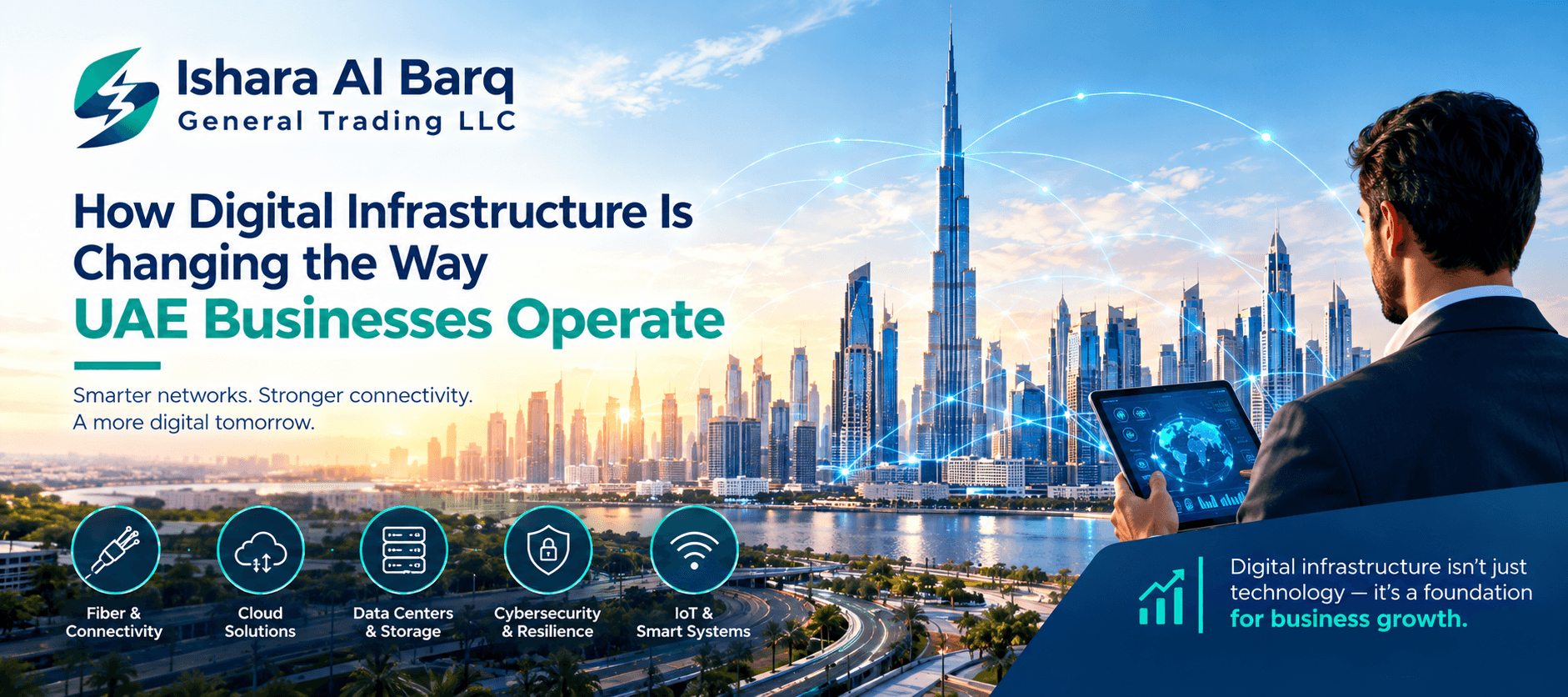
From Connectivity to Competitive Advantage: The Digital Foundation Behind Modern UAE Businesses
Digital transformation is no longer something businesses can treat as a future objective. Across the UAE, technology has become part of everyday business operations—from communication and cloud applications to e-commerce, data analytics, smart buildings, cybersecurity, and connected infrastructure.
But behind every digital service is something that is often less visible:
Digital infrastructure.
Reliable networks, fiber connectivity, data centers, cloud access, wireless systems, telecommunications infrastructure, cybersecurity technologies, and connected devices all contribute to the digital environment in which modern businesses operate.
For UAE businesses, this infrastructure is becoming more than a technical requirement. It is increasingly becoming a business enabler.
The companies that understand this shift can make better decisions about technology investments, network capacity, infrastructure planning, procurement, and long-term growth.
What Is Digital Infrastructure?
Digital infrastructure refers to the physical and technological foundation that allows digital systems and services to function.
It can include:
-
Fiber-optic networks
-
Telecommunications networks
-
Data centers
-
Cloud connectivity
-
Wireless networks
-
5G infrastructure
-
Structured cabling
-
Network equipment
-
Servers and storage
-
Cybersecurity infrastructure
-
IoT systems
-
Digital communication platforms
-
Smart-building technologies
These elements work together to move, process, store, and protect information.
For a business, this infrastructure may not always be visible. Employees may simply connect to Wi-Fi, access a cloud application, make a video call, process an online order, or access business data.
Behind that simple experience is a much larger infrastructure ecosystem.
Why Digital Infrastructure Matters to UAE Businesses
The UAE has developed a highly connected business environment, with companies increasingly depending on digital services to operate efficiently.
A modern business may rely on digital infrastructure for:
Communication → Operations → Customer Service → Data → Payments → Logistics → Security → Decision-Making
If the underlying infrastructure is unreliable, the impact can extend across several business functions.
For example, slow or unstable connectivity can affect cloud applications. Network interruptions can disrupt communication. Poor infrastructure planning can make future expansion more difficult.
This is why businesses should look at digital infrastructure as part of their overall business strategy, rather than treating it only as an IT expense.
Fiber Connectivity Is a Foundation for Digital Business
High-capacity connectivity is fundamental to many modern business applications.
Fiber-optic infrastructure supports high-speed data transmission and can provide the capacity needed for businesses operating cloud platforms, communication systems, digital services, and data-intensive applications.
For UAE businesses, fiber can be particularly important in:
-
Corporate offices
-
Data centers
-
Commercial buildings
-
Industrial facilities
-
Smart buildings
-
Telecommunications networks
-
Large-scale developments
But installing fiber is not simply about selecting a cable.
Businesses need to consider network design, pathways, equipment, termination, connectivity, testing, maintenance, and future expansion.
Infrastructure quality matters just as much as connectivity speed.
Cloud Computing Has Changed Business Infrastructure
Cloud services have changed how businesses think about technology resources.
Instead of depending entirely on equipment located inside their own offices, businesses can access applications, storage, computing resources, collaboration tools, and other services through cloud platforms.
This can provide greater flexibility, but it also increases the importance of reliable connectivity.
A business that depends heavily on cloud applications needs infrastructure capable of supporting consistent access.
This creates a direct relationship:
Cloud Strategy → Connectivity → Network Infrastructure → Business Productivity
As cloud adoption grows, infrastructure planning becomes increasingly important.
Digital Infrastructure Is Changing the Modern Workplace
The traditional office has changed significantly.
Employees may now use:
-
Cloud applications
-
Video conferencing
-
VoIP communication
-
Shared digital platforms
-
Wireless devices
-
Collaboration software
-
Digital security systems
-
Connected meeting rooms
A modern workplace therefore requires infrastructure that can support many devices and applications simultaneously.
This means businesses need to think beyond simply having an internet connection.
They need to consider:
-
Network capacity
-
Wi-Fi coverage
-
Structured cabling
-
Network security
-
Device management
-
Redundancy
-
Scalability
A well-planned digital workplace can help employees work more efficiently while giving businesses greater flexibility.
Smart Buildings Depend on Digital Infrastructure
Smart buildings are becoming an important part of modern commercial and urban environments.
Sensors, access-control systems, building-management platforms, surveillance systems, energy monitoring, and connected devices can communicate through digital networks.
This creates opportunities for businesses to improve:
-
Operational visibility
-
Resource management
-
Security
-
Building efficiency
-
User experience
-
Maintenance planning
However, smart systems are only as effective as the infrastructure supporting them.
A smart building requires reliable connectivity between devices, systems, and centralized platforms.
The smarter the building becomes, the more important its digital foundation becomes.
IoT Is Creating More Connected Businesses
The Internet of Things, or IoT, allows physical devices to collect and exchange information.
In business environments, IoT can be used in areas such as:
-
Industrial monitoring
-
Asset tracking
-
Building management
-
Logistics
-
Energy management
-
Security
-
Equipment monitoring
-
Environmental monitoring
Every additional connected device creates another requirement for network connectivity, data management, security, and infrastructure capacity.
Businesses considering IoT should therefore think about the complete ecosystem rather than simply purchasing connected devices.
Digital Infrastructure Supports Better Business Decisions
One of the biggest changes brought by digital transformation is the ability to use information more effectively.
Businesses can collect data from operations, customers, equipment, supply chains, and digital platforms.
But data only becomes valuable when businesses can:
Collect → Connect → Process → Secure → Analyze → Act
Digital infrastructure supports this entire chain.
Reliable connectivity enables information to move.
Computing infrastructure processes information.
Storage systems retain it.
Security systems protect it.
Analytics platforms help businesses interpret it.
Together, these technologies can support more informed decision-making.
AI Is Increasing Infrastructure Requirements
Artificial intelligence is becoming increasingly relevant across industries.
Businesses are exploring AI for:
-
Customer service
-
Data analysis
-
Automation
-
Forecasting
-
Marketing
-
Document processing
-
Operational optimization
-
Business intelligence
However, AI applications can increase demands on computing, storage, connectivity, and data infrastructure.
As businesses adopt more AI-enabled systems, infrastructure planning needs to consider not only today's requirements but also future data and computing demands.
This is another reason why scalable infrastructure is becoming increasingly important.
Cybersecurity Must Be Part of Infrastructure Planning
Digital connectivity creates opportunities, but it also introduces security considerations.
Businesses now have more:
-
Connected devices
-
Digital accounts
-
Cloud applications
-
Remote users
-
Data exchanges
-
Network access points
Security therefore cannot be treated as something added at the end of a technology project.
It should be considered during infrastructure planning.
Businesses should evaluate areas such as:
-
Network security
-
Access control
-
Device security
-
Data protection
-
Monitoring
-
Backup
-
Business continuity
-
Disaster recovery
A connected business needs infrastructure that is not only fast and scalable, but also appropriately protected.
Digital Infrastructure Is Changing Customer Expectations
Customers increasingly expect businesses to provide fast, convenient, and reliable digital experiences.
Depending on the industry, this can include:
-
Online purchasing
-
Digital payments
-
Real-time communication
-
Mobile applications
-
Online customer support
-
Digital documentation
-
Faster service delivery
When digital infrastructure performs well, customers may experience a smoother journey without thinking about what makes it possible.
When infrastructure fails, however, the customer often notices immediately.
This makes digital infrastructure part of the customer experience, even when it remains invisible.
Supply Chains Are Becoming More Digital
Digital infrastructure is also changing how businesses manage supply chains.
Modern supply chains increasingly depend on digital systems for:
-
Inventory visibility
-
Order management
-
Supplier communication
-
Shipment tracking
-
Documentation
-
Forecasting
-
Procurement
-
Data analysis
This means supply chain performance is increasingly connected to technology infrastructure.
A business may have excellent suppliers, but without reliable systems for managing information, coordination can still become difficult.
The future of supply chains will therefore depend on both physical movement and digital connectivity.
Digital Infrastructure and Business Continuity
Business continuity is another area where infrastructure becomes critical.
Businesses need to consider what happens if:
-
A network connection fails
-
A critical system becomes unavailable
-
Equipment stops working
-
A data center experiences disruption
-
A cyber incident occurs
-
A physical infrastructure component is damaged
Resilience can involve appropriate redundancy, backup systems, alternative connectivity, disaster recovery planning, and well-designed network architecture.
The objective is not necessarily to eliminate every possible disruption.
It is to ensure that the business is better prepared to respond and recover.
Infrastructure Must Be Designed for Growth
One of the most common mistakes businesses can make is planning infrastructure only around today's requirements.
Imagine a company starts with 50 employees but grows to 200.
Its network requirements may change dramatically.
More employees can mean:
-
More devices
-
More bandwidth
-
More applications
-
More cloud usage
-
More security requirements
-
More data
-
More infrastructure
Similarly, a new branch, warehouse, production facility, or commercial development can introduce additional requirements.
This is why businesses should consider scalability from the beginning.
A future-ready infrastructure strategy asks:
“Will this solution still work when the business grows?”
Technology Procurement Is Becoming More Strategic
As infrastructure becomes more complex, purchasing technology requires greater consideration.
Businesses should evaluate:
Technical suitability
Does the product meet the actual application requirements?
Compatibility
Will it integrate with existing systems?
Quality
Is the product appropriate for the intended environment?
Availability
Can it be sourced within the required timeline?
Supplier reliability
Can the supplier support the requirement consistently?
Scalability
Can the solution accommodate future growth?
Total cost
What is the complete cost of ownership, not simply the purchase price?
This is where technology procurement and business strategy increasingly overlap.
The Importance of the Right Infrastructure Partner
Businesses do not always need more technology.
Sometimes they need better coordination between the technologies they already use.
An experienced infrastructure and technology partner can help businesses think through:
Requirement → Product → Supplier → Technical Evaluation → Procurement → Logistics → Delivery
This can be particularly valuable for organizations sourcing telecommunications equipment, networking products, infrastructure components, and specialized technology from international markets.
The objective should be to connect technical requirements with practical business needs.
The UAE Opportunity
The UAE's position as a global business, technology, logistics, and trading hub creates significant opportunities for companies that can effectively use digital infrastructure.
Businesses operating in Dubai and across the UAE increasingly compete in an environment where:
-
Connectivity matters
-
Digital customer experiences matter
-
Data matters
-
Operational efficiency matters
-
Technology adoption matters
-
Infrastructure reliability matters
Digital infrastructure can therefore become an important part of how companies differentiate themselves.
It is not simply about having the latest technology.
It is about creating an infrastructure foundation that allows the business to use technology effectively.
The Ishara Al Barq Perspective
At Ishara Al Barq General Trading LLC, we view technology and infrastructure as closely connected to the wider business environment.
Our experience across technology, telecommunications, general trading, international sourcing, and infrastructure has reinforced an important principle:
The right technology solution begins with understanding the requirement.
Whether a business needs telecommunications products, infrastructure components, networking equipment, or technology sourced from international suppliers, the process involves more than finding a product.
It requires understanding the application, evaluating suitable options, coordinating with suppliers, considering technical and commercial requirements, and supporting the procurement journey toward delivery.
This connected approach helps position technology procurement as part of a broader business solution rather than an isolated transaction.
Looking Ahead: From Digital Infrastructure to Intelligent Infrastructure
The next stage of digital transformation will likely involve even greater interaction between infrastructure, data, automation, AI, IoT, cloud services, and intelligent systems.
Networks will need to support more devices.
Businesses will generate more data.
Applications will become increasingly connected.
Infrastructure will need to become more scalable and resilient.
This means the question for businesses is changing.
It is no longer simply:
“What technology do we need today?”
It is increasingly:
“What infrastructure will allow our business to grow, adapt, and compete tomorrow?”
That shift in thinking can lead to better long-term decisions.
Final Thoughts
Digital infrastructure may operate behind the scenes, but its impact is visible across almost every part of modern business.
It supports communication, cloud computing, smart buildings, IoT, AI, cybersecurity, digital commerce, supply chains, customer experiences, and everyday operations.
For UAE businesses, investing in the right infrastructure is therefore not simply an IT decision.
It can be a business growth decision.
The strongest digital businesses will not necessarily be those that purchase the most technology.
They will be the ones that understand how to connect people, systems, infrastructure, data, and technology into a reliable business ecosystem.
And that is where digital infrastructure becomes more than connectivity.
It becomes a foundation for growth.
Key Takeaways
-
Digital infrastructure is the foundation behind modern digital business operations.
-
Fiber, telecommunications networks, cloud connectivity, data centers, and wireless systems support today's connected businesses.
-
Smart buildings and IoT increase the importance of reliable network infrastructure.
-
AI and data-driven applications are creating new infrastructure requirements.
-
Cybersecurity and business continuity should be considered during infrastructure planning.
-
Digital infrastructure can influence customer experience and operational efficiency.
-
Supply chains increasingly depend on reliable digital systems and connectivity.
-
Businesses should design infrastructure with future growth and scalability in mind.
-
Technology procurement should consider technical suitability, quality, compatibility, availability, and total value.
-
For UAE businesses, digital infrastructure is increasingly becoming a strategic foundation for competitiveness and growth.