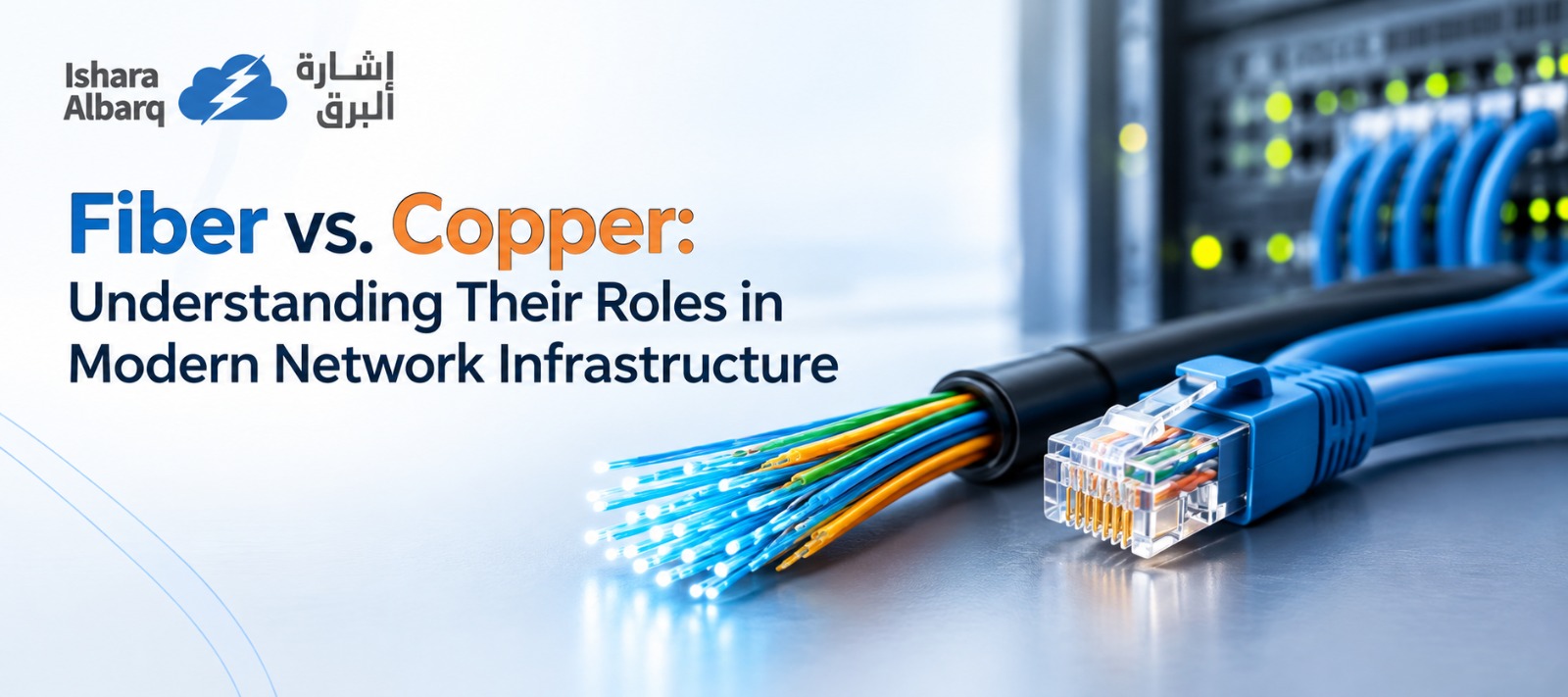
Modern businesses depend on reliable network infrastructure for almost everything they do — from cloud applications and video conferencing to data centers, security systems, and everyday communication.
Two technologies continue to play an important role in this infrastructure: fiber optic and copper cabling.
While fiber is increasingly associated with high-speed and long-distance connectivity, copper remains widely used because of its practicality, established standards, and suitability for many short-distance network connections. The right choice depends on the application, environment, distance, performance requirements, and future plans of the business.
What Is Fiber Optic Cabling?
Fiber optic cable transmits information using pulses of light through extremely thin strands of glass or plastic.
Because it uses light rather than electrical signals, fiber can support high data rates over much longer distances than traditional copper cabling. It is commonly used for backbone networks, data centers, telecommunications infrastructure, internet connectivity, and connections between buildings.
Fiber also offers strong resistance to electromagnetic interference, making it useful in environments where electrical interference could affect copper-based communication.
What Is Copper Cabling?
Copper cabling carries information using electrical signals. It has been a fundamental part of Ethernet networking for decades and remains common in offices, commercial buildings, homes, and many structured cabling installations.
Modern copper standards can support high-speed Ethernet over appropriate distances, while technologies such as Power over Ethernet (PoE) allow a single cable to carry both data and electrical power to compatible devices.
This makes copper particularly useful for devices such as:
-
Computers and workstations
-
IP phones
-
Wireless access points
-
IP cameras
-
Access-control systems
-
Network switches
-
IoT devices
Fiber vs. Copper: What Is the Difference?
The biggest differences are related to transmission method, distance, interference, installation requirements, and application.
1. Transmission Distance
Fiber is designed to support communication over much longer distances than typical copper Ethernet connections.
For large facilities, telecommunications networks, campus environments, and connections between buildings, fiber can provide an effective way to create high-capacity links without the same distance limitations associated with copper.
Copper is generally more practical for shorter horizontal connections within buildings.
2. Speed and Bandwidth
Fiber provides substantial bandwidth capacity and is widely used where networks need to handle large amounts of data.
This is particularly relevant for applications involving cloud computing, video, large data transfers, data centers, and high-capacity backbone networks.
However, copper should not be considered outdated simply because fiber can provide higher capacity. Modern copper Ethernet technologies continue to support demanding business applications when installed within their appropriate specifications.
3. Electromagnetic Interference
One of fiber's major advantages is its resistance to electromagnetic interference because it transmits data using light.
Copper uses electrical signals and can be more sensitive to interference in certain environments. Proper cable selection, installation practices, grounding, and separation from electrical systems can help manage these risks.
For industrial environments or locations with significant electrical interference, fiber can therefore be an important infrastructure option.
4. Power Delivery
This is an area where copper has a significant practical advantage.
Power over Ethernet allows compatible copper Ethernet connections to deliver both network connectivity and electrical power through the same cable.
This can simplify installations for devices such as wireless access points, IP cameras, VoIP phones, and certain IoT equipment.
Fiber does not normally provide this same direct power-delivery function.
Why Businesses Often Use Both
The decision does not always have to be fiber versus copper.
In many modern networks, the two technologies work together.
For example, a commercial building might use fiber for the main backbone connection between network rooms and copper Ethernet cabling for connecting individual workstations, phones, cameras, and access points.
A typical infrastructure could therefore look like:
Internet / Core Network → Fiber Backbone → Network Switch → Copper Cabling → End Devices
This combination allows businesses to use each technology where it makes the most practical sense.
Choosing the Right Cabling for Your Network
Before selecting fiber or copper, businesses should consider several factors.
Distance
Determine how far the network connection needs to travel. Longer links may make fiber a more suitable option.
Bandwidth Requirements
Consider current and expected future data requirements. Networks supporting growing cloud usage, large data transfers, high-resolution video, or other bandwidth-intensive applications may benefit from fiber infrastructure.
Power Requirements
If connected devices need Power over Ethernet, copper may be necessary for the final connection.
Installation Environment
Consider electromagnetic interference, temperature, physical conditions, building layout, and other environmental factors.
Scalability
Network infrastructure is often expected to remain operational for many years. Choosing cabling based only on today's requirements can create limitations later.
Total Project Cost
The cost of a network is not determined by cable price alone. Businesses should consider installation, connectors, transceivers, switches, termination, testing, maintenance, and future expansion when evaluating an infrastructure solution.
The Importance of Professional Network Planning
Selecting the right cable is only one part of building reliable network infrastructure.
Cable routing, termination, labeling, testing, rack organization, connector selection, equipment compatibility, and documentation can all affect network performance and long-term maintenance.
A properly designed structured cabling system can make troubleshooting easier, support future expansion, and reduce unnecessary disruption to business operations.
Looking Ahead: Building Networks for the Future
Network requirements continue to evolve as businesses adopt cloud platforms, artificial intelligence, IoT devices, digital collaboration tools, security systems, and data-intensive applications.
This makes infrastructure planning increasingly important.
Fiber and copper are not simply competing technologies. They are different tools that can serve different roles within a modern network.
The most effective approach is to understand the requirements of the environment and build an infrastructure strategy around performance, reliability, scalability, and long-term business needs.
Final Thoughts
Fiber and copper each have an important place in modern telecommunications and networking.
Fiber is particularly valuable for high-capacity, long-distance, and backbone connectivity, while copper remains highly practical for many short-distance connections and applications requiring Power over Ethernet.
Rather than choosing one technology for every situation, businesses can benefit from understanding where each solution performs best.
A well-planned network combines the right technologies with proper design, installation, testing, and ongoing infrastructure management — creating a stronger foundation for reliable business connectivity.
This version is suitable for a Lowkot/Ishara newsletter or blog, and I can also create a catchy short description + hashtags + 900×400 Ishara blog image concept for this topic.