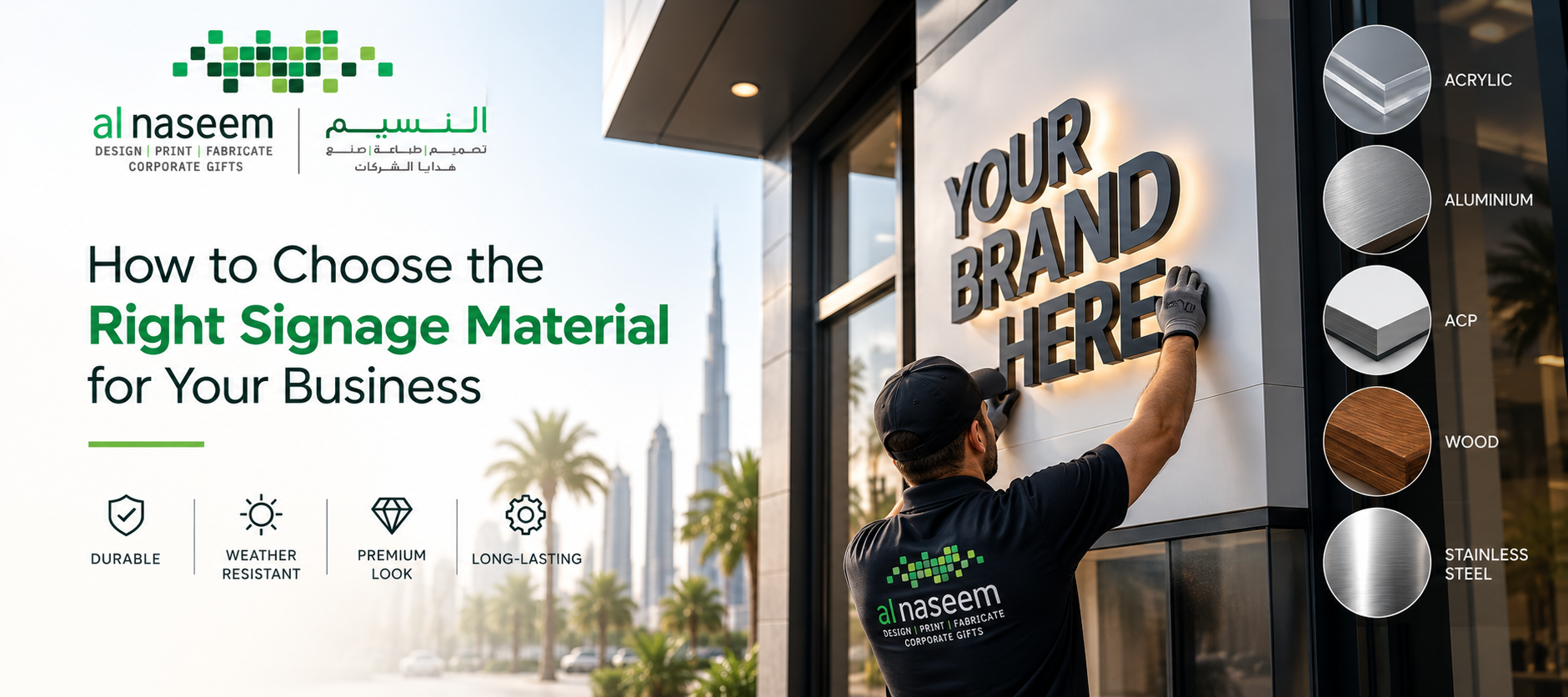
A Complete Guide to Choosing the Right Signage Material
Choosing the right signage material is not simply a design decision. The material you select affects durability, appearance, maintenance, visibility, installation, and overall signage performance.
A sign that works perfectly inside an office may not be suitable for an outdoor storefront. Similarly, a material that looks premium may not be the most practical choice for a large exterior sign exposed to sunlight, heat, dust, and humidity.
For businesses in Dubai and across the UAE, selecting signage materials carefully is particularly important because outdoor signs can be exposed to demanding environmental conditions.
So, how do you choose the right material?
The answer depends on several factors—including where the sign will be installed, its size, exposure conditions, lighting requirements, design, maintenance expectations, and budget.
1. Start With the Sign's Location
The first question should always be:
Where will the signage be installed?
There is a significant difference between indoor and outdoor signage.
Indoor Signage
Indoor signs are generally protected from direct weather exposure. Materials such as:
- Acrylic
- PVC
- MDF
- Foam board
- Aluminium
- Acrylic letters
can be considered depending on the application.
For reception areas, offices, retail interiors, showrooms, and directional signage, appearance and brand consistency may be the primary considerations.
Outdoor Signage
Outdoor signs require greater consideration of:
- Sun exposure
- Heat
- Humidity
- Dust
- Wind
- Rain
- Temperature changes
- Cleaning requirements
Materials should therefore be selected according to the actual installation environment rather than simply based on appearance.
2. Understand the Most Common Signage Materials
Different materials offer different combinations of appearance, strength, weight, cost, and maintenance requirements.
Acrylic
Acrylic is widely used for business signs, reception signs, illuminated signage, logos, and lettering.
It provides a clean, contemporary appearance and can be produced in different colors, finishes, and thicknesses.
Acrylic is particularly useful when a business wants a polished and modern visual identity.
Common applications:
- Reception signs
- Wall logos
- 3D lettering
- Illuminated signs
- Retail signage
- Indoor branding
The correct acrylic specification should be selected according to the sign's size, location, fixing method, and whether illumination is required.
3. Aluminium: A Practical Choice for Many Applications
Aluminium is valued in signage because it offers a useful combination of low weight, strength, and resistance to corrosion.
It can be used for different types of commercial and outdoor signage, particularly where a lightweight but durable construction is required.
Aluminium can also be finished in different ways to achieve a particular visual appearance.
Common applications include:
- Outdoor business signs
- Directional signs
- Building identification
- Industrial signage
- Commercial panels
- Safety and information signs
The grade, thickness, finish, and fabrication method should be selected based on the specific application.
4. ACP for Large Signage Panels
Aluminium Composite Panel (ACP) consists of aluminium skins bonded to a core material.
It is commonly used for architectural cladding and signage applications where businesses require a large, flat, clean-looking panel.
ACP can provide a contemporary appearance and is often considered for:
- Shopfront signage
- Building fascia
- Corporate signage
- Large-format sign backgrounds
- Commercial exterior applications
However, not every ACP panel is identical. The core type, thickness, surface finish, fire-performance requirements, and installation method matter.
For larger commercial projects, material specifications should be checked rather than choosing a panel based only on color or price.
5. Stainless Steel for a Premium Appearance
Stainless steel is often selected when a business wants a sophisticated, durable, and premium-looking finish.
It can be used for:
- 3D letters
- Corporate logos
- Reception branding
- Building signs
- Premium retail signage
- Decorative signage
Brushed, polished, and other finishes can create significantly different visual effects.
For outdoor applications, the appropriate stainless-steel grade and fabrication details should be considered based on the environment.
6. Consider Whether Your Sign Needs Illumination
Lighting changes the material requirements.
An illuminated sign may require materials that can work effectively with:
- LED modules
- LED strips
- Internal illumination
- Backlighting
- Front illumination
- Halo illumination
For example, translucent materials may be appropriate where light needs to pass through the sign face.
The sign should also be designed with adequate internal space, ventilation where necessary, appropriate electrical components, and suitable access for maintenance.
Good illuminated signage is not simply about adding LEDs. The material, construction, lighting layout, diffusion, and installation need to work together.
7. Think About Dubai's Outdoor Environment
For businesses operating in Dubai, environmental exposure deserves particular attention.
Outdoor signage may experience prolonged sunlight, high temperatures, dust, humidity, and occasional rain.
This makes the selection of surface finishes, paints, vinyls, adhesives, fixings, and structural components important—not just the main sign material.
For example, a technically strong panel can still develop problems if unsuitable graphics, adhesives, fasteners, or installation methods are used.
This is why professional signage fabrication should consider the complete signage system, rather than looking at the panel material in isolation.
8. Don't Choose a Material Based Only on Price
One of the most common mistakes businesses make is selecting the cheapest material without considering the sign's intended lifespan and environment.
A lower initial price does not necessarily mean lower total cost.
A better evaluation considers:
Initial cost + installation + maintenance + expected service life + replacement requirements
For a temporary promotional campaign, an economical material may make sense.
For permanent storefront or corporate signage, however, durability and maintenance may deserve greater priority.
9. Consider the Size and Structure of the Sign
The dimensions of the sign can influence material selection.
A small indoor logo and a large external fascia sign have very different technical requirements.
For larger signs, designers and fabricators may need to consider:
- Weight
- Wind loading
- Supporting structure
- Fixing points
- Material thickness
- Frame construction
- Installation access
- Electrical requirements
- Expansion and movement
- Maintenance access
This is one reason professional signage fabrication should begin with the site and application, not just a graphic design.
10. Think About Maintenance Before Installation
A sign may look impressive on installation day, but it also needs to remain practical to maintain.
Before selecting a material, consider:
- How often will it need cleaning?
- Can damaged components be replaced?
- Can lighting be accessed easily?
- Will the surface show dust easily?
- Can individual letters or panels be repaired?
- Is the finish suitable for the location?
Planning maintenance during the design stage can make future servicing considerably easier.
Material Selection Should Match the Business
There is no single "best" signage material for every business.
A luxury retail store may require a different combination of materials and finishes than a warehouse, clinic, restaurant, office, or corporate building.
The right choice should balance:
Design + Durability + Location + Visibility + Safety + Maintenance + Budget
A professional signage provider can evaluate these factors and recommend a suitable material and construction method for the specific application.
Choosing signage material is a technical decision as much as it is a branding decision.
A successful sign needs to look good, communicate clearly, withstand its environment, and remain practical to maintain.
Whether you are planning storefront signage, outdoor business signs, illuminated signage, 3D letters, reception branding, ACP signage, or corporate signage, the material should be selected according to the sign's actual purpose and installation conditions.
At Al Naseem, professional signage involves more than printing a design and putting it on a wall. Material selection, fabrication, finishing, illumination, and installation all contribute to the final result.