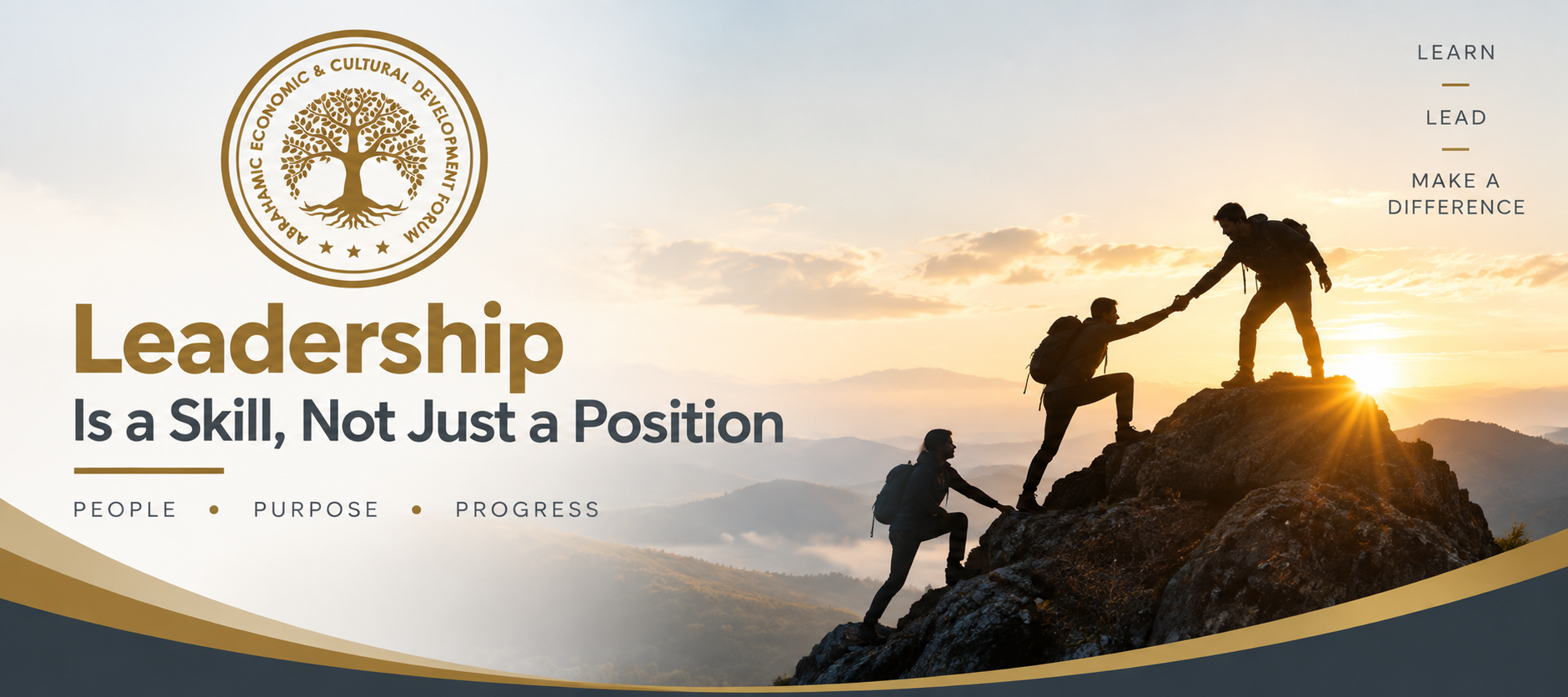
Leadership is not just a title. It is a skill you practice every day.
Leadership is often associated with job titles, senior positions, or formal authority. But some of the most meaningful examples of leadership come from people who do not have a management title at all.
A student who takes responsibility for a community project, an employee who helps colleagues solve a difficult problem, an entrepreneur building a small business, or a volunteer organizing an initiative can all demonstrate leadership.
This is because leadership is not simply about having authority over others. It is about taking responsibility, making thoughtful decisions, communicating clearly, supporting people, and contributing toward a shared goal.
In a rapidly changing world, organizations and communities need people who can lead with knowledge, integrity, adaptability, and a willingness to learn. Leadership development is therefore relevant not only to executives, but also to students, young professionals, educators, entrepreneurs, community members, and future decision-makers.
What Does Leadership Really Mean?
Leadership can be understood in different ways depending on the context.
In a business, leadership may involve setting direction, managing teams, and making strategic decisions. In education, it may involve guiding students and encouraging collaboration. In a community, leadership might mean bringing people together around a shared concern.
Despite these differences, effective leadership often involves several common abilities:
- Taking responsibility
- Communicating clearly
- Listening to others
- Making informed decisions
- Building trust
- Solving problems
- Supporting collaboration
- Acting ethically
- Learning from experience
A formal position may give someone authority, but leadership is demonstrated through actions.
A Position Can Give Authority, But Leadership Builds Trust
A manager can assign responsibilities because of their position.
A leader, however, needs people to understand the purpose of their work, communicate openly, and contribute willingly.
This distinction matters.
Someone can have a senior title but struggle to build trust. Another person with no formal authority may become someone others naturally turn to for advice, cooperation, and support.
Why Trust Matters
Trust develops when people see consistency between what a leader says and what they do.
For example, a team leader who expects punctuality but regularly ignores deadlines may weaken trust. A leader who accepts responsibility for mistakes and gives credit to others can demonstrate a different standard.
Leadership therefore involves credibility built through everyday behavior, not simply status.
Leadership Begins With Self-Leadership
Before leading a team, people need to learn how to manage themselves.
Self-leadership includes understanding personal strengths, recognizing limitations, managing commitments, and taking responsibility for decisions.
Important Elements of Self-Leadership
Self-awareness: Understanding how your behavior affects others.
Discipline: Following through on responsibilities even when motivation is low.
Accountability: Accepting responsibility for decisions and mistakes.
Continuous learning: Being willing to improve rather than assuming you already know enough.
Emotional awareness: Recognizing emotions and responding thoughtfully rather than reacting impulsively.
These qualities can help people become more dependable colleagues, managers, entrepreneurs, and community leaders.
Communication Is a Core Leadership Skill
Leadership and communication are closely connected.
A leader may have a strong idea, but if the idea is unclear or poorly communicated, people may not understand what is expected of them.
Effective communication involves more than speaking.
It includes:
- Listening actively
- Asking useful questions
- Explaining expectations clearly
- Giving constructive feedback
- Handling difficult conversations respectfully
- Communicating across different cultures and backgrounds
Listening Is Part of Leadership
Good leaders do not need to have every answer.
Listening to employees, students, customers, community members, or partners can reveal information that may otherwise be missed.
A leader who listens carefully can identify concerns, understand different perspectives, and make more informed decisions.
Leadership Requires Good Judgment
Leaders frequently have to make decisions without having perfect information.
This could involve choosing between competing priorities, allocating limited resources, responding to a problem, or deciding when to change direction.
Good judgment does not mean always making the perfect decision.
It means considering relevant information, recognizing uncertainty, understanding potential consequences, and being prepared to review the decision when new evidence becomes available.
Ask Better Questions
Before making an important decision, leaders can ask:
- What do we know?
- What do we not know?
- Whose perspective is missing?
- What alternatives are available?
- What are the possible consequences?
- What values or responsibilities should guide the decision?
- How will we evaluate the outcome?
These questions can encourage more thoughtful leadership.
Leadership Is About People, Not Just Performance
Organizations are made up of people with different experiences, motivations, abilities, and perspectives.
A leader's responsibility is not simply to achieve targets. It also involves creating an environment where people can understand their responsibilities, contribute ideas, develop their capabilities, and work respectfully with others.
Supporting Others to Grow
Leadership can include:
- Mentoring junior colleagues
- Sharing knowledge
- Giving useful feedback
- Recognizing contributions
- Creating learning opportunities
- Encouraging responsible initiative
A leader who helps others develop can contribute to a stronger organization beyond their own individual performance.
Leadership and Teamwork
Leadership does not mean doing everything yourself.
Strong teams often depend on people with different skills working toward a common purpose.
A leader can strengthen teamwork by making roles clear, encouraging communication, resolving misunderstandings, and ensuring that different perspectives can be considered.
From "Me" to "We"
A useful shift in leadership is moving from:
"How can I demonstrate that I am capable?"
to:
"How can we achieve this together?"
This does not reduce individual responsibility. It recognizes that complex challenges often require collaboration.
Leadership in Entrepreneurship
Entrepreneurs frequently have to lead before they have large teams or formal organizational structures.
A founder may need to communicate a vision, negotiate with partners, understand customers, manage finances, make difficult choices, and motivate a small team.
Entrepreneurship can therefore become a practical leadership classroom.
Lessons Entrepreneurs Can Develop
Entrepreneurs often learn through experience how to:
- Make decisions with limited information
- Manage uncertainty
- Communicate with different stakeholders
- Accept feedback
- Recover from setbacks
- Delegate responsibilities
- Build relationships
These experiences can develop leadership capabilities that extend beyond business.
Youth Leadership Starts Early
Leadership development does not need to wait until someone enters the workforce.
Young people can develop leadership through:
- Student organizations
- Community projects
- Volunteering
- Sports and cultural activities
- Research initiatives
- Entrepreneurship projects
- Peer mentoring
- Environmental activities
A young person organizing a local project may learn about planning, communication, teamwork, conflict resolution, and accountability.
These experiences can provide practical lessons that complement academic education.
Give Young People Real Responsibility
One of the most useful ways to develop young leaders is to give them meaningful responsibilities rather than simply talking about leadership.
They need opportunities to make decisions, learn from mistakes, receive feedback, and see the results of their work.
Women's Leadership and Professional Development
Leadership development is also an important part of expanding professional and entrepreneurial opportunities for women.
Training programs can support skills in areas such as:
- Communication
- Negotiation
- Management
- Entrepreneurship
- Public speaking
- Digital capabilities
- Strategic thinking
- Financial awareness
However, leadership development should go beyond training alone.
Mentorship, professional networks, practical responsibilities, and opportunities to lead projects can help people apply what they learn.
Organizations can contribute by creating professional environments where women have meaningful opportunities to develop and demonstrate leadership capabilities.
Leadership in Education
Educators are leaders in many different ways.
Teachers and academic professionals influence how learners think, communicate, collaborate, and approach problems.
Educational leadership can include:
- Creating supportive learning environments
- Encouraging curiosity
- Promoting respectful discussion
- Supporting student initiatives
- Developing new teaching approaches
- Mentoring emerging professionals
- Connecting education with community needs
Students also benefit when they are encouraged to take responsibility for projects rather than simply receive information.
Ethical Leadership Matters
Leadership without responsibility can create problems.
Ethical leadership involves considering how decisions affect people, organizations, communities, and other stakeholders.
This can mean being honest about limitations, handling information responsibly, avoiding conflicts of interest, respecting people, and accepting accountability.
The Importance of Consistency
Ethical leadership is often most visible when decisions are difficult.
It is relatively easy to speak about values when circumstances are favorable. The challenge is applying those values when there are competing interests or pressure to choose the easiest option.
Leadership therefore involves not only asking:
"What can we do?"
but also:
"What is responsible to do?"
Leadership in a Changing World
The nature of leadership continues to evolve.
Professionals increasingly work across cultures, disciplines, technologies, and geographic boundaries. Leaders may need to coordinate remote teams, understand new technologies, respond to changing economic conditions, and communicate with people who have different perspectives.
This requires flexibility.
A leader does not need to know everything. Instead, they need to know how to learn, ask questions, seek expertise, and adapt when circumstances change.
Future Leadership Skills
Some useful leadership capabilities include:
- Critical thinking
- Digital awareness
- Communication
- Collaboration
- Adaptability
- Problem-solving
- Cultural awareness
- Emotional intelligence
- Ethical decision-making
- Continuous learning
These skills can complement technical expertise and professional experience.
Leadership and International Cooperation
Many modern challenges extend beyond national borders.
Economic development, education, sustainability, research, entrepreneurship, technology, and cultural cooperation can involve multiple countries and communities.
International leadership therefore requires more than knowledge of one's own environment.
It also requires the ability to:
- Listen across cultural differences
- Understand different perspectives
- Build relationships
- Communicate respectfully
- Find areas of common interest
- Work toward practical cooperation
Leadership in an international context is often about creating space for dialogue and collaboration rather than simply directing others.
Research and Evidence in Leadership
Good leadership should not rely entirely on instinct.
Research, evidence, professional experience, and informed discussion can help leaders understand complex situations.
Leaders can develop stronger decision-making habits by asking:
- What evidence supports this conclusion?
- Is the information reliable?
- What assumptions are being made?
- Are there alternative explanations?
- What evidence could change our view?
This approach does not eliminate uncertainty, but it can make decision-making more thoughtful and transparent.
Leadership Can Be Learned
Some people may naturally feel comfortable speaking in front of groups or taking initiative. Others may develop confidence gradually.
Leadership development is not limited to personality.
Skills can be practiced.
A person can become better at:
- Giving presentations
- Listening
- Delegating
- Negotiating
- Managing conflict
- Providing feedback
- Organizing projects
- Making decisions
- Mentoring others
Like other professional skills, leadership improves through practice, reflection, feedback, and experience.
AECD Forum Perspective
The idea that leadership is a skill, not just a position connects naturally with the broader interests of the Abrahamic Economic & Cultural Development (AECD) Forum.
Leadership development has relevance across education, professional development, youth development, women's participation, entrepreneurship, research, economic development, international cooperation, and sustainable development.
For young people, leadership skills can help turn ideas into practical community initiatives. For professionals, they can strengthen collaboration and responsible decision-making. For entrepreneurs, leadership is closely connected with building teams, relationships, and sustainable ventures.
Leadership also plays an important role in international cooperation. Bringing people from different communities and professional backgrounds together requires communication, mutual respect, listening, and the ability to identify areas of shared interest.
AECD Forum's broader focus on economic and cultural development provides a natural context for encouraging conversations about how leadership capabilities can contribute to individuals, organizations, and communities.
The objective is not to create leaders who simply hold authority. It is to encourage people who are prepared to take responsibility, develop others, work across differences, and contribute constructively to society.
Practical Action Points
1. Take Responsibility for One Meaningful Project
Choose a project at work, in education, or in your community and take responsibility for moving it forward.
2. Practice Active Listening
In your next important conversation, focus on understanding the other person's perspective before preparing your response.
3. Ask for Feedback
Invite colleagues, mentors, teachers, or team members to identify one leadership strength and one area you could improve.
4. Develop Your Communication Skills
Practice presenting ideas clearly, writing concise messages, giving constructive feedback, and handling difficult conversations respectfully.
5. Mentor or Support Someone Else
Share your knowledge with a student, junior colleague, peer, or community member. Helping others grow is an important part of leadership.
6. Learn From Decisions
After an important project or decision, review what happened. Identify what worked, what did not, and what you would change next time.
7. Build Leadership Through Service
Volunteer for community, educational, professional, or social initiatives where you can contribute while learning to work with others.
Leadership does not begin when someone receives a promotion.
It begins when a person chooses to take responsibility.
A job title may provide authority, but meaningful leadership is developed through communication, trust, judgment, accountability, collaboration, and service to a shared purpose.
For students, leadership can begin through projects and community activities. For professionals, it can develop through teamwork and responsibility. For entrepreneurs, it can emerge through building businesses and relationships. For educators and community members, it can be demonstrated through mentorship and service.
The most effective leaders are not necessarily those who speak the most or hold the highest positions.
They are people who are willing to listen, learn, take responsibility, support others, make thoughtful decisions, and continue developing themselves.
Leadership is not a destination attached to a title.
It is a skill that can be practiced, strengthened, and demonstrated every day.
#Leadership #LeadershipSkills #LeadershipDevelopment #YouthLeadership #ProfessionalDevelopment #Entrepreneurship #WomenInLeadership #SkillDevelopment #FutureLeaders #AECDForum