Technology & Digital Infrastructure
Business connectivity is changing rapidly. As companies adopt cloud computing, artificial intelligence, IoT devices, automation, and real-time digital services, the amount of data being generated is growing every day.
Traditionally, much of this data has been sent to centralized cloud or data center environments for processing. But as businesses increasingly need faster responses, lower latency, and real-time decision-making, another technology is becoming increasingly important: edge computing.
Edge computing brings data processing closer to where data is created and where it is needed.
For businesses in the UAE, this approach could play an important role in the future of digital infrastructure, smart technologies, telecommunications, logistics, retail, manufacturing, healthcare, and many other industries.
What Is Edge Computing?
In simple terms, edge computing means processing data closer to its source instead of sending everything to a distant centralized data center or cloud platform.
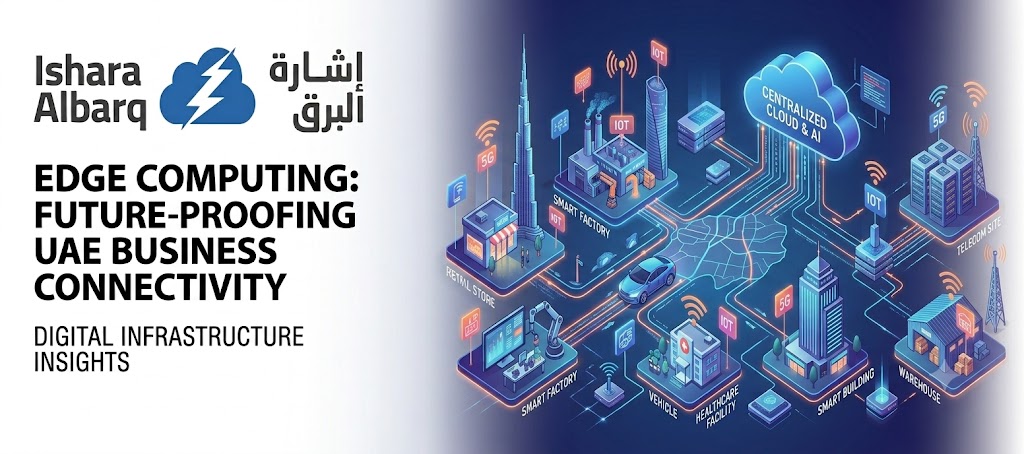
The "edge" can be a location such as:
-
A retail store
-
A factory
-
A warehouse
-
A telecommunications site
-
A smart building
-
A vehicle
-
A healthcare facility
-
An industrial facility
For example, a smart camera may generate a large amount of video data. Instead of sending all that information to a remote data center for processing, an edge device can analyze some of the information locally and send only the relevant results.
This can make digital systems faster and more efficient.
Why Is Edge Computing Becoming Important?
Modern businesses increasingly depend on real-time information.
Consider an automated warehouse where sensors continuously monitor inventory, equipment, temperature, and movement.
If every piece of information has to travel to a distant server before a decision is made, the additional network delay may affect the speed of the operation.
With edge computing, some processing can happen locally.
The result is a more responsive digital environment where certain decisions can be made closer to the point where the data is generated.
Edge Computing and Cloud Computing Work Together
Edge computing is not necessarily a replacement for cloud computing.
Instead, the two technologies can complement each other.
The cloud remains highly valuable for large-scale data storage, analytics, centralized management, applications, and computing workloads.
Edge computing can handle time-sensitive processing closer to the user or device.
A business might therefore use:
Edge infrastructure → Local processing → Network connectivity → Cloud/data center → Centralized analytics
This combination creates a distributed digital infrastructure capable of supporting different types of workloads.
Lower Latency for Real-Time Applications
One of the major advantages of edge computing is reduced latency.
Latency refers to the time it takes for data to travel between a device and the system processing that data.
For applications where every second matters, reducing this delay can be important.
Examples include:
-
Industrial automation
-
Smart traffic systems
-
Connected vehicles
-
Remote monitoring
-
Video analytics
-
Interactive digital services
-
IoT applications
-
Real-time security systems
By processing certain information closer to the source, edge computing can help these applications respond more quickly.
Supporting the Growth of IoT
The Internet of Things, or IoT, connects physical devices to digital networks.
Sensors and connected devices can generate enormous amounts of data.
Sending all of that information to centralized infrastructure can create unnecessary network traffic.
Edge computing provides another approach.
Some data can be processed locally, while only important information is transmitted to centralized systems.
This can make IoT deployments more practical and scalable, particularly in environments with thousands of connected devices.
Edge Computing and 5G Connectivity
The growth of 5G networks is another factor supporting the development of edge computing.
5G is designed to provide high-speed connectivity, improved capacity, and low-latency communication for suitable applications.
When combined with edge computing, businesses can build digital environments where connected devices communicate with nearby processing infrastructure.
This can create opportunities across industries such as:
-
Smart cities
-
Logistics
-
Manufacturing
-
Transportation
-
Retail
-
Healthcare
-
Energy
-
Telecommunications
The combination of 5G, edge computing, IoT, and cloud infrastructure is becoming an important part of the broader digital transformation landscape.
How Edge Computing Could Benefit UAE Businesses
The UAE has a rapidly developing digital economy, with businesses adopting smart technologies and increasingly connected operations.
Edge computing can support organizations that need fast data processing across distributed locations.
For example, a logistics company could use edge devices to process information from warehouses, vehicles, and tracking systems.
A retailer could use edge technology for real-time store analytics.
A manufacturing facility could process sensor information locally to monitor equipment.
A smart building could analyze data from connected systems to improve operational management.
The exact benefits depend on the application, network architecture, and infrastructure design.
Improving Network Efficiency
Not every piece of generated data needs to travel to a centralized data center.
Consider thousands of cameras, sensors, and connected devices generating information continuously.
Processing some of this information locally can reduce the amount of data that needs to move across the network.
This can help organizations manage network resources more efficiently.
For businesses operating large numbers of connected devices, this can become an important consideration when designing digital infrastructure.
Edge Computing and Data Security
Data security is another important part of the discussion.
Keeping certain processing activities closer to the source can reduce unnecessary movement of some data across networks.
However, edge computing does not automatically make a system secure.
Distributed infrastructure also creates more locations that need to be protected.
Businesses therefore need appropriate security measures across:
-
Edge devices
-
Networks
-
Applications
-
Access controls
-
Cloud platforms
-
Data centers
-
Monitoring systems
Security should be considered throughout the architecture rather than added after deployment.
Edge Infrastructure Requires Reliable Connectivity
Edge computing depends heavily on network infrastructure.
If edge devices need to communicate with cloud platforms, data centers, enterprise systems, or other locations, reliable connectivity becomes essential.
This makes technologies such as:
-
Fiber-optic networks
-
Structured cabling
-
Routers
-
Switches
-
Wireless connectivity
-
5G networks
-
Network security systems
-
Data center infrastructure
important parts of the wider edge computing ecosystem.
In other words, edge computing is not an isolated technology. It operates as part of a much larger digital infrastructure environment.
The Role of Data Centers Is Still Important
The growth of edge computing does not mean traditional data centers will disappear.
Instead, businesses may increasingly operate a combination of centralized and distributed infrastructure.
Central data centers can continue handling large-scale computing, storage, backup, analytics, and enterprise workloads, while edge locations handle applications requiring localized processing.
This creates a more distributed model of digital infrastructure.
For businesses, the challenge will be determining which workloads belong at the edge, which should remain centralized, and how the two environments should communicate.
What Businesses Should Consider Before Adopting Edge Computing
Edge computing can offer significant advantages, but businesses should first identify a genuine operational requirement.
Before investing, organizations should consider:
1. What Problem Are You Solving?
Is the goal to reduce latency, improve IoT performance, reduce network traffic, or enable real-time processing?
2. Where Is Data Being Generated?
Understanding where devices and users are located helps determine whether edge infrastructure is appropriate.
3. How Much Processing Is Required?
Some applications may need local processing, while others may work perfectly well through centralized cloud infrastructure.
4. How Will Security Be Managed?
Every edge location needs appropriate protection, monitoring, access controls, and maintenance.
5. Can the Infrastructure Scale?
Businesses should consider what happens when the number of connected devices or locations increases.
6. How Will Edge and Cloud Systems Work Together?
A successful architecture needs clear communication between local edge environments and centralized infrastructure.
The Future of Business Connectivity
Business connectivity is moving toward a more distributed model.
Instead of relying entirely on centralized infrastructure, organizations can combine cloud computing, data centers, edge devices, telecommunications networks, and local processing environments.
This evolution is being driven by the increasing demand for:
Faster decisions
Real-time data
Connected devices
AI applications
Smart infrastructure
Reliable connectivity
For businesses, this means digital infrastructure is becoming more complex — but also more capable.
Final Thoughts
Edge computing represents an important development in the evolution of business connectivity.
By moving selected computing and data-processing capabilities closer to where information is generated, organizations can create more responsive and efficient digital systems.
For the UAE, where technology, smart infrastructure, telecommunications, logistics, and digital business continue to develop, edge computing could become an increasingly relevant part of future infrastructure strategies.
The future is unlikely to be about choosing between cloud, data centers, or edge computing.
Instead, successful digital infrastructure will increasingly depend on how effectively these technologies work together.